Context Rot vs. Context Lag: Two Ways Agent Context Fails
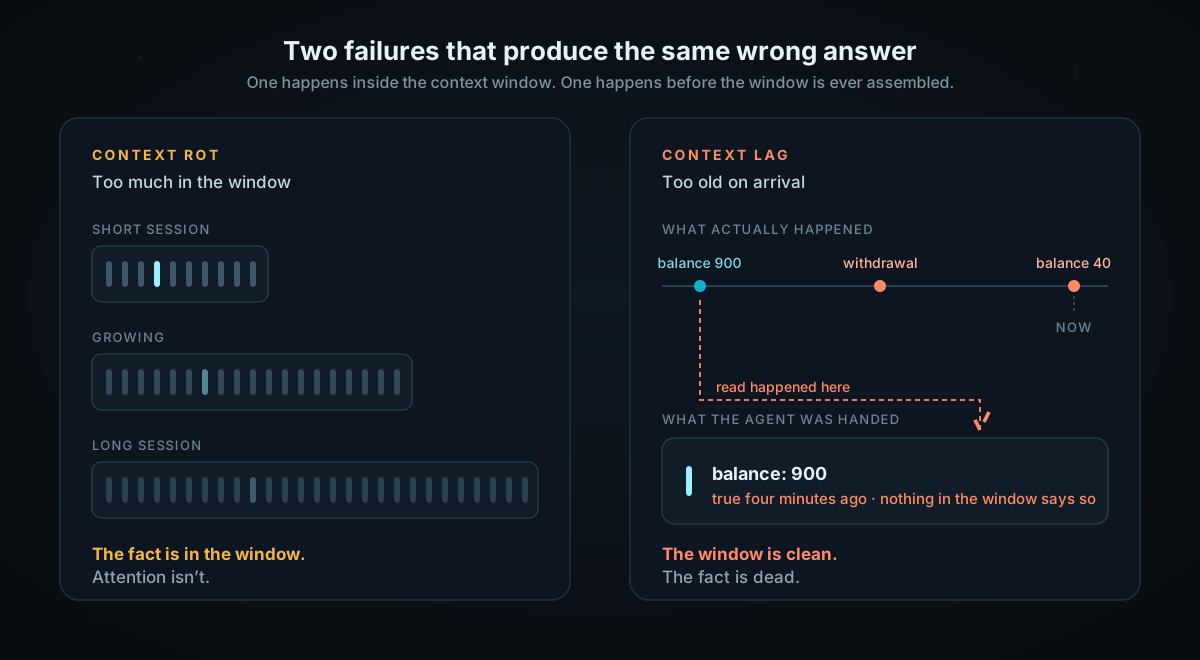
Context rot is what happens to a fact after it enters the context window. Context lag is what happened to it before. They produce the same confidently wrong answer, and only one of them is fixable with better prompts.
TL;DR: Context rot is the gradual loss of accuracy, coherence, and instruction-following as an agent’s context window fills up with conversation history, files, and tool output. It’s real, well-researched, and fixable with compaction, pruning, and sub-agents. Context lag is different: the fact was already wrong when it entered the window, because it came from a store that hadn’t caught up with reality. Both produce a confident, fluent, incorrect answer, and both get worse at scale — so teams reach for the rot playbook first. Trimming a prompt cannot repair a balance that was true four minutes ago. Rot is an application-layer problem. Lag is a data-infrastructure problem, and it needs an infrastructure fix.
Your agent approved something it should have declined. You pull the trace. The reasoning is clean, the tool calls all returned 200s, and the final answer is wrong.
The reflex is to blame the window: trim the system prompt, compact the history, add a reranker, split the work across sub-agents. That reflex is well-earned — there’s a real, well-researched failure mode behind it, and it has a name. Start there, because you need it defined precisely before the more interesting question comes into view.
What Is Context Rot?
Context rot is the gradual loss of accuracy, coherence, and instruction-following in a large language model or AI agent as its input context window fills up with long conversation histories, files, and tool outputs. The information is still in the window — the model simply attends to it less reliably as the window grows. It’s a degradation curve, not a cliff at the token limit.
The term got its shape from Chroma’s research, which tested models across increasing input lengths and found that performance degrades non-uniformly as tokens grow — the failure isn’t a wall at the window limit, it’s a slope that starts well before it. Anthropic’s context engineering guide treats context as a finite budget for the same reason. Both build on the “lost in the middle” finding: information buried mid-window gets used less reliably than information at the edges.
In practice it shows up as long-session decay. An agent that was sharp for the first twenty turns starts ignoring its own instructions by turn sixty. The constraint is still sitting in the window. The model is no longer reliably acting on it.
A concrete example. A support agent opens its session with a policy cap: refunds above $200 require escalation. It honors that cleanly for the first stretch of the conversation. Sixty turns later — after two policy PDFs got pulled in, a dozen order lookups returned full JSON payloads, and the customer told a long story — it approves $340 without escalating. Nothing revoked the rule. The rule is still in the window, thousands of tokens back, competing for attention with everything that arrived after it. The agent isn’t overriding policy. It’s attending to it less.
How to Prevent Context Rot
The through-line of every effective fix is the same: rot is a curation problem, not a capacity problem. You’re not trying to fit more into the window — you’re trying to keep what’s in it worth attending to.
Compact the history. Summarize completed stretches of the conversation into a short state record and drop the raw turns. What matters is the decisions and constraints established, not the transcript that produced them.
Prune tool output at the boundary. Tool calls are the biggest source of accidental bloat — a full API response lands in context when the agent needed two fields. Filter before injection, not after.
Scope retrieval tightly. Injecting thirty plausible documents instead of three relevant ones actively harms the answer. More retrieved context is not more useful context, and past a point it’s the mechanism of the failure.
Split work across sub-agents. Hand isolated sub-tasks to agents with their own clean windows and return only the result. This is the single most effective structural fix for long-running work, because it caps window growth instead of managing it.
Externalize durable state. Facts the agent must remember across a long session belong in agent memory or a scratchpad it can query, not carried forward as conversation.
Put constraints where attention is strongest. Since the middle of the window is the weak zone, restate the critical rules near the end of the assembled context rather than trusting a system prompt from fifty turns ago to still be doing its job.
Measure it before you fix it. Track whether your failure rate correlates with session length or token count. If it doesn’t, you’re about to optimize the wrong thing — which is exactly where the rest of this post picks up.
None of this is controversial, and none of it is what this post is arguing with. Run the playbook — it works on the failure it addresses.
The argument is with what happens after you run it and the agent is still wrong — because the fact it reasoned over was never good in the first place.
Context Rot vs. Context Lag
Context lag is the delay between when something becomes true in the world and when the system serving that fact reflects it — so the value entering the context window is already out of date when it arrives. Where context rot degrades a good fact after retrieval and is fixed at the application layer, context lag delivers a bad fact before retrieval and can only be fixed at the data layer.
Side by side:
That last row is why lag is expensive. Rot leaves fingerprints. Lag looks exactly like a healthy system.
Every value an agent reasons over has an age. A balance read from a cache is as old as the last write-through. A velocity counter is as old as the last window the stream job closed. A vector index is as old as its last sync. An aggregate from the warehouse is as old as the last batch.
Under human-paced software this was mostly invisible, because a human clicking a button tolerates a stale number and a person notices when something looks wrong. Agents remove both properties. They read far more per decision, and nothing between the read and the action asks whether the number looked right.
The compounding version is what makes it structural. A single decision usually needs several retrieval patterns at once — a point lookup for current state, an aggregate for recent behavior, a similarity search for pattern match. When those come from three independently operated systems, they reflect three different moments. The agent receives a context that looks complete and internally consistent, and it isn’t: those values never coexisted in reality. That’s the context gap — lag is the mechanism, the gap is what the decision experiences.
The consequence is not a slightly degraded answer. It’s a correct decision procedure applied to a fiction. As we put it in Context Gaps and How to Close Them: the prepared answer is ready, fast to read, and already wrong.
Lag also has the property rot doesn’t: it gets worse exactly when it matters most. A traffic burst is both the moment your derived counters lag furthest behind and the moment the decision they inform is most consequential. Pipelines fall behind under load; the decision doesn’t get to wait.
Telling Them Apart
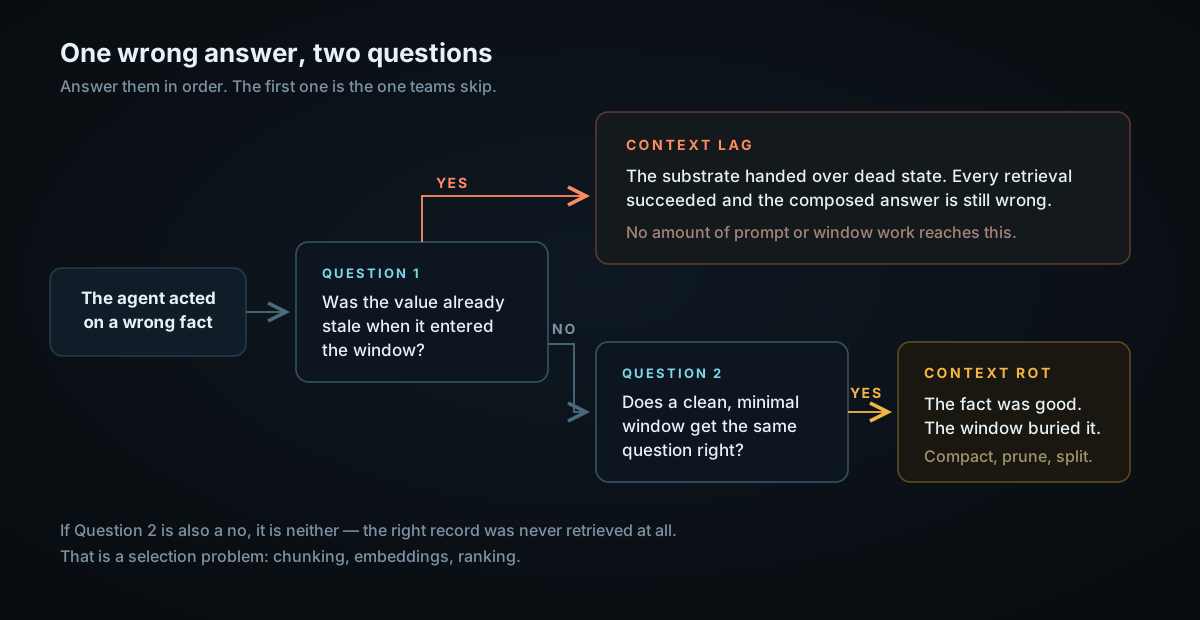
Question 1: was the value already stale when it entered the window?
Take the specific fact the agent got wrong. Find its value in the system of record at the moment the agent read it, and compare that to what the agent was handed. If they differ, you have lag, and you can stop the investigation — no amount of window engineering will change what an upstream store returned.
Most teams skip this question because it requires instrumenting reads with the event time of the underlying data, not just the wall-clock time of the query. That instrumentation is usually the first thing worth building. If you can’t answer “as of when?” for the values in a decision, you can’t tell these failures apart at all.
Question 2: does a clean, minimal window get it right?
If the value was current, replay the same question with a stripped context — just the relevant facts, no accumulated history. If the agent now answers correctly, you have rot, and the playbook applies. If it’s still wrong with good data in a clean window, the right record was probably never retrieved: that’s a selection problem living in chunking, embeddings, and ranking, and it’s a third thing again.
A few practical tells. Rot correlates with session length and rarely reproduces on the first turn. Lag correlates with system load and reproduces reliably during bursts. Rot is usually a single agent losing the thread; lag shows up as multiple agents acting on the same state and reaching contradictory conclusions within seconds of each other, each of them locally reasonable.
Why the Two Keep Getting Confused
Both failures are silent. The model doesn’t know its window is degrading, and it doesn’t know its inputs are stale — there’s no exception, no null, no confidence drop. Even models built to report calibrated confidence can’t flag it, because the confidence is measured against the input they were handed. You get fluent, well-structured, confident wrongness in both cases.
Both scale with success. More usage means longer sessions, and more usage means higher event velocity. So both symptoms arrive in the same week, usually the week after launch.
And the rot vocabulary is simply more available. Context rot has research behind it, a memorable name, and a tooling ecosystem. Lag is described in the sober language of data engineering — replication delay, propagation, freshness versus latency — and it belongs to a different team than the one debugging the agent. So the agent team runs the playbook they have. Trimming the prompt is cheap and satisfying; discovering that your architecture assembles decisions from four independent timelines is neither.
Fixing Lag Is an Architecture Question
There’s no prompt for this, which is the uncomfortable part. If the staleness is structural, the fix has to change the structure.
Every decision has a validity window — the span in which its context is still true enough to act on. A weekly report has a wide one. An eligibility check inside a live session has a narrow one. Lag is only a problem when it exceeds that window, and it exceeds it most often under concurrent load, when many events are changing the same state at once and cached context goes stale faster than it can be served.
The direction that works is reducing the number of independent timelines a single decision depends on. Concretely:
Serve the decision’s retrieval patterns from one system, on one snapshot. Not because consolidation is a virtue, but because that’s the only way point lookups, aggregates, and similarity search can be guaranteed to reflect the same moment. Three systems means three moments, and no coordination layer above them fixes that.
Compute derived context where the data lives. Aggregates, velocity counters, and features that get built in an external pipeline arrive at the decision already behind. Maintaining them as incremental materialized views against the same state removes the hop, and the lag that comes with it.
Ingest continuously from systems of record via change data capture, so the serving layer tracks the source rather than catching up to it on a schedule. A batch refresh guarantees the serving layer is behind by design; the only open question is how far.
Instrument freshness as a first-class signal. Not the design target — the observed distribution. If nobody measures how old the values in a decision actually are, lag stays invisible until it produces an incident.
This is the argument for context infrastructure as a distinct layer, and it’s what the Tacnode Context Lake™ is built to be: real-time, multi-modal data infrastructure that ingests operational state from systems of record via CDC, maintains derived context as incremental materialized views, and serves every retrieval pattern a decision needs from a single coherent snapshot — inside the validity window the decision actually has, under concurrent load. It doesn’t make your agent smarter. It removes the class of failure where a smart agent reasons perfectly over a fact that stopped being true.
Rot and lag are both real, and the honest summary is that they’re not competing explanations — they’re different layers of the same stack. Fix rot with the context engineering playbook. Fix lag underneath it. Just check which one you have before you spend a quarter on the wrong one.
Frequently Asked Questions
Context RotContext EngineeringAI AgentsData FreshnessContext Lake