Stale Data: Causes, Detection, and How to Set Freshness SLAs
Stale data silently breaks models, dashboards, and automated decisions. This guide covers what causes data staleness across batch and streaming pipelines, how to detect it, and how to set freshness SLAs by use case.
TL;DR: Stale data is information that looks valid but no longer reflects reality — your queries return results, but those results are out of date. It's caused by batch pipelines, cache lag, replication delay, and manual processes. The fix: real-time synchronization, automated freshness monitoring, and data governance that enforces SLAs. For AI and automated decisions, stale context is especially dangerous because models act confidently on outdated inputs.
Stale data refers to information that no longer reflects current reality. Unlike missing or corrupted records, stale data looks perfectly normal — your dashboards render, your data analysis runs, and your data teams see no errors. But every decision made on outdated data is a decision made on outdated information.
The staleness risks are significant: poor decision making, inaccurate insights, missed opportunities, and poor customer experience. In regulated industries, outdated entries create compliance risks and increase compliance risks for security teams responsible for data integrity. Retaining unreliable data from former customers can also expand the data breach surface area. For scientists running predictive analytics, old data means models produce unreliable business outcomes no matter how sophisticated the algorithm.
Here's what makes this insidious: stale data doesn't announce itself. A fraud model scoring transactions against hour-old behavioral signals still returns a confident score. It's just the wrong score. We've seen organizations lose millions before anyone noticed the underlying information was outdated.
This guide covers what stale data means, the root causes of staleness in modern organizations, how to detect stale data before it causes damage, and the data management processes that actually prevent it.
What Is Stale Data? Understanding Data Staleness
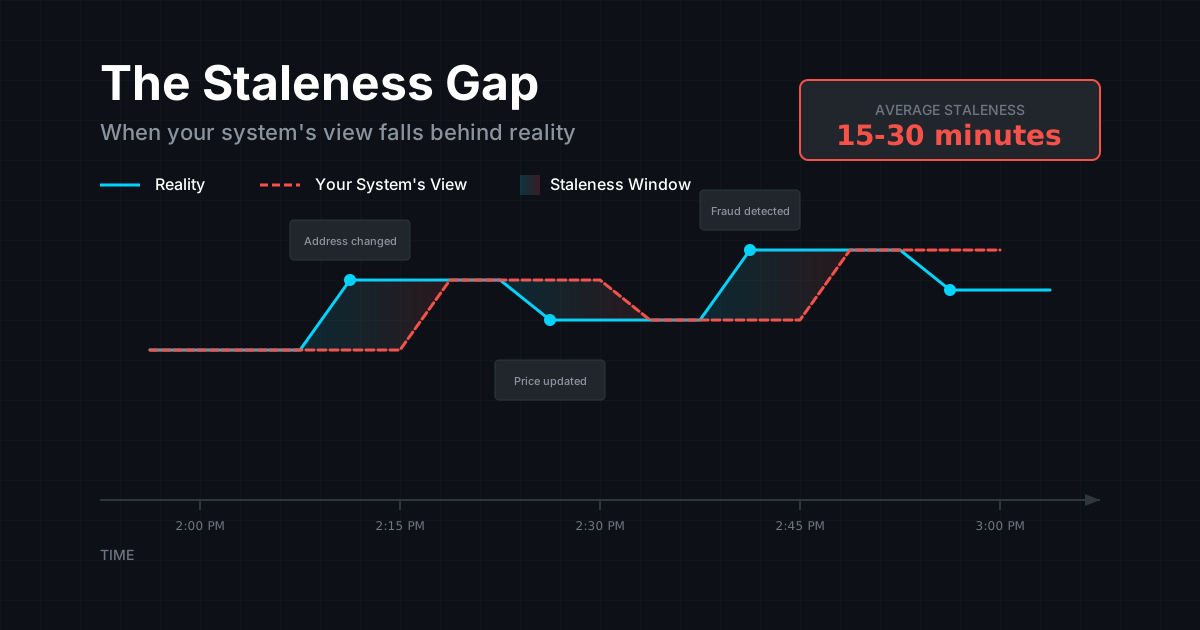
Stale data is outdated data that no longer accurately represents the current state of the real world. When data updates happen in your source systems but don't propagate to the target system downstream, you have data staleness — a gap between reality and what your systems believe is true.
Here's a real world example: A customer updates their shipping address in your CRM at 2:00 PM. Your warehouse management system still shows the old address at 2:05 PM because the data integration syncs every 15 minutes. A shipment goes out at 2:10 PM to the wrong address. That's stale data causing real business damage — not because anything was "broken," but because customer data was simply out of date.
More formally: stale data refers to any information whose age exceeds your requirements for its intended usage. Accurate and timely information is essential for effective decisions. Five minutes of staleness might be fine for monthly reporting, but catastrophic for fraud detection. Data freshness requirements vary by use case, and maintaining freshness is the key to operational efficiency.
Stale data is distinct from other data quality issues:
Missing values — the record doesn't exist in your collection
Inaccurate data — the record has wrong values, affecting data accuracy
Duplicate records — the same record appears multiple times
Obsolete data — irrelevant information that's no longer needed and should be removed per data retention policies
Stale data — the record exists, passes validation, but represents a past state
Incomplete data — the record exists but lacks critical fields needed for decisions
The danger is that stale data passes every check in your data quality monitoring. Engineers see syntactically correct records with all required fields. Those records just happen to contain outdated datasets because the world moved on while your data pipelines lagged behind. Data aging is the silent failure mode behind most data quality issues.
How Staleness Impacts Different Domains
The business impact of stale data depends on how fast your domain changes and how sensitive your decisions are to timing. What's acceptable staleness in one context is catastrophic in another. These real world examples show how various factors affect the severity of staleness risks across industries.
Domain
5 Minutes Stale
1 Hour Stale
1 Day Stale
Fraud Detection
Missed fraud signals, approved bad transactions
Entire fraud rings operate undetected
Catastrophic losses, regulatory exposure
Inventory Management
Minor overselling on hot items
Widespread stockouts, customer complaints
Supply chain planning completely broken
Dynamic Pricing
Suboptimal margins on fast-moving products
Significant revenue loss to competitors
Pricing disconnected from market reality
AI/ML Features
Slightly degraded model accuracy
Predictions based on outdated patterns
Model operating on training-time assumptions
Customer 360
Minor personalization misses
Recommendations feel irrelevant
Customer context from a different lifecycle stage
Compliance Reporting
Acceptable for most regulations
Potential audit flags
Failed regulatory requirements
Causes of Stale Data: Why Information Becomes Outdated
Several factors contribute to stale data accumulating in organizations. Understanding the root causes helps data teams implement effective prevention strategies and maintain integrity across their systems.
Batch ETL and Pipeline Delays
Traditional data pipelines use batch processing — extracting information overnight, transforming it, and loading it by morning. This approach guarantees staleness by design and undermines freshness from the start.
Think about what this means in practice: if your ETL runs at midnight, analysts are looking at yesterday's information until tomorrow. For strategic planning, that might be acceptable. For daily operations involving inventory data, pricing, or customer interactions, it's a liability that produces outdated entries across the organization. Batch processing is the most common source of these problems.
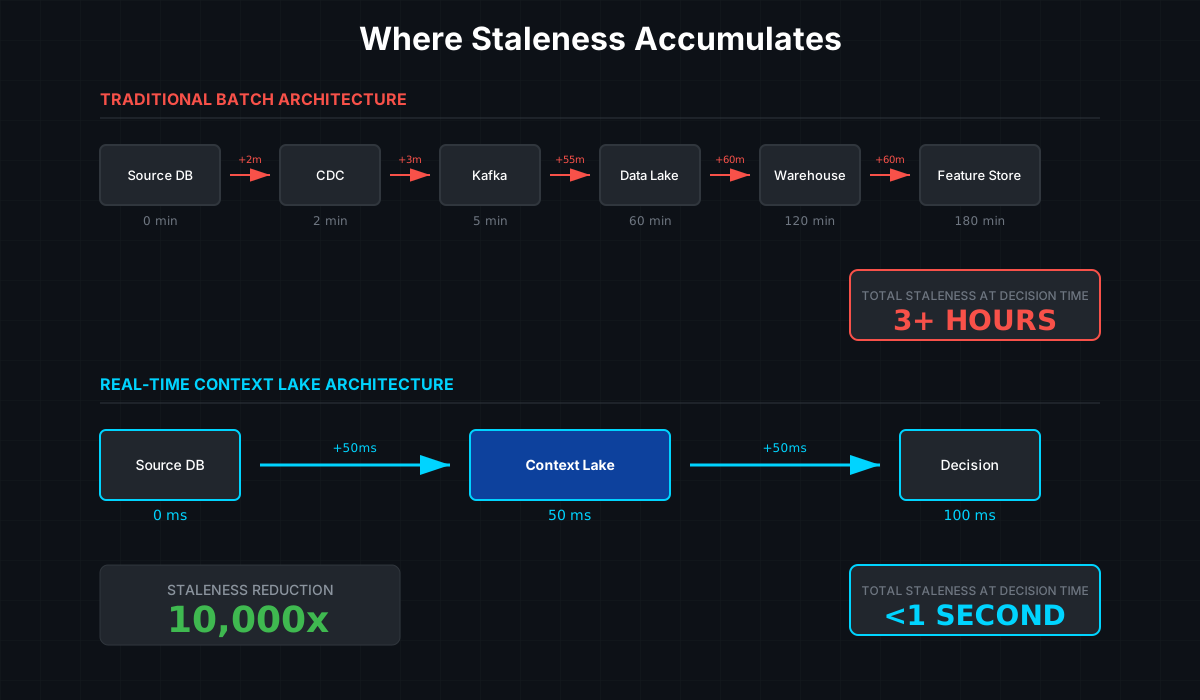
When you monitor data pipelines end-to-end, you often find that each hop adds latency. Information moves from source to collection layer to transformation to warehouse to business intelligence tool — the tiered progression formalized in medallion architecture. Each step introduces delays. System outages or backpressure compound the problem, and without real time synchronization, staleness accumulates across the organization.
Manual Data Entry and Process Gaps
Manual data entry is a leading cause of this issue. When updates depend on manual processes, delays are inevitable. Sales reps forget to update the CRM after calls. Customer service doesn't log interactions promptly. The result is outdated entries that affect data accuracy and customer satisfaction everywhere. Manual errors compound the problem.
We see this constantly: a customer calls support, the agent pulls up their profile, and the information is weeks old because someone didn't log the last three interactions. That's not a technology failure — it's a process failure that creates outdated data.
Human-driven workflows also introduce error, compounding data quality issues. Regular audits often reveal that manually-entered records have higher rates of both staleness and inaccuracy compared to automated processes and automated data collection.
Cached Data and Replication Lag
Cached information improves read performance but creates staleness risks. When your data sources update but the cache doesn't invalidate, downstream consumers see outdated values across multiple locations. The longer your cache retention periods, the longer the staleness window — and the harder it becomes to identify outdated data across your systems. Teams evaluating Redis alternatives usually find the deciding question is not throughput but how long a cached value is permitted to disagree with its source. Cloud storage layers compound this when caches replicate across regions, creating multiple versions of the same record at different points in time.
Database replication introduces similar issues. Read queries against replicas see records that are milliseconds to seconds behind the primary. Under heavy load, this lag can spike unpredictably, causing stale results in real-time applications exactly when accuracy matters most for business operations.
Poor Data Governance and Retention Policies
Without a proper data governance framework, organizations accumulate obsolete entries without clear ownership. Data retention policies that don't account for freshness requirements lead to stale entries persisting indefinitely, increasing storage costs and confusing practitioners. Without ongoing visibility into which datasets are actively maintained, sensitive data ages out of compliance with regulatory frameworks like GDPR, SOX, and PCI-DSS — turning quiet staleness into compliance violations.
Effective governance establishes accountability: who owns each data asset, what freshness SLAs apply, how teams should handle outdated records. Data contracts formalize these expectations between producers and consumers. Organizations with a mature data governance framework and strong access controls experience significantly fewer problems associated with stale data — not because the technology is better, but because responsibilities are clear.
System Outages and Data Integration Failures
System outages disrupt data pipelines and create gaps in data collection. When source systems go down, fresh information stops flowing, and all downstream records become progressively stale. Without proper incident response, these gaps may go undetected for hours, creating large datasets of stale information.
Data integration failures between systems — failed API calls, dropped messages, connections to multiple sources breaking — silently cause staleness. Your CRM might update correctly while your analytics platform sees outdated information from a different target system, leading to conflicting views and poor choices across the organization.
Where Staleness Accumulates: Batch vs Real-Time
In traditional architectures, staleness compounds at every hop in your pipeline. Each system adds latency, and the cumulative effect can be hours of delay between when something happens and when your systems know about it. Minimizing these hops is essential for freshness.
Cloud Environments and Stale Data Challenges
As organizations shift to cloud storage, handling staleness becomes more complex. Cloud environments distribute information across databases, warehouses, file systems, and SaaS platforms — making it harder to identify stale data and ensure every system reflects current reality. Without streaming pipelines, updates in one system may not propagate to others quickly enough, producing outdated values across the stack and creating significant challenges for any team trying to maintain data integrity.
Maintaining freshness in cloud environments requires robust data management processes. Regular audits help flag stale records and detect incomplete data before it impacts operations. Automated quality monitoring can track usage patterns and timeliness across all sources, alerting engineers when data collected from upstream systems becomes outdated. Strong access controls and retention policies further prevent unauthorized access to sensitive data and ensure irrelevant entries are archived or deleted on schedule.
Stale Data Risks: How Outdated Information Affects Business Operations
The risks of stale data extend across every function that relies on accurate information. Understanding these risks helps justify investment in monitoring data freshness and modern data management practices.
Poor Decision Making and Inaccurate Insights
Stale data directly causes poor decision making by providing outdated information to leaders. Executives reviewing stale reports make strategic choices based on conditions that no longer exist. Without actionable insights based on fresh data, even experienced leaders make wrong calls.
When informed decision making relies on stale information, even correct analysis produces wrong conclusions. Your methodology might be sound, but if the underlying records contain outdated values, outcomes suffer and meaningful insights become impossible.
Missed Opportunities and Operational Inefficiencies
Stale data creates missed opportunities when real-time information would have enabled action. A sales team working from an outdated lead list wastes time on former customers who've already bought elsewhere. A pricing engine using stale competitor signals leaves money on the table.
Operational inefficiencies compound when teams can't trust accuracy. Analysts spend hours reconciling conflicting reports caused by outdated values across multiple locations. Scientists rebuild models when they discover training records were stale. These inefficiencies drain operational efficiency and resources that could drive actionable insights — and they significantly reduce the ROI of every downstream analytics investment.
Poor Customer Experience and Outdated Customer Records
Customers notice when you're working from outdated records. A support agent who doesn't know about yesterday's order creates poor customer experience and damages customer satisfaction. Marketing sending promotions for items already purchased destroys trust.
In healthcare, outdated patient records pose serious risks. Clinicians making treatment decisions need up to date information — outdated entries about medications could lead to administering the wrong medication, and outdated allergies or test results can have life-threatening consequences. This is why healthcare demands the strictest freshness requirements and the most rigorous monitoring practices for decision making processes that touch patient safety.
Compliance Risks and Regulatory Requirements
Regulatory frameworks increasingly require organizations to maintain integrity and accuracy. Regulatory requirements like GDPR mandate accurate information about individuals, including sensitive information. Financial regulations require up-to-date records for reporting.
Stale data that causes inaccurate reports creates compliance risks and potential penalties. When auditors find outdated entries affecting required reports, consequences include fines, remediation costs, and reputational damage. Organizations must improve data quality to meet regulatory requirements, prevent compliance violations, and protect analytics operations.
Detecting Stale Data: Data Quality Monitoring
You can't prevent stale data if you can't detect it. Effective data quality monitoring gives teams visibility into staleness across pipelines and data sources, turning invisible problems into actionable insights.
Implement Data Observability
A data observability platform provides automated monitoring across your pipelines to flag outdated entries and identify stale data before it causes damage. Observability tools track freshness metrics at each stage, alerting engineers when staleness exceeds predefined criteria — and giving security teams ongoing visibility into which active data is at risk.
Modern observability tools monitor continuously, spotting staleness when new information stops flowing or when data updates lag behind expectations. This proactive approach catches problems early, before they affect decisions.
Use Automated Alerts for Data Freshness
Automated alerts notify teams immediately when data freshness degrades. Configure alerts based on predefined criteria for each source — critical data assets might alert after 5 minutes of staleness, while less time-sensitive ones might tolerate longer delays.
These automation capabilities reduce reliance on manual checks for spotting staleness. Instead of periodic reviews, your observability platform monitors continuously through regular monitoring, ensuring rapid response when information becomes outdated.
Conduct Regular Data Audits
Regular data audits verify accuracy and flag stale records that automated monitoring might miss. Audits compare current entries against source systems, identifying outdated values and data quality issues across cloud environments and on-premise infrastructure.
Audits should examine collection processes, pipeline health, and retention policies. Often, audits reveal systemic root causes of staleness — input bottlenecks, integration failures, or governance gaps that create staleness organization-wide. Check usage logs to understand which stale data assets are still being actively consumed.
Managing Stale Data: Prevention Best Practices
Prevention beats detection. These stale data management practices help organizations prevent staleness and maintain integrity across their operations.
Shift to Real Time Synchronization
The single biggest lever for managing stale data is replacing overnight ETL with real-time pipelines. Streaming architectures process updates as they happen, maintaining freshness measured in seconds rather than hours.
This is where we see the most dramatic improvements. Organizations that move critical flows from overnight batch to real-time streaming typically see staleness drop from hours to sub-second. The operational complexity increases, but for use cases like fraud detection, dynamic pricing, or AI inference, there's no substitute for fresh data at the point of decision.
Real-time pipelines require more sophisticated data management but deliver dramatically better freshness. For teams supporting choices that require accurate and timely information, real time synchronization is increasingly essential for operational efficiency.
Automate Collection and Eliminate Manual Data Entry
Automating collection reduces stale data caused by input delays. Integrate systems directly through data integration so updates flow automatically between sources and the target system. Where manual processes remain necessary, implement workflows that prompt timely completion.
Reducing manual input also improves accuracy beyond just freshness. Automated processes with strong automation capabilities eliminate human error, ensure consistent quality, and prevent incomplete data from entering your systems. Ensuring all data collected through automated channels is validated at ingestion time further reduces staleness.
Implement Strong Data Governance
Data governance establishes accountability for quality including data freshness. Define owners for each asset. Set freshness SLAs based on usage requirements. Create data management workflows for teams to report and remediate outdated entries.
Effective governance also addresses retention policies. Obsolete information that's no longer actively maintained becomes stale and misleads users. Clear retention periods and access controls ensure quality by removing irrelevant records from active systems.
Monitor Pipelines Continuously
Monitor data pipelines end-to-end to catch stale data at its source. Track latency at each stage. Alert when information stops flowing. An observability platform makes freshness tracking practical at scale across large datasets.
When you monitor pipelines effectively, you identify stale data within minutes of it occurring. Rapid detection enables fast incident response by engineers, minimizing the window where outdated information affects daily operations and decisions.
Setting Data Freshness SLAs
Not all information needs real-time freshness. The key to managing stale data is matching your freshness SLA to actual business requirements — over-engineering wastes resources, under-engineering causes damage.
But here's the shift most organizations haven't internalized: the SLAs you set five years ago were designed for human consumption. Dashboards refreshing hourly were fine because analysts checked them a few times a day. Nightly ETL was acceptable because reports were reviewed each morning.
AI agents don't work that way. They make decisions in milliseconds, often irreversibly, often at scale. An agent approving loan applications, routing customer service tickets, or adjusting inventory doesn't pause to consider whether information might be outdated. It acts — confidently and immediately — on whatever context it's given.
This means freshness SLAs that were "good enough" for human workflows become dangerous when those same flows feed autonomous systems. If your ML features update hourly but your agent makes decisions every second, you have 3,600 decisions per feature refresh — all potentially based on stale context. Closing that gap is the problem real-time AI has to solve.
The table below reflects this new reality. Notice how many use cases now demand sub-second freshness — not because the business changed, but because machines replaced humans in the decision loop. Maintaining freshness at these thresholds requires fundamentally different architecture.
Use Case
Target Freshness
Why This Threshold
Consequence of Missing SLA
AI Agent Actions
< 1 second
Agents act autonomously in milliseconds
Wrong decisions, compounding errors
Fraud/Risk Scoring
< 1 second
Transactions approved in real-time
Approved fraud, financial loss
Real-time Personalization
< 1 second
User context changes mid-session
Irrelevant experiences, lost conversions
Inventory at Checkout
< 1 second
Availability confirmed at purchase
Overselling, customer trust damage
Dynamic Pricing
< 1 minute
Competitive markets move fast
Margin erosion, lost deals
Operational Dashboards
< 5 minutes
Operators need current state
Delayed incident response
Executive Reporting
< 1 day
Strategic decisions tolerate lag
Acceptable for planning
The Tacnode Approach: Maintaining Data Freshness at Decision Time
Most architectures accept some degree of staleness as inevitable — information moves through pipelines, gets transformed, lands in a warehouse, feeds a feature store, and finally reaches a model or dashboard. Each hop adds latency. Each cache adds staleness risk. So does every pre-computed aggregate: a materialized view in Postgres is exactly as fresh as its last refresh, no matter how fast the query against it runs.
We think that's backwards.
At Tacnode, we built the Context Lake to eliminate staleness where it matters most: at decision time. Instead of stitching together Redis, ClickHouse, and a feature store — each refreshing on its own schedule, each returning a different version of reality — we serve all the context a decision needs under one consistent snapshot. When an AI agent needs customer data, it gets current state, not a cache that was updated an hour ago.
This matters because for AI and predictive analytics, stale data is especially dangerous. Machine learning models confidently produce outputs based on their inputs. If those inputs are outdated, the outputs are stale decisions — but they look just as confident as correct ones. This is why feature freshness is critical for ML systems.
Scientists can build excellent models, but if those models consume stale data at inference time, they'll produce inaccurate insights. Closing the context gap — the staleness between when events happen and when decisions see them — ensures models always see current reality instead of outdated answers.
Frequently Asked Questions About Stale Data
Key Takeaways: Managing Stale Data
Stale data refers to outdated information that no longer reflects current reality. Unlike other data quality issues, stale data passes validation — it's just wrong because the world moved on while your pipelines lagged.
The causes of stale data include pipeline delays, input bottlenecks, cached information, poor governance, and system outages. Various factors contribute, but most trace back to processes that prioritize throughput over freshness.
The risks are significant: poor decision making, inaccurate insights, missed opportunities, poor customer experience, compliance risks, and operational inefficiencies. Outdated information affects every function that relies on accurate, reliable data.
To detect stale data, implement quality monitoring through an observability platform, use automated alerts for freshness tracking, conduct regular audits, and track lineage. Teams need visibility into staleness to act before damage occurs.
To prevent stale data, shift to real-time pipelines with real time synchronization, automate collection, implement strong governance with access controls, monitor pipelines continuously, and establish clear retention policies.
For AI applications, consider architectures that serve fresh context at decision time rather than accepting pre-computed staleness. The architectural requirement is live context — information that reflects the current state of the world at the moment of decision, not a snapshot from minutes ago.
Start by measuring staleness across your critical sources. You might be surprised how much stale data is affecting your decisions — and how much value is waiting on the other side of fixing it.
Data QualityStale DataData FreshnessData EngineeringReal-Time