AI Agent Memory Architecture: The Three Layers Production Systems Need
AI agents need more than a vector database. Production systems require three distinct memory layers — episodic, semantic, and state. Here's what each layer does and why it matters.
In developing the theoretical foundations for Context Lake, I spent considerable time analyzing why production AI agents fail. The pattern was remarkably consistent: teams build sophisticated agent logic on top of agent memory systems that were never designed for agent workloads.
Ask most AI teams how they handle agent memory and you'll hear one of two answers: "We use a vector database" or "We're figuring it out." Neither is sufficient. Vector databases solve retrieval. They don't solve memory.
What production AI agents actually require is an agent memory architecture with distinct layers — working memory, episodic, semantic, and state — unified under a single coherent substrate. Most teams are building with only one. The consequences are predictable: agents spin their wheels on stale, fragmented context instead of compounding intelligence over time.
Why Memory Architecture Matters for AI Agents
Human analysts can tolerate latency. They cross-reference dashboards, notice inconsistencies, adjust their mental model. An analyst looking at yesterday's data can still make reasonable decisions because they understand the data is stale.
AI agents cannot do this. They operate at millisecond decision cycles, often making irreversible choices — approving transactions, triggering workflows, updating customer records. When an agent acts on stale or inconsistent data, it doesn't know it's wrong. It proceeds with confidence.
This is not an optimization target. It is a fundamental requirement for any system where AI agents make concurrent decisions over shared resources. Agent memory systems are how you meet it — and they require infrastructure that most teams have not built.
Memory Types in AI Agents
The vocabulary for AI agent memory borrows from cognitive science. Human long-term memory encompasses three distinct types: episodic memory (specific past experiences and events), semantic memory (general knowledge and facts), and procedural memory (learned skills and behaviors that operate automatically). Short-term memory and working memory refer to the temporary, capacity-limited processing space where immediate reasoning happens.
When this framework is applied to AI agents, the mapping is useful but imprecise. Human cognitive processes evolved for a single, embodied mind. Agent memory systems must serve concurrent AI agents operating over shared state — with consistency guarantees that human memory never required.
The practical taxonomy for production agent memory is not a direct translation from human memory types. It is derived from what AI agents actually need at each timescale: immediate context for the current decision, accumulated experience from past interactions, learned knowledge for reasoning, and authoritative current state. Each layer has different mutability requirements, different lifecycle characteristics, and different failure modes when absent. Understanding all four is the starting point for building AI agent memory that works under production conditions.
Working Memory, Context Windows, and Short-Term Memory
For large language models — and the AI agents built on top of them — the context window is working memory. It is the active, temporary space where an agent holds immediate context: the current conversation history, recent tool outputs, task instructions, and relevant information retrieved from longer-term storage. Like short-term memory in human cognition, context windows are capacity-limited and ephemeral: the active memory clears when the session ends.
Context window management is itself a form of memory management. As conversation history and tool outputs accumulate, AI agents must decide what relevant context to maintain, what to summarize, and what to retrieve from persistent agent memory stores. Retrieval augmented generation (RAG) addresses this directly: rather than loading the full history of past interactions into the window, semantic search retrieves only the most relevant memories from long-term storage at the moment they are needed.
Context engineering — deciding exactly what enters the working memory window for each decision — is one of the most underappreciated aspects of agent system design. Short-term memory typically holds only what is immediately useful. An AI agent that treats its context window as its only memory will lose all accumulated knowledge between sessions, cannot share learned context with other agents, and has no access to the full record of past interactions that inform accurate decisions. Working memory is essential — but it is the entry point to a deeper agent memory architecture, not the architecture itself.
The Three Persistent Memory Layers
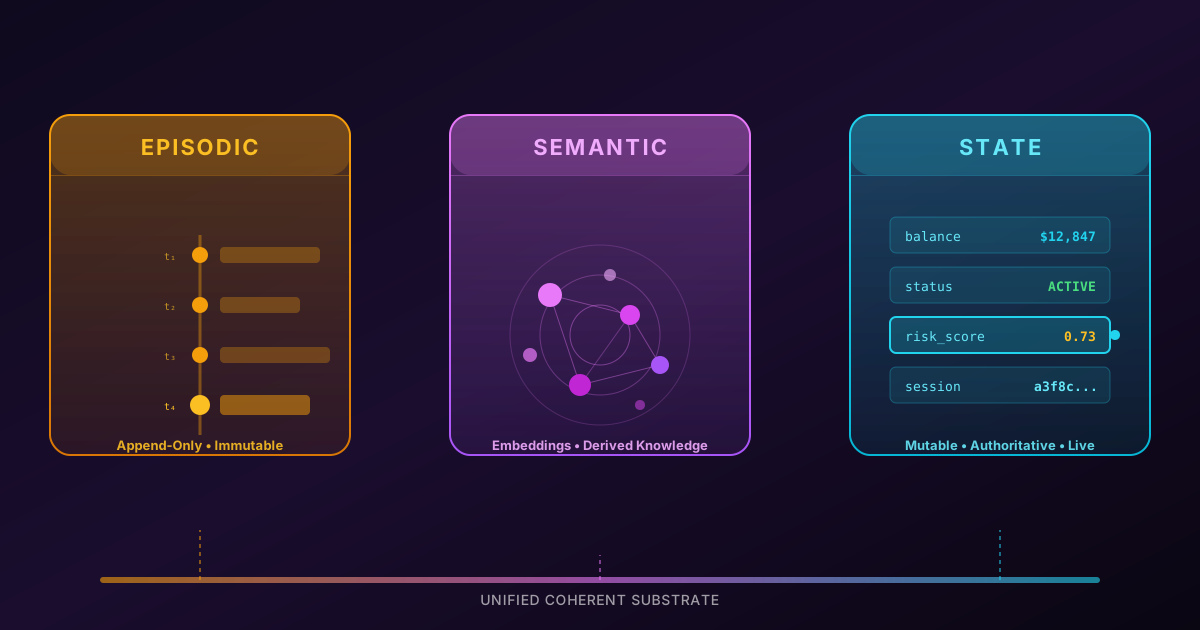
Beyond working memory, production agent memory architecture requires three persistent layers with different characteristics, lifecycles, and access patterns:
| Layer | Mutability | Key Property | Primary Use |
|---|---|---|---|
| Episodic | Append-only | Temporal ordering | Raw events, audit trail |
| Semantic | Governed | Shared interpretations | Embeddings, learned patterns |
| State | Mutable | Authoritative | Current conditions |
Episodic Memory
Episodic memory stores immutable observed experiences — every interaction, event, and piece of raw data the agent encounters, recorded as-is and timestamped. This is the layer that captures what the agent actually saw: specific past interactions, conversation history across sessions, tool call results, and the full sequence of events leading to each decision.
This layer enables time-travel queries: the ability to ask "what did the agent know at the moment it made this decision?" When a fraud detection agent misses a suspicious transaction, you need to reconstruct exactly what data it saw. Retrieving the state of the episodic memory store at a given point in time — the interaction history, the inputs, the context window contents — is essential for debugging, auditing, and compliance.
Episodic memory stores also feed the memory consolidation process that builds semantic knowledge. The raw data in episodic memory — past conversations, user preferences observed across interactions, behavioral patterns that emerge over time — is the source material for the representations stored in semantic memory. Without a structured episodic layer, there is nothing durable to retrieve.
The common mistake is treating episodic memory as optional logging. It is the foundation for reproducibility, temporal context, and every retrieval operation that depends on knowing what actually happened.
Semantic Memory and Long-Term Knowledge
Semantic memory stores mutable shared interpretations — derived knowledge, aggregations, and learned patterns that AI agents use for reasoning. Unlike episodic memory, semantic memory evolves as understanding improves.
This is the long-term memory layer that makes AI agents progressively smarter. It stores what they have learned: user preferences, risk scores, behavioral patterns, factual memory about domain knowledge, and the semantic meaning embedded in vector representations. A customer service agent that learns which issue categories a user encounters most frequently stores that pattern in semantic memory, retrieving it to personalize future interactions.
Semantic retrieval — finding relevant memories using semantic search rather than exact keyword matches — is the primary access pattern for this layer. An AI agent reasoning about a problem retrieves relevant information from semantic memory: past conversations about similar cases, known user preferences, and factual context about the subject. The system retrieves this context, loads it into working memory, and the agent reasons over it. Retrieval augmented generation (RAG) is the most common implementation of this pattern — but RAG is a retrieval technique, not an agent memory architecture.
The problem is that semantic memory alone is not sufficient. Vector databases optimize for retrieval similarity, not consistency guarantees. When Agent A updates a customer's risk profile while Agent B is mid-decision, you need transactional semantics — not just vector search. Semantic memory is a long-term knowledge store; it is not a complete AI memory architecture.
State Memory
State memory stores current operative conditions — the live, mutable data that represents "right now." Account balances, inventory levels, session states, active workflows.
This is where decisions become actions. When an agent approves a transaction, that approval must be immediately visible to every other agent that might act on the same account. Data freshness is a correctness requirement, not a performance optimization.
The common mistake is relying on caches or replicas for state. Any replication lag creates a window where AI agents see different versions of reality — and that window is where coordination failures occur. Memory operations against state must be atomic: the agent reads, reasons, and writes as a single transaction, with no possibility of another agent observing an intermediate result.
Memory Consolidation, Retrieval, and Memory Management
Building the three persistent layers is necessary but not sufficient. Production agent memory systems also require explicit strategies for moving information between layers: consolidating episodic records into semantic representations, retrieving relevant memories efficiently at decision time, and managing memory storage as the system grows.
Memory consolidation is the process of extracting durable knowledge from raw episodic events. An AI agent encountering thousands of past interactions per day cannot load the full record into its context window at decision time. Consolidation converts specific past interactions into the behavioral patterns, user preferences, and factual representations stored in semantic memory — compressing relevant details from episodic records into forms retrievable in future queries. This is how short-term observations become long-term memory.
Retrieval is where most teams invest too early. Semantic search and vector search are powerful tools for finding relevant memories — but retrieval quality is bounded by what was stored. An agent with poor episodic memory stores has little useful to retrieve from semantic memory, regardless of how sophisticated its vector search implementation is. Effective memory strategies must address storage before retrieval.
Memory management at scale also requires deciding what to forget. Generative AI systems accumulate past data across multiple sessions and large numbers of AI agents. Strategies include pruning obsolete records, resolving conflicts between outdated and current semantic knowledge, and maintaining storage efficiency as interaction history grows. Summarization memory — compressing older conversation history and past data into higher-level representations — is one approach to managing this accumulation without discarding relevant context.
Summary: AI Memory Architecture for Production Systems
AI agent memory is not one thing. It is a set of distinct memory types serving different functions at different timescales.
Working memory (the context window) holds immediate context during active reasoning: conversation history, tool outputs, and the relevant information retrieved at the moment of decision. It is short-term, capacity-limited, and ephemeral.
Episodic memory stores immutable observed experiences — the raw events, specific past interactions, and conversation history the agent accumulates, preserved for temporal reasoning and audit.
Semantic memory stores the long-term knowledge layer: derived knowledge, factual memory, behavioral patterns, and learned representations that AI agents use for reasoning and retrieval via semantic search. Together with episodic memory, it constitutes the long-term memory of the agent.
State memory stores current operative conditions — the live, authoritative data that represents "right now" and where decisions become actions.
Most teams build AI agents with only one layer, typically semantic (a vector database). The result: agents that cannot audit past decisions, cannot share learned context across agent memory systems, or cannot see consistent current state. Understanding all four memory types — working, episodic, semantic, and state — is the foundation of the AI memory architecture that production AI agents can trust.
Written by Xiaowei Jiang
Building the infrastructure layer for AI-native applications. We write about Decision Coherence, Tacnode Context Lake, and the future of data systems.
View all postsContinue Reading
Agent Coordination: How Multi-Agent AI Systems Work Together
What Are LLM Agents? The 4 Components That Take You From POC to Production
Retrieval Patterns for AI Agents: What Retrieval Really Means in Production
Ready to see Tacnode Context Lake in action?
Book a demo and discover how Tacnode can power your AI-native applications.
Book a Demo