ACID for Agents: Why Database Consistency Is the Bottleneck for Production AI
AI agents and automated decision systems need ACID consistency on the data they read at decision time — not just the data they write. The industry agrees the agent data layer is broken; it disagrees on why. The converged-database camp says storage fragmentation. We argue it’s computation fragmentation: the derived state decisions depend on — velocity counters, risk scores, features — is maintained in pipelines outside the transactional boundary, so it’s always slightly stale. A Context Lake converges the computation, not just the storage, ingesting via CDC from existing systems without requiring migration.
TL;DR: ACID consistency is becoming a correctness requirement for AI agents and automated decision systems. The industry now broadly agrees the data layer is broken; it disagrees on why. The converged-database camp says the problem is storage fragmentation — fix it by putting all data types in one engine. We argue the problem is computation fragmentation: the derived state decisions actually read (velocity counters, risk scores, features) is maintained in pipelines outside the transactional boundary, so it’s always slightly stale. Converging storage doesn’t fix this. A Context Lake converges the computation — ingesting via CDC from existing systems and maintaining derived state incrementally inside one transactional boundary — without requiring migration.
AI agents and automated decision systems are hitting the same wall in production: the data layer was built for human-paced reads, not millisecond decision loops. An agent reads a balance from one system, a risk score from another, a velocity counter from a third — and each of those values reflects a different point in time. The decision is wrong, and there’s no human in the loop to catch it.
The industry now broadly agrees this is the problem. The major database vendors have started shipping the agentic-AI capabilities to address it, anchored on a single architectural claim: AI agents need ACID-transactional guarantees across all the data types they reason over. Not eventually consistent sync pipelines. Not separate vector stores, graph databases, and relational systems stitched together with ETL. One transactional boundary. One consistent view of reality.
We agree. We’ve been making the same architectural argument under the name Context Lake. The diagnosis is shared: the agent data layer is broken, and ACID consistency is the fix.
Where we diverge from the converged-database camp is on why the data layer is broken — and that disagreement leads to fundamentally different architectures.
The dominant industry response says the problem is storage fragmentation: data lives in too many separate systems, so agents read inconsistent state. The fix is to converge all data types into one database engine. That response has a long history — it is the same answer HTAP gave a decade ago, and it stalled for the same reason.
Our thesis is that the problem is computation fragmentation: the derived state that decisions actually depend on — velocity counters, risk scores, aggregations, feature vectors — is computed in pipelines outside the transactional boundary, so it’s always slightly stale. The fix is to compute derived state incrementally inside a transactional boundary, fed by change data capture from existing systems.
These sound similar. They’re not. The first requires migrating your data. The second requires rethinking where computation happens. This post explains why the distinction matters — for AI agents, for fraud detection, for credit decisioning, for any automated system that reads derived data and acts on it.
The Problem: Agents Assemble Context from Multiple Points in Time
ACID for agents means applying the atomicity, consistency, isolation, and durability guarantees of transactional databases to the data an agent or automated decision system reads at decision time. The requirement isn’t that the agent’s actions are transactional — it’s that the context the agent reads is internally coherent, isolated from concurrent writes, and current within the decision’s validity window. Without these guarantees, agents make irreversible decisions on inconsistent state.
Most production agent deployments today are built across multiple specialized systems. A typical stack includes a relational database for transactional state, a vector store for embeddings and similarity search, a cache (usually Redis) for low-latency lookups, and a feature store or data warehouse for computed aggregates. Each system is optimized for one retrieval pattern. None of them share a transactional boundary.
This works in demos. It breaks in production.
The failure mode is predictable: sync pipelines between these systems introduce latency. Under load, the latency grows. The vector store reflects embeddings computed from data that’s 30 seconds behind the relational database. The cache holds a velocity counter that doesn’t include the last 5 transactions. The feature store aggregation was refreshed 2 minutes ago.
An agent — or any automated decision system — querying across these systems to make a decision assembles its context from four systems at four different points in time. It doesn’t know the data is inconsistent. It reads, reasons, and acts. The decision is wrong, and nobody catches it until the damage is done. Each system gives a correct answer and none of them is lying — they are simply answering about different moments.
Everyone working on production agents agrees on this much. The question is what’s actually causing it. The framework-layer view of the same gap shows up in LLM orchestration: control flow vs shared state — orchestration tools like LangGraph and CrewAI coordinate the flow but not the state, which is where the structural inconsistency this post argues about lives.
Why ACID Compliance Matters for Decision Systems
ACID — Atomicity, Consistency, Isolation, Durability — is a set of properties that guarantee database transactions are processed reliably. These properties have been the foundation of reliable software systems for decades. They’re the reason your bank doesn’t lose money when two ATM withdrawals hit the same account simultaneously.
For traditional applications with human users, ACID compliance was a database concern. The application read from the database, rendered a page, and the human decided what to do. If the data was a few seconds stale, the human didn’t notice — or they refreshed the page.
Agents and automated decision systems are different. They operate in tight decision-time loops: read state, reason, act, read again. Each cycle takes milliseconds, not seconds. And the action is often irreversible — a blocked transaction, an adjusted price, a committed order, a denied application. There is no “refresh the page” in an autonomous system.
This changes which ACID properties matter most:
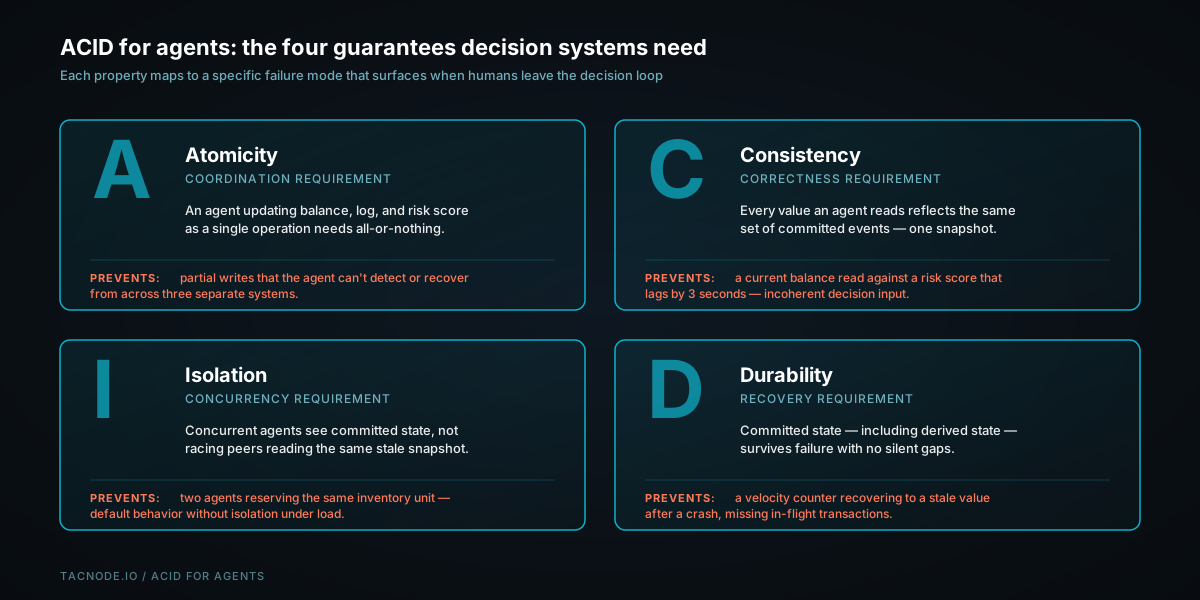
Consistency becomes a correctness requirement. An agent reading an account balance from one system and a risk score from another needs both values to reflect the same set of transactions. If the balance is current but the risk score lags by 3 seconds, the agent makes a decision on inconsistent state. In a fragmented stack, there is no mechanism to guarantee cross-system consistency because each system maintains its own state independently.
Isolation becomes a concurrency requirement. In multi-agent systems, multiple agents may read and write shared state simultaneously. Agent A reads inventory and reserves a unit. Agent B reads the same inventory before A’s write is visible and also reserves a unit. Without isolation guarantees, this race condition is not an edge case — it’s the default behavior under concurrent load.
Atomicity becomes a coordination requirement. An agent that needs to update a balance, log a transaction, and adjust a risk score as a single operation cannot do so across three separate systems. If the balance update succeeds but the risk score update fails, the system is in an inconsistent state that the agent cannot detect or recover from.
Durability remains what it always was — the guarantee that committed data survives failures. But for agent workloads, durability extends to derived state. If an agent computes a velocity counter and the system crashes, the counter must recover to its exact pre-crash value, not recompute from scratch with potential gaps.
These aren’t new requirements. They’re the same ACID properties databases have provided for decades. What’s new is that they now need to apply not just to raw data, but to the derived context that agents and automated systems actually reason over.
Two Theories of the Root Cause
The converged-database camp and the Context Lake architecture agree completely on the symptom: agents read inconsistent state because the data layer is fragmented. They diverge on the root cause — and the divergence leads to architectures that look different, deploy differently, and make different demands on the teams adopting them.
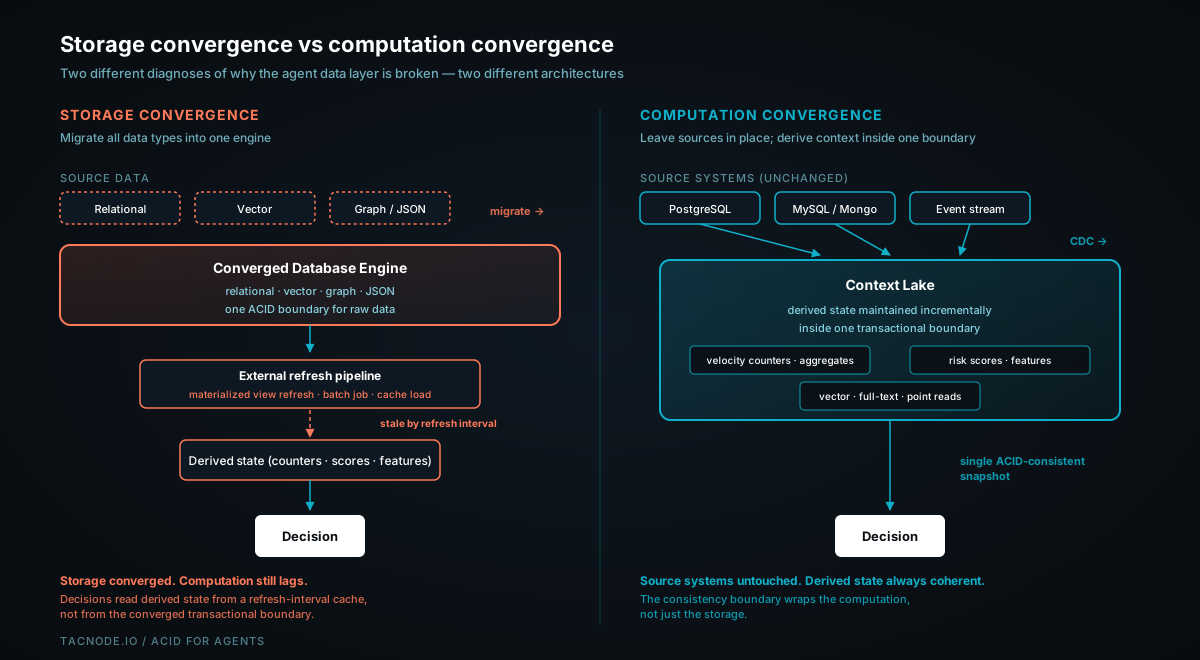
Theory 1: Storage fragmentation. Data lives in separate specialized systems — a relational database here, a vector store there, a cache over there. Each system has its own consistency boundary. Agents querying across them read values that reflect different points in time. The fix: converge all data types into one database engine with one transactional boundary. If everything lives in one system, every query gets a consistent snapshot.
This is a clean theory. It has a clean solution. And for organizations that can actually consolidate into a single database engine, it works.
Theory 2: Computation fragmentation. This is our thesis. The inconsistency problem isn’t primarily about where raw data is stored. It’s about where derived state is computed.
Consider what an agent actually reads when it makes a decision. It rarely queries raw transaction records. It reads a velocity counter (“how many transactions has this card processed in the last 60 seconds?”), a risk score (“what’s the current fraud probability for this session?”), an aggregation (“what’s the customer’s total exposure across all open positions?”), or a feature vector (“what’s the embedding for this user’s recent behavior?”).
These are all derived state — computed from raw events, not stored directly. And in most production architectures, they’re computed in pipelines outside the transactional boundary: a Spark job that refreshes the feature store every 2 minutes, a Flink pipeline that updates the velocity counter with a 15-second lag, a batch process that recomputes risk scores hourly and loads them into a cache.
The derived state is stale not because the raw data lives in the wrong database. It’s stale because the computation that produces it runs in a pipeline that is, by design, asynchronous and eventually consistent.
This is why converging storage alone doesn’t fully solve the problem. Even if you moved all your raw data into a single database engine, you would still need to answer: where do velocity counters get maintained? Where are risk scores recomputed as each new transaction arrives? Where do aggregations update in real time? If the answer is “in a materialized view with periodic refresh” or “in application logic that runs outside the database,” the derived state is still stale. You’ve converged your storage but left your computation fragmented.
What the Storage-Convergence Approach Gets Right
Before explaining where the theories diverge in practice, it’s worth being specific about what the converged-database camp gets right. There are three insights that the broader industry has been slow to recognize, and the major database vendors stating them explicitly accelerates the conversation for everyone.
First, that the problem is architectural, not feature-level. Adding vector search to a relational database (which every major database vendor has done) doesn’t solve the agent data problem on its own. The problem is that agents need to query across data types — vector, relational, key-value, graph, time-series — within a single consistent snapshot. As long as those data types live in separate systems with separate consistency boundaries, agents read inconsistent state. The architectural argument — converged, ACID-compliant data access across all retrieval patterns — is the right frame.
Second, that access control must be enforced at the data layer, not the application layer. Traditional applications enforce permissions in code — the app checks what the user can see before querying the database. Agents bypass this model because they generate queries dynamically. An agent tasked with “find the best candidate for this role” might query salary data, performance reviews, and demographic information unless the data layer itself enforces row-level and column-level access controls. Access control for agents must be declarative at the data layer, not imperative in application code.
Third, that purpose-built vector databases are a stepping stone, not a destination. Agents don’t just need vector search. They need vector search AND relational queries AND aggregations AND graph traversal — from the same transactional state. Purpose-built vector databases like Pinecone, Qdrant, and Weaviate solve the vector search problem well, but they create a new sync pipeline when agents need to combine vector results with relational data.
Where the Theories Diverge
A converged database puts all data types in one engine, queryable under ACID guarantees. That’s real, and for query-time joins across raw data types, it’s powerful.
But converging storage doesn’t converge computation. And for decision-time workloads, it’s the computation that matters.
The derived state gap. A fraud detection agent doesn’t query a raw transactions table and compute a velocity counter on the fly. At decision-time latency requirements (single-digit milliseconds), that’s not feasible against a hot table with thousands of concurrent writes. The velocity counter needs to be pre-computed, maintained incrementally, and available as a point read.
A converged database gives you the raw ingredients — all data types under one roof. But turning those raw ingredients into the derived context a decision system needs still requires building the computation layer: materialized views, triggers, stored procedures, or application-side logic. “Fast refresh” materialized views are the closest native primitive most converged engines offer, but they operate on refresh intervals — not continuous, event-driven incremental maintenance inside the transactional boundary.
This is the gap between converging storage and converging computation. A Context Lake makes incremental, transactionally consistent derived state the core primitive — not an afterthought layered on top of a general-purpose database.
The migration constraint. The storage-convergence thesis requires data to live inside the converged engine. For the many production systems running on PostgreSQL, MySQL, DynamoDB, or MongoDB, this means migration — a multi-year, high-risk project that most engineering teams will not undertake for a single architectural benefit.
The computation-convergence thesis doesn’t require moving raw data. It ingests change streams via CDC from existing systems of record and computes derived state inside its own transactional boundary. The source systems don’t change. The agent data layer is additive, not migratory.
This isn’t just an adoption-friction difference. It reflects the underlying architectural claim: if the problem is where raw data lives, migration is the logical fix. If the problem is where derived state is computed, migration is unnecessary — you need a computation layer that sits alongside existing systems, not a database that replaces them.
The Context Lake Architecture
The Context Lake architecture follows from the computation-fragmentation diagnosis. If the problem is that derived state is computed in pipelines outside the transactional boundary, the fix is a system purpose-built for maintaining derived state inside one.
Instead of migrating source databases into a single converged engine, a Context Lake:
Ingests via change data capture from existing systems of record — PostgreSQL, MySQL, MongoDB, event streams, application databases. The source systems don’t change. No migration, no re-platforming.
Computes derived state incrementally inside a single transactional boundary. Velocity counters, risk scores, feature vectors, aggregations — all maintained continuously as source data changes. Not in batch pipelines. Not in periodic refresh cycles. The derived state is always consistent with the latest committed source events.
Serves all retrieval patterns — point lookups, aggregations, full-text search, vector similarity — from one ACID-consistent snapshot. Agents and decision systems query one system and get consistent context across all derived data types.
Is PostgreSQL-compatible. Existing tools, ORMs, and applications connect without modification. No proprietary protocol, no specialized drivers.
The result is ACID-compliant derived context for decision-time workloads — the same architectural requirement the converged-database camp identified — without requiring source systems to migrate into a single database engine. The consistency boundary wraps the computation, not the storage.
What This Means for Teams Building Decision Systems
The major database vendors moving toward converged, ACID-compliant data access matters regardless of which one you use. It signals that the industry’s largest infrastructure vendors now recognize that the data layer for AI agents, fraud detection, credit decisioning, pricing engines, and other real-time decision systems is broken — and that ACID compliance across retrieval patterns is the architectural requirement.
If you’re building production agent systems or automated decision workflows today, the questions to ask are:
What are your agents actually reading — raw data or derived state? If the answer is derived state (counters, scores, aggregations, features), then where and how that state is computed matters more than where the raw data is stored.
Is your derived state computed inside a transactional boundary? If velocity counters, risk scores, or feature vectors are computed in a pipeline and loaded into a cache, the derived state is always slightly behind the source data. For decision-time workloads, “slightly behind” means “potentially wrong.”
Are your decision systems reading from a single consistent snapshot? If an agent or automated process queries a cache for one value and a database for another, there’s no guarantee those values reflect the same state. Under load, this inconsistency grows.
Do your agents have isolation guarantees? If two agents can read the same state and both act on it without detecting the conflict, you have a concurrency problem that will surface in production.
Can you enforce access control at the data layer? If permissions are checked in application code, agents that generate dynamic queries will eventually request data they shouldn’t see. Access control must be enforced where the data lives.
The agent data layer problem is real, and the largest database vendors have now validated it. The remaining question is whether the root cause is storage fragmentation — and the fix is migrating into a converged database engine — or computation fragmentation — and the fix is a purpose-built context layer that computes and serves derived state with ACID guarantees from the systems you already run.
Frequently Asked Questions
What is ACID compliance in the context of AI agents?
ACID compliance for AI agents means that when an agent reads data to make a decision, the data is guaranteed to be atomically consistent (all values reflect the same state), isolated from concurrent writes by other agents, and durably persisted. Without these guarantees, agents make decisions on inconsistent or stale data — leading to incorrect approvals, conflicting actions, and undetectable errors.
Why can’t I just use a converged database for my agents?
You can — and for query-time joins across raw data types, it works. The gap shows up when agents read derived state: velocity counters, risk scores, aggregations, feature vectors. A converged database stores the raw events that those values are computed from, but maintaining the derived state itself still falls to materialized views with periodic refresh, triggers, stored procedures, or application logic. Refresh intervals reintroduce the staleness problem the converged storage was supposed to eliminate. The decision-time consistency guarantee has to wrap the computation, not just the storage.
For low-stakes decisions (chatbot responses, content recommendations), eventual consistency is often sufficient. For high-stakes decisions (fraud detection, credit approvals, pricing, multi-agent coordination), ACID transactions are a correctness requirement. Without them, agents read stale or inconsistent state and make irreversible decisions based on data that doesn’t reflect reality.
What is a Context Lake?
A Context Lake is an operational context layer that ingests data via change data capture from existing systems of record, computes derived state incrementally inside a transactional boundary, and serves all retrieval patterns — point lookups, aggregations, full-text search, vector similarity — from a single ACID-consistent snapshot. Unlike a converged database that requires migrating source systems, a Context Lake derives and maintains decision context from existing infrastructure.
What’s the difference between storage convergence and computation convergence?
Storage convergence (the converged-database approach) puts all data types — relational, vector, graph, key-value — into one database engine so queries get a consistent snapshot of raw data. Computation convergence (the Context Lake approach) takes change streams from existing databases and computes the derived state that decisions depend on — counters, scores, aggregations, features — inside a single transactional boundary. Storage convergence requires migrating data. Computation convergence works with existing systems of record. For the wider set of production failure modes this one belongs to, see agentic AI architecture: patterns and what breaks in production.
AI AgentsACIDContext LakeDecision SystemsData ArchitectureDerived State