
Tacnode
Back to Blog
Architecture

Polyglot Persistence and the Retrieval Gap: Why Multiple Databases Break Real-Time Decisions

Polyglot persistence solved database specialization. It also made it structurally impossible for a single decision to read consistent context across stores — and no amount of pipeline tuning can fix it.

Alex Kimball
Alex Kimball
Product Marketing
14 min read
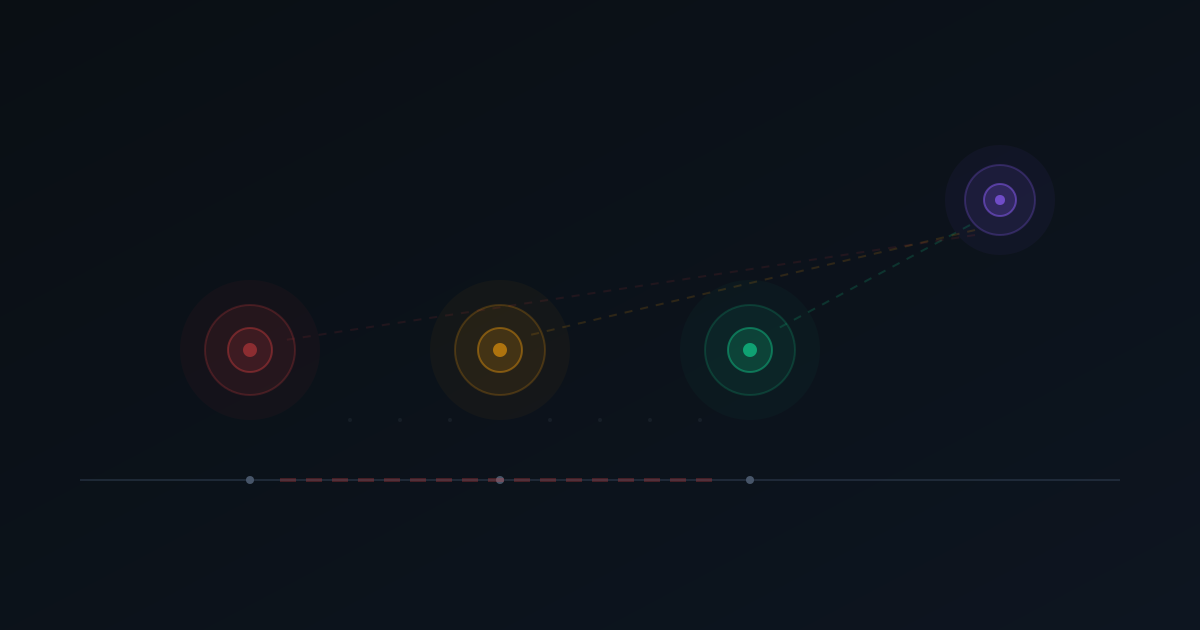
Diagram showing multiple database systems returning reads at different points in time to a single decision

Polyglot persistence refers to using different database technologies for different access patterns — and it was the right call. But it introduced a problem nobody addresses: when a single decision reads from multiple data stores, each read reflects a different moment in time. The decision evaluates a composite state that never existed. This is the retrieval gap. It's structural, not operational. Faster pipelines shrink the window but can't close it. The fix is context infrastructure that serves all context from one consistent snapshot at decision time.

The Decision Reads Three Databases. Each One Answers From a Different Moment.

The retrieval gap is the structural inability of a composed architecture — multiple databases, each advancing independently — to serve a single decision all the context it needs under one consistent snapshot. The decision completes in milliseconds, but the context it evaluates never existed as a coherent whole at any single point in time.

A card authorization at a fintech company. Standard polyglot stack. Three reads:

  • Account balance from Postgres. System of record. Reflects the current committed state. - Transaction velocity — rolling count of transactions in the last 60 seconds — from Redis. Updated by an event pipeline. 2–5 seconds of propagation lag. - Risk score — composite signal from historical transaction patterns — from ClickHouse. Refreshed by a Flink job on 10–15 second checkpoint intervals.

The authorization service fans out all three reads concurrently. Each returns fast. Each succeeds. Every operational metric is green.

All this data — transactional data from Postgres, derived counters from Redis, analytical aggregations from ClickHouse — arrives from different sources at different speeds. The balance is current. The velocity counter is 3 seconds old. The risk score is 12 seconds old. The decision evaluates all three together, as if they describe the same instant.

They don't. The composite state the decision sees never existed as a coherent whole.

This is the retrieval gap. And it's a structural property of the architecture, not a failure of any individual component.

Polyglot Persistence Was the Right Call

Martin Fowler named the pattern in 2011. The idea was simple and correct: a relational database is not the best tool for every job. No one database is the right tool for every access pattern. One size does not fit all.

Key-value stores like Redis handle point lookups. Analytical engines like ClickHouse handle aggregations. Full-text search belongs in Elasticsearch. Graph databases like Neo4j handle relationship traversals. NoSQL database technologies — document stores, column-family stores, key-value caches — each solve different problems that relational databases handle poorly at scale. The right database depends on the access pattern, not on organizational convention.

The benefits were real. Teams could choose different data storage technologies for different kinds of data: relational databases for transactional data, data warehouses for analytics, key-value stores for session state, graph databases for relationship queries. Each database type optimized for its specific use cases. The combination of specialized systems outperformed any single system trying to manage all data types.

Fifteen years later, polyglot persistence isn't a design philosophy. It's the default. Any production system serving modern applications at non-trivial scale runs multiple data stores. The microservices movement accelerated it: each service owns its data, picks its own engine, optimizes for its own access pattern. The database-per-service pattern is standard practice in application development.

Nobody is going back to only one database for everything. The monolith application with a single database and vertical scaling solved a simpler era. That argument is settled.

But the original thesis was about writes and data storage — picking the right database to persist each type of data. It said almost nothing about what happens when a single operation needs to read from several of those engines at once.

The write side was solved. The read side was assumed.

What Polyglot Persistence Involves in Practice

Polyglot persistence involves managing multiple databases across different data storage technologies — and in practice, the complexity is substantial.

Consider what a typical e-commerce platform runs: Postgres for transactional data (orders, payments, inventory), MongoDB or a document store for product catalogs with flexible data structures, Redis for session state and real-time counters, Elasticsearch for search, a data warehouse like Snowflake or BigQuery for analytics processing, and increasingly a vector store for recommendation embeddings. Six different database systems. Six different data stores. Each handling different kinds of data — structured transactions, unstructured data like product descriptions, semi-structured events, massive amounts of behavioral logs.

Each store is the right tool for its job. Each handles large amounts of its specific data type with performance and scalability that a single database couldn't match.

But managing multiple databases creates integration complexity that grows with every store you add. Different technologies use different languages for queries, different formats for data, different protocols for replication. The cost isn't just infrastructure — it's the engineering effort to create and maintain the pipelines connecting them, to manage schema evolution across different data stores, and to reason about data flowing through multiple data storage technologies at different speeds.

The standard solution is to connect everything with event pipelines — Kafka, CDC, Flink, batch ETL. Data flows from each source into downstream stores. The architecture looks clean on a whiteboard.

The problem is what happens at read time.

What Concurrency Does to the Gap

When each store is only a few seconds stale, the retrieval gap sounds like a rounding error. For dashboards and reports, it is.

For automated decisions under concurrency — where the validity window is milliseconds, not minutes — it's a different problem entirely.

One customer making one purchase every few minutes won't expose the inconsistency. A fraud ring running 15 concurrent transactions against the same account will.

Here's the sequence:

  • 15 authorization requests arrive within 200 milliseconds. - Each one reads the velocity counter from Redis. - None of the concurrent transactions have propagated yet. - Each authorization sees a clean history. Each one approves. - By the time the velocity counter catches up, all 15 have cleared.

The problem isn't that the pipeline is slow. The problem is that between the moment the balance changes in Postgres and the moment the velocity counter reflects it in Redis, there's a window. Within that window, the decision sees an internally contradictory state: a balance that reflects the latest debit, but a velocity count that doesn't include it.

This is everywhere once you look:

  • Margin liquidation engines reading stale position state while concurrent orders change the position underneath them. - Checkout fraud models on an e-commerce platform that see ten minutes of normal browsing behavior but miss the three rapid-fire purchases from 8 seconds ago — because the order history hasn't propagated to the different data stores yet. - Surge pricing combining supply data, demand data, and trend aggregations from different sources, each updating on its own cadence, none synchronized. - AI agents reasoning over structured state from Postgres, embeddings from a vector store, and a derived risk signal from a pipeline — three different database systems, three different ages, no way to know.

High-value accounts change state fastest. Popular products update most frequently. Trending assets move most rapidly. The entities where the gap matters most are the ones where it's widest.

The stores that need to agree most urgently are the ones diverging most rapidly.

The Pipeline Fallacy

The natural response is faster pipelines. Reduce Kafka consumer lag. Shrink the Flink checkpoint interval. Move from batch ETL to streaming CDC.

These are good operational improvements. They make the gap narrower. They do not make it zero.

Even if every pipeline stage runs in under 100 milliseconds, the architecture still involves multiple independently advancing systems:

  • Balance commits in Postgres at time T. - CDC event reaches Kafka at T+50ms. - Flink processes it at T+80ms. - Redis counter updates at T+120ms.

During those 120 milliseconds, every authorization that reads from both Postgres and Redis sees a balance that includes the debit and a velocity counter that doesn't. The window is smaller. The inconsistency is identical.

Under high concurrency — which is exactly when it matters — dozens of decisions execute within that window.

The architectural constraint is fundamental: polyglot persistence distributes context across database systems with independent clocks and independent commit boundaries. No pipeline connecting them can simulate a shared transaction. There is no "distributed read transaction" across Postgres, Redis, and ClickHouse.

This isn't a performance problem. It's a consistency model problem. Consistency model problems don't yield to faster hardware or better tuning.

The gap isn't operational. It's architectural.

The Problem the Original Thesis Left Behind

Most polyglot persistence content — from Fowler's original bliki post to every Medium explainer — answers the same question: which database should store what?

That was the right question in 2011. Data was stored and queried by humans on human timescales. Dashboards refreshed every few seconds. Reports ran nightly. An analyst could tolerate — and mentally compensate for — slight inconsistencies between systems.

The question has changed. Now the consumers are automated decisions and AI agents. They execute in milliseconds, under concurrency, against state that's changing while they read it. They can't tolerate inconsistency because they can't detect it. They can't compensate because there's no human in the loop.

The original polyglot thesis solved data storage. It left the read side as someone else's problem. For a decade, it didn't matter much. Humans were the decision layer, and humans are tolerant of staleness.

Now machines are the decision layer. And machines are not.

Polyglot persistence solved how to write. The retrieval gap is what happens when you read.

What Decisions Actually Need

The retrieval gap isn't a product of bad engineering. It's a structural property of composed architectures. Each specialized store advances independently — that's what makes it good at its job. But independent advancement is exactly what prevents consistent reads across multiple data stores.

What real-time decisions need is the opposite:

  • All retrieval patterns in one place. Point lookups, range scans, aggregations, secondary index access, similarity search — served from a single system, not fanned out across five different databases. - One snapshot boundary. Every read in the decision reflects the same committed state. No window between systems where one reflects an event and another doesn't. - Freshness under concurrency. The context stays current even when hundreds of concurrent writes are changing the entities the decision cares about.

This is the architectural requirement that polyglot persistence cannot meet — not because any individual store is inadequate, but because no combination of independently advancing database technologies can provide a single consistent read.

The decision needs context that reflects one moment. Polyglot persistence gives it context from many.

Frequently Asked Questions

The Read Side Has a Name Now

Polyglot persistence was the right answer to the right question: how should we store different types of data? The database-per-service pattern is standard for good reason. Nobody should go back to forcing everything through one relational engine.

But the question has changed. The question now is: how does a decision get consistent context when that context is spread across different database systems that advance independently?

Faster pipelines narrow the window. Better caching reduces latency. Neither eliminates the retrieval gap, because the gap is architectural — a structural property of composed systems, not an operational failure of any one component.

Closing it requires a different approach: serving all the context a decision needs from one consistent read boundary. Not replacing the specialized systems that store and process data. Adding a layer — a Context Lake — where all the context a decision depends on is prepared, stored, and retrieved under one consistent snapshot, so the decision layer never has to fan out across independently advancing stores.

The polyglot stack solved storage. The retrieval gap is the read-side problem it left behind. And it's the problem that matters most when decisions are automated, concurrent, and real-time.

Polyglot PersistenceContext EngineeringReal-Time Data EngineeringArchitecture & ScalingDecision Systems
Alex Kimball

Written by Alex Kimball

Former Cockroach Labs. Tells stories about infrastructure that actually make sense.

Ready to see Tacnode Context Lake in action?

Book a demo and discover how Tacnode can power your AI-native applications.

Book a Demo