Fraud detection on 10-minute-old data? You already approved the transaction. Dynamic pricing on yesterday's inventory? You're selling what you don't have. Five industries where data freshness directly determines revenue.
TL;DR: Data freshness — how current your data is at the moment of use — directly impacts revenue in five domains: fraud detection (sub-second freshness prevents approved fraud), dynamic pricing (stale competitor data bleeds margin), inventory (minutes of lag cause overselling), AI agent context (agents contradict each other on stale snapshots), and ML feature serving (training-serving skew silently degrades accuracy). The fix isn't faster queries — it's architectures where data is fresh at the point of decision.
Stale data doesn't throw errors. It doesn't trigger alerts. It just makes your system confidently wrong — and the damage compounds silently until someone notices a revenue gap, a compliance violation, or a wave of customer complaints.
Most data engineering teams obsess over data latency — how fast a query returns. But a query that returns in 2ms is worthless if the underlying data is 15 minutes old. Stale data is the real risk — data freshness measures something different: how closely your system's view of the world matches the present moment.
In this article, we'll explain what data freshness refers to, why data freshness matters for your business needs, and walk through five real world examples where stale data causes direct revenue loss. We'll also cover key data freshness metrics, best practices for maintaining data freshness, and how to build freshness monitoring into your data pipelines.
Data Freshness: A Quick Definition
Data freshness measures the gap between when an event occurs in the real world and when that data is available for decision making. If a customer places an order at noon and your warehouse system reflects it at 12:05, your data age is five minutes — and in some domains, that's enough to cause real damage. For a full breakdown of freshness metrics, thresholds, and best practices, see the data freshness pillar page.
Why Is Data Freshness Important?
Data freshness is important because every downstream system — from analytics dashboards to AI agents to customer-facing applications — makes decisions based on the data it can see. When that data is stale, those decisions are based on outdated information, leading to missed opportunities, poor customer experiences, and direct revenue loss.
Fresh data gives your data teams a competitive edge. Companies that can process data and act on relevant data in real time outperform those waiting for overnight batch refreshes. Whether you're optimizing pricing, personalizing customer preferences, or running a machine learning model for accurate predictions, timely data is the foundation of informed decisions.
The consequences of stale data compound across your organization. A single outdated data asset — like an inventory count or a customer risk score — can cascade through multiple systems. When data changes in the real world but your system still shows the old value, every agent, model, and dashboard downstream makes decisions against a false picture.
Here are five domains where the gap between reality and your system's view has direct, measurable financial consequences.
1. Fraud Detection: Minutes of Staleness Mean Millions in Losses
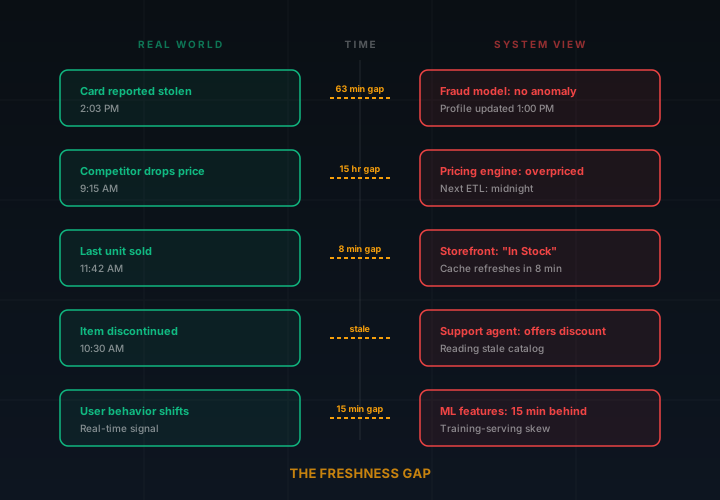
A cardholder reports their card stolen at 2:03 PM. At 2:07 PM, a fraudulent transaction hits for $847. Your fraud model evaluates the transaction against a behavioral profile last updated at 1:00 PM — before the theft report existed. The model sees nothing unusual because the raw data hasn't propagated through your data pipelines yet. The transaction is approved.
This isn't a hypothetical. Batch-updated fraud systems routinely miss signals that exist in the data sources but haven't reached the scoring layer. The fraud signal was there — the system just couldn't see it because its data was stale. The data collection happened, but the data processing lag created a window for fraudsters.
Freshness requirement: Sub-second. Fraud models need to evaluate transactions against behavioral context that includes events from the last few seconds. Every minute of staleness is a window where new data about suspicious activity hasn't arrived yet.
The cost of staleness: Industry estimates put card-not-present fraud losses at over $10 billion annually. A significant portion of these losses stem from detection systems acting on outdated data rather than failures in the models themselves.
2. Dynamic Pricing: Stale Competitor Data Bleeds Margin
Your competitor dropped their price on a popular SKU at 9:15 AM. Your pricing engine pulls competitor data from a data warehouse refreshed overnight. For the next 15 hours, you're overpriced — and you don't know it. Customers comparison-shop, find the lower price elsewhere, and leave.
Alternatively, a flash sale drives unexpected demand. Your pricing engine doesn't see the velocity spike because inventory counts update hourly. The data refreshes aren't frequent enough to capture how recently data has changed. You sell out at the original price when the demand signal warranted a premium.
Freshness requirement: Under 1 minute for competitive pricing. Under 30 seconds for demand-responsive pricing. Your data pipelines need to process data from external data sources fast enough to maintain a competitive edge.
The cost of staleness: Pricing teams at major retailers estimate that even a 1% improvement in data accuracy — largely a function of data freshness — translates to tens of millions in annual margin. The data exists to make better decisions; it's just arriving too late to be relevant data.
The product page shows "In Stock." The customer orders. Ten minutes later, they get a cancellation email — the last unit sold 3 minutes before their order, but the inventory count hadn't propagated to the storefront yet. The data age was only a few minutes, but it was enough to cause a failure.
This is the most visible freshness issue because customers experience it directly. Multi-channel retailers running separate inventory systems for web, mobile, and in-store frequently encounter this: each channel reads from a different cache with a different lag. The collection frequency timestamps differ across data sources, so no single system has up to date information.
Freshness requirement: Under 30 seconds for inventory counts. Under 5 seconds during high-velocity events like flash sales. Event driven systems that push data updates when an event occurs outperform polling-based approaches here.
The cost of staleness: Overselling triggers refunds, reshipments, and customer service costs. But the larger cost is trust erosion — failing to deliver exceptional customer experiences. A customer who gets a cancellation email after checkout is unlikely to return. Eliminating stale data directly correlates with customer retention in e-commerce.
4. AI Agent Decisions: Stale Context Makes Agents Fight
A support agent offers a 20% discount on an item. A fulfillment agent flags that same item as discontinued and blocks shipping. A pricing agent reprices it based on inventory data that's 10 minutes old. None of these agents are wrong individually — they're each making informed decisions based on what they can see. The problem is they're all seeing different snapshots of the same reality because the data is available at different freshness levels.
This is the multi-agent coordination problem at its core. When agents read from separate caches with different refresh intervals, they inevitably contradict each other. The customer sees the chaos even if your logs don't. Outdated information in any single data source can lead to contradictory actions across the entire system.
Freshness requirement: Under 5 seconds for shared context across agents. All agents must read from the same source of truth with the same freshness guarantee — not separate caches updated on different schedules.
The cost of staleness: Contradictory agent actions erode customer trust faster than slow responses do. Shared context through a unified data layer eliminates this class of failures by design, ensuring every agent operates on fresh data that reflects the present moment.
5. ML Feature Drift: Training on Fresh Data, Serving on Stale
Your machine learning model was trained on features computed from real-time data. In production, those same features are served from a pipeline that lags by 15 minutes. The model expects fresh inputs but receives stale ones. This is training-serving skew, and it degrades data accuracy silently — your model can't make accurate predictions when it's being fed outdated data.
The insidious part is that standard monitoring won't catch it. The model still returns predictions. Data latency metrics look fine. But the predictions are subtly wrong because the input features don't reflect the current state of the world. A feature store with real-time serving eliminates this by ensuring fresh data in production matches training. Without it, your data engineering team will waste cycles retraining models to fix what are actually freshness issues in the serving layer.
Freshness requirement: Features must be served at the same freshness as the training data pipeline. If you trained on hourly features, hourly serving is acceptable. If you trained on real-time data processing, serving must be real-time too.
The cost of staleness: Model accuracy degradation is difficult to quantify because it’s gradual — a form of data decay. Teams often retrain models to fix accuracy issues that are actually freshness issues. The model isn’t wrong — it’s just being fed outdated inputs that no longer reflect the business context. Time travel queries can help diagnose these issues by letting you replay what the feature values looked like at the time a prediction was made, revealing whether staleness — not the model — was the root cause.
How Fresh Is Fresh Enough?
Not everything needs sub-second updates. Freshness thresholds vary by domain and business needs — but knowing your actual requirement prevents both over-engineering and silent failures. Set freshness thresholds based on your specific business context and the potentially costly consequences of stale data in each system.
Domain
Freshness Target
Failure Mode When Stale
Fraud detection
< 1 second
Approved fraudulent transactions
Dynamic pricing
< 1 minute
Margin leakage, lost sales
Inventory
< 30 seconds
Overselling, cancellation emails
AI agent context
< 5 seconds
Contradictory agent actions
ML feature serving
Match training pipeline
Silent accuracy degradation
Analytics (e.g. Google Analytics)
< 15 minutes
Delayed business decisions
Measuring Data Freshness
You can't fix what you don't measure. The key freshness metrics — data age, pipeline lag, SLA compliance, and staleness ratio — should be tracked at the point of use, not at ingestion. For detailed definitions and how to instrument each metric, see What Is Data Freshness?
Keeping Data Fresh Where It Matters
The short version: prefer event-driven systems over batch ETL, reduce pipeline hops, monitor freshness at the point of use, and set explicit SLAs per data asset. For the full best-practices checklist, see the data freshness guide.
Data Freshness and Data Observability
Data observability is the practice of monitoring data quality, data freshness, and data pipeline health across your entire data stack. Freshness is one of the most critical dimensions of data observability because stale data can lead to cascading failures that are hard to diagnose after the fact.
Modern data observability tools track data freshness alongside other data quality dimensions — data accuracy, completeness, schema conformance, and volume. But freshness deserves special attention because it degrades continuously. A table that was fresh five minutes ago is already staler. Data decay is constant and inevitable unless your architecture is designed to counteract it.
For data teams managing dozens of data sources and hundreds of data pipelines, freshness monitoring is essential. Without it, you won't know whether your data warehouse is serving up to date data or quietly falling behind. Google Ads campaigns optimizing on stale conversion data, customer-facing dashboards showing outdated information, machine learning models making predictions on old features — all of these failures are invisible without proactive freshness monitoring.
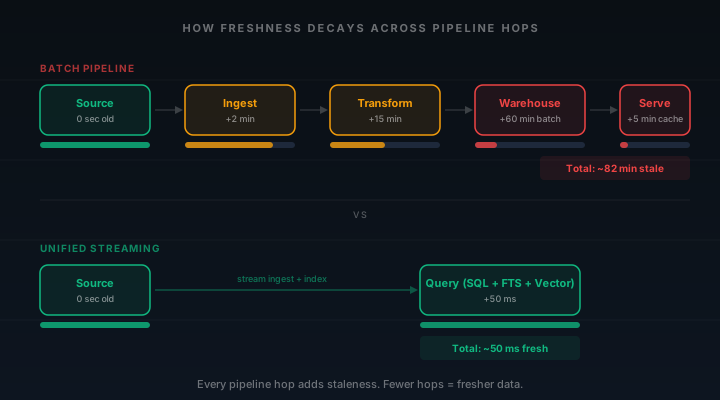
The best practices here converge: event driven systems for data collection, minimal pipeline hops for data processing, freshness thresholds for every data asset, and automated data freshness checks that alert your data engineering team before stale data reaches decision-making processes. Together, these ensure that fresh data enables organizations to deliver exceptional customer experiences and maintain a competitive edge.
Frequently Asked Questions
Freshness Is a First-Class Metric
Most teams monitor data latency religiously but treat data freshness as an afterthought. The use cases above show why that's backwards: a fast system serving stale data is worse than a slightly slower system serving fresh data. Your customers don't care if the query took 2ms — they care that the answer was right and based on up to date information.
Start by measuring data freshness across your critical paths. Track the data age at the moment of use, not at the moment of ingestion. Set freshness thresholds per domain using the table above as a starting point. Run data freshness checks regularly and surface results in your data observability tooling.
Then ask whether your current architecture — likely a chain of batch data pipelines feeding separate caches — can actually deliver the freshness your business needs demand. If not, it might be time to look at a unified data layer that keeps data live at the point of decision, not just at the point of storage. Because in the end, data freshness matters more than almost any other data quality dimension — it determines whether your systems are making informed decisions on the present moment or confidently acting on the past.
Data FreshnessReal-TimeUse CasesData QualityData Engineering