
Back to Blog
Data Engineering

What Is a Data Contract? The Complete Guide to Data Contracts [2026]

A data contract defines the structure, format, and quality expectations for data exchanged between systems. Learn how to create, implement, and enforce data contracts across your data platform.

Alex Kimball
Marketing
20 min read
Share:
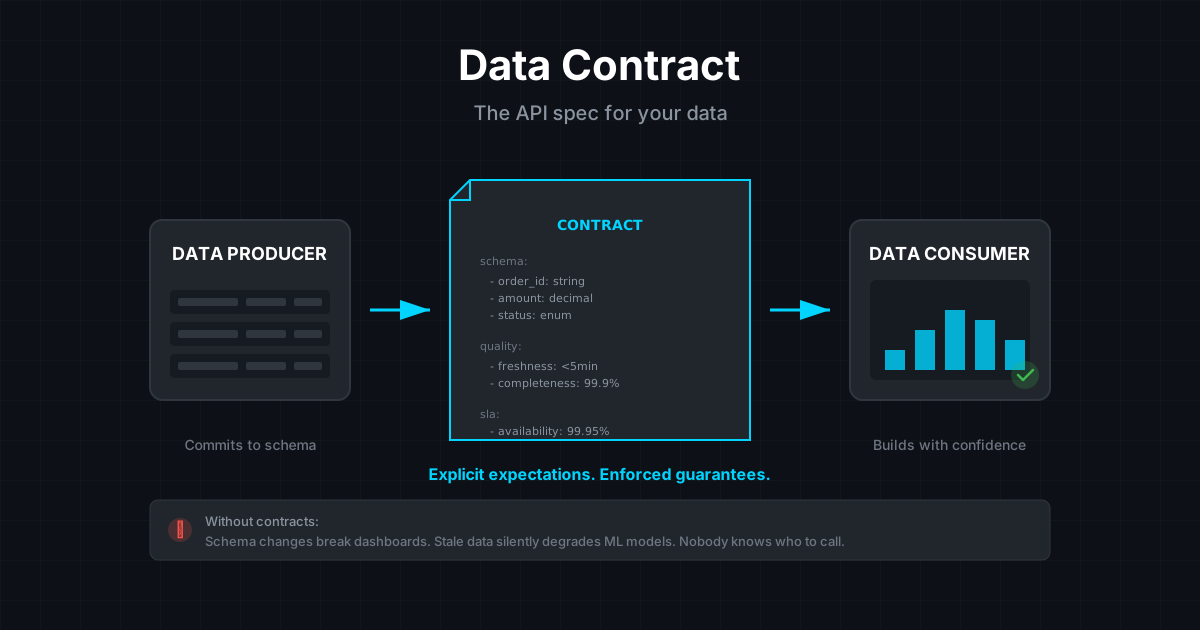
Diagram showing data contract as the API spec between data producers and consumers

A data contract is a formal agreement between data producers and data consumers that defines the structure, format, and data quality expectations for data exchanged between systems. A data contract defines the rules that a data product must follow — think of it as an API spec for your data pipelines. It tells downstream processes exactly what to expect, and it holds upstream systems accountable for delivering it.

Without data contracts, teams discover data quality issues after the damage is done: a broken dashboard, a failed ML model, an angry customer. With data contracts, you catch problems at the source — before bad data pollutes your entire data platform.

Understanding Data Contracts

Understanding data contracts starts with a simple premise: when producers and consumers of data exchange information across systems, both sides need formal agreements about what that data looks like. Data contracts provide these formal agreements — explicit specifications that define what a data product delivers and what data consumers can depend on.

Data contracts are not documentation. Documentation describes what data looks like today. Data contracts enforce what data must look like always. The distinction matters: documentation is advisory, data contracts are enforceable. When data conforms to its contract, downstream processes work. When it doesn't, the violation is caught immediately rather than silently corrupting your data stack.

The Open Data Contract Standard (ODCS) has emerged as a vendor-neutral way to express data contract definitions. The Open Data Contract Standard provides a common format that works across cloud data platforms, relational databases, and streaming systems — making data contracts portable across your entire data stack.

Why Data Contracts Are Important

Modern data architectures are distributed. Data flows from dozens of sources through complex data pipelines into warehouses, lakes, and real-time data systems. In this environment, implicit assumptions about data are a liability. Data contracts are important because they replace assumptions with enforceable guarantees.

When data producers commit to a data schema, quality rules, and service level agreements, data consumers can build with confidence. When those commitments are enforced through contract validation, data reliability becomes a guarantee rather than a hope.

The business case is straightforward:

  • Reduced incidents: Data quality issues caught at ingestion don't become production fires
  • Faster debugging: When something breaks, data contracts tell you exactly where the violation occurred
  • Clear ownership: Data producers and consumers have defined contractual obligations
  • Scalable trust: New data consumers can onboard without reverse-engineering upstream systems
  • Enhanced data quality: Quality rules are enforced consistently, not checked intermittently
  • Predictable data: Downstream data teams and data scientists know exactly what to expect

In a distributed data architecture — especially in data mesh implementations — data contracts are essential. Without them, distributed data ownership becomes decentralized chaos. Data contracts play a central role in making data mesh work at scale: they're the mechanism that lets autonomous data teams publish data products that other teams can trust.

What Problems Do Data Contracts Solve?

Data contracts solve a specific class of failures that plague organizations exchanging data across teams and systems:

Schema changes breaking downstream processes. A data producer adds a field, renames a column, or changes a data type — and every downstream consumer breaks. Data contracts solve this by requiring producers to version schema changes and maintain backward compatibility. Schema changes become managed migrations, not surprise outages.

Silent data quality degradation. A source starts sending missing or incomplete data in fields that used to be complete. Without data contracts, nobody notices until an analytics team gets wrong numbers or a data scientist's model degrades. Data contracts solve this with data quality rules that catch violations at the boundary.

Unclear ownership and accountability. When bad data appears in a dashboard, who's responsible? The producer? The pipeline? The consumer? Data contracts solve this with explicit ownership: data producers own the contract and are accountable for violations.

Data freshness and data timeliness gaps. Consumers need data within specific time windows, but producers have no commitment to deliver. Data contracts solve this with service level agreements that define data freshness requirements and latency guarantees.

Entropy across data pipelines. Over time, without enforcement, data quality drifts. Fields that were once reliable become inconsistent. Formats vary. Existing data degrades. Data contracts provide the guardrails that prevent entropy data quality decay across your data pipelines.

Key Components of a Good Data Contract

A good data contract includes several elements:

Schema Definition — The foundation of any data contract is the data schema. This defines field names and data types (string, integer, timestamp), required vs. optional fields, valid format specifications (date formats, enum values, regex patterns), and nested structures. Schema validations enforce these rules at runtime.

Data Quality Rules — Beyond structure, data contracts specify quality expectations: completeness (no missing or incomplete data in required fields), uniqueness (primary keys must be unique), referential integrity (foreign keys must reference valid records), and business rules (domain-specific validation like "order_total must be positive"). These quality rules are what distinguish data contracts from simple schema definitions.

Service Level Agreements — Data contracts should define operational expectations: data freshness requirements, latency guarantees, availability targets, and volume limits. Service level agreements make data timeliness a contractual obligation rather than a best-effort aspiration.

Metadata and Ownership — Good data contracts document context: data owners responsible for each data product, contact information for when something breaks, semantic descriptions of each field, access controls for sensitive data, and classification of critical datasets.

Versioning and Lifecycle — Data contracts evolve. Include version identifiers, deprecation policies, and migration paths for breaking schema changes. Data contract definitions should specify how schema changes are communicated to data consumers.

Data Contract Example

Here's what a data contract might look like for an orders data product. This data contract example shows how a data contract template structures schema validations, quality rules, and service level agreements for a critical data product:

yaml
name: orders
version: 2.1.0
owner: commerce-team@company.com
description: Order line item data from the web shop

schema:
  - name: order_id
    type: string
    description: Internal order ID
    constraints:
      - required: true
      - unique: true
      
  - name: customer_id
    type: string
    description: Reference to customer record
    constraints:
      - required: true
      
  - name: order_total
    type: decimal
    description: Total order value (includes shipping)
    constraints:
      - required: true
      - minimum: 0
      
  - name: order_status
    type: string
    description: Business status of the order
    constraints:
      - required: true
      - enum: [pending, confirmed, shipped, delivered, cancelled]
      
  - name: created_at
    type: timestamp
    description: When the order was placed
    constraints:
      - required: true

quality:
  freshness:
    max_age: 5 minutes
  completeness:
    threshold: 99.9%
    
sla:
  availability: 99.95%
  latency_p99: 500ms

This data contract template can be adapted for various data products — from line item data for sales analysis to real-time event streams. The key is that every data product has a contract, and every contract is enforced.

How to Create Data Contracts

To implement data contracts requires both technical infrastructure and organizational alignment. Here's how to create data contracts that actually work:

Step 1: Identify Critical Data — Start with your most critical datasets: data products feeding customer-facing applications, inputs to ML models and decision systems, data shared across data teams, and regulatory or compliance-sensitive data. Data leaders should prioritize data contracts for data assets where violations cause the most damage.

Step 2: Define Ownership — Every data contract needs clear data owners. Data producers own the contract and are accountable for violations. Data consumers have input on requirements but don't own the contract. Data engineers often facilitate the process but shouldn't own business data. In a data mesh, each domain team owns the data contracts for their data products.

Step 3: Start Simple — Your first data contracts don't need to cover everything. Start with data schema (fields and data types), a few quality rules, and basic freshness requirements. Add sophistication over time as your data teams mature.

Step 4: Choose Your Tooling — Several approaches exist for data contract tooling: schema registries (Confluent, AWS Glue) validate data at ingestion across cloud data platforms, transformation-layer tools enforce schema validations during processing, the Open Data Contract Standard (ODCS) provides a vendor-neutral specification, and custom solutions using JSON Schema, Protobuf, or Avro. Choose tooling that fits your data stack and data platforms.

Step 5: Enforce, Don't Just Document — A data contract that isn't enforced is just documentation. Build enforcement into your data pipelines: reject non-conforming records at ingestion, alert on schema validations failures, track contract compliance over time, and block deployments that break data contracts. When you implement data contracts with real enforcement, data quality becomes a systemic guarantee.

How Data Contracts Improve Data Governance

Data governance has traditionally been a top-down discipline — policies, standards, and procedures defined centrally and pushed to data teams. Data contracts flip this model: they make data governance enforceable at the point where data is produced, not just where it's consumed.

Data contracts improve data governance in several ways:

Accountability through ownership. Data contracts assign explicit data owners to every data product. When data governance policies require that sensitive data is handled according to specific rules, data contracts encode those rules directly. Contract compliance becomes the measurable proof of data governance adherence.

Automated enforcement. Instead of relying on manual audits to verify data governance policies, data contracts enforce them automatically. Schema validations, quality rules, and contract validation run on every record — making data governance continuous rather than periodic.

Data lineage and impact analysis. When data contracts define the relationships between data producers and consumers, data governance teams gain visibility into how data flows across the organization. Schema changes to one data product can be assessed for impact on all downstream data consumers before they're deployed.

Protecting data assets. Data contracts help organizations catalog and protect their data assets. By requiring that every data product has a contract, data governance ensures that critical datasets are documented, classified, and subject to appropriate access controls. Data scientists and the analytics team can discover and trust data products because data contracts provide the metadata and data quality expectations that data governance requires.

For data leaders implementing data governance at scale, data contracts are the enforcement layer that turns governance policies into operational reality. Without data contracts, data governance remains aspirational.

Contract Validation and Schema Changes

Two of the hardest ongoing challenges when you implement data contracts are contract validation (verifying that data conforms to its contract) and handling schema changes (evolving contracts without breaking consumers).

Contract validation should be continuous, not periodic. Effective contract validation includes: runtime checks that validate data as it flows through data pipelines, batch audits that periodically scan existing data against contracts, and anomaly detection that identifies trends suggesting contract drift. Schema validations are the most common form of contract validation — checking that fields exist, data types match, and required values are present.

Schema changes are inevitable as business requirements evolve. Data contracts must handle schema changes gracefully: additive changes (new fields) should be backward-compatible by default, breaking changes (removed or renamed fields, changed data types) require version bumps and consumer migration, and data contract definitions should specify a deprecation timeline for old versions. When data producers make schema changes, all downstream data consumers should be notified through the contract registry.

Handling schema changes well is what separates mature data contracts from fragile ones. Organizations that treat schema changes as managed migrations — with impact analysis, consumer notification, and versioned rollout — maintain data integrity across their data pipelines. Organizations that make ad-hoc schema changes break their consumers' trust and undermine the entire data contracts program.

The Timing Problem: When Data Contracts Are Enforced Too Late

Here's the uncomfortable truth about most data contract implementations: they validate data too late.

Tools like dbt have popularized data contracts in the analytics engineering workflow. These data contracts enforce schema validations when models run — catching violations during transformation. This works well for batch analytics, but it means invalid data has already landed in your data warehouse before you know about it. For real-time data systems, that's too late.

Consider the typical flow:

1. Data is produced by a source system

2. Data lands in a staging area or data lake

3. Data is transformed (this is where most data contracts run)

4. Validated data is loaded into serving layer

5. Downstream data consumers use the data

If a contract violation occurs at step 1, you don't find out until step 3. By then, bad data is already in your lake. If you're running hourly or daily batches, you might not discover the issue for hours. This is the same staleness problem that affects data quality across the board.

A data contract you discover was violated is a data contract that already broke something.

The Alternative: Validate Data at Ingestion

The most effective data contracts are enforced at the point of ingestion — before bad data enters your data platform at all.

This requires:

  • Streaming-native validation: Check data contracts as events arrive, not in batch
  • Schema enforcement at the edge: Reject non-conforming records immediately
  • Real-time alerting: Know about violations in seconds, not hours
  • Quarantine mechanisms: Route invalid data to dead-letter queues for inspection

When data contracts are enforced at ingestion, your data warehouse, your data mesh, and your ML models never see bad data. The production environment stays clean. Data conforms to its contract before it touches any downstream processes.

Tacnode's Approach: Data Contracts at the Speed of Events

At Tacnode, we believe data contracts should be enforced at the moment data enters your system — not hours later when it's discovered during batch processing.

The Tacnode Context Lake validates incoming data against data contracts in real-time:

  • Sub-second enforcement: Data contracts are checked as events stream in
  • Immediate rejection: Non-conforming data never reaches your serving layer
  • Automatic routing: Invalid records go to quarantine for analysis
  • Zero-lag freshness: Your data is always as fresh as reality allows

This is the difference between maintaining data quality as an aspiration and data quality as a guarantee.

When you manage data products at scale — especially for real-time decisioning, ML inference, or operational intelligence — catching contract violations in a nightly batch job isn't good enough. You need enforcement at the speed of events.

Getting Started with Data Contracts

Whether you implement data contracts in your transformation layer, use a dedicated contract registry, or build real-time enforcement with tools like Tacnode, the principles remain the same:

1. Make expectations explicit: Document what data producers commit to and what data consumers depend on through formal agreements

2. Start with critical datasets: You don't need data contracts for everything — start where violations hurt most

3. Enforce, don't just document: A data contract without enforcement is a suggestion

4. Consider timing: The earlier you catch violations through contract validation, the less damage they cause

5. Integrate with data governance: Data contracts are the enforcement layer for data governance policies

Data contracts aren't just about data quality — they're about building data systems where data teams, data engineers, data scientists, and the analytics team can collaborate at scale without constant firefighting. Data contracts provide predictable data that everyone can trust.

The organizations that master data contracts will move faster, break less, and build the enhanced data quality foundations that modern AI and analytics require.

Data ContractsData QualityData GovernanceData EngineeringSchema ManagementData Mesh
T

Written by Alex Kimball

Building the infrastructure layer for AI-native applications. We write about Decision Coherence, Tacnode Context Lake, and the future of data systems.

View all posts

Ready to see Tacnode Context Lake in action?

Book a demo and discover how Tacnode can power your AI-native applications.

Book a Demo