
Back to Blog
AI & Agentic Systems
The Ideal Agent Stack for AI in 2026
A practical, vendor-agnostic look at what it takes to build reliable, production-grade agents.
A practical, vendor-agnostic look at what it takes to build reliable, production-grade agents.
TL;DR: A production-grade AI agent stack in 2026 requires six foundational layers: Context Substrate (fresh, unified data), Semantic Retrieval (hybrid vector/keyword search), Reasoning (LLM model routing and prompt management), Tooling (safe, observable actions), Orchestration (durable execution and multi-agent coordination), and Observability (tracing and decision logging). The most common failure mode is over-investing in reasoning while under-investing in context. Agent reliability isn’t a model problem — it’s a systems problem.
AI agents are at the heart of today’s intelligent systems, acting as autonomous software entities that can perceive their environment, make decisions, and execute tasks with minimal human intervention. These agents are designed to handle a wide range of responsibilities, from automating routine business processes to powering complex decision-making in real time. As the development of AI continues to accelerate, agents are becoming more sophisticated, capable of adapting to new information and evolving requirements.
There are several types of AI agents, each suited to different scenarios. Simple reflex agents respond directly to environmental stimuli, while model-based reflex agents maintain an internal state to inform their actions. Goal-based agents plan their behavior to achieve specific objectives, and utility-based agents weigh different outcomes to maximize overall benefit. Understanding these distinctions is crucial for anyone building or deploying AI agents, as the right architecture can dramatically improve the performance and reliability of intelligent systems.
In practice, AI agents are transforming industries by automating tasks, streamlining workflows, and enhancing decision making. Whether it’s a customer support bot resolving queries, a financial agent detecting anomalies in transactions, or an industrial agent optimizing manufacturing processes, the development of robust, adaptable agents is central to the future of AI.
I just got back from AWS re:Invent 2025, where every booth and keynote promised smarter, faster, more autonomous AI agents. But walking the expo floor, talking to builders, one theme kept surfacing: the model isn’t the bottleneck anymore.
The environment around the model is. The context. The memory. The ability to act on fresh, unified state rather than fragments scattered across systems.
This post is a synthesis of those conversations—a practical, vendor-agnostic look at what it actually takes to build reliable, production-grade agents in 2026. Not a pitch for any single tool. A map of the terrain.
The common thread? Agent reliability isn’t a model problem. It’s a systems problem.
Agentic AI differs from traditional LLM applications in one crucial way: agents operate in closed loops. They observe, think, act, and then observe again. Each cycle depends on the accuracy and freshness of the information available.
Legacy data stacks—built for batch analytics and periodic reporting—weren’t designed for this. Integrating AI agents with legacy systems introduces significant challenges and costs, as outdated infrastructure increases both complexity and expense. They assume humans will tolerate latency, that dashboards can refresh every few minutes, that warehouses, pipelines, and periodic synchronization are good enough. That assumption breaks the moment an agent — not a human — is the one reading the data, which is exactly why agentic analytics lives or dies on the freshness and coherence of the layer underneath it.
Agents don’t tolerate latency. Stale context causes them to act on outdated assumptions, leading to errors that compound with every loop iteration.
A production-grade agent stack in 2026 requires six foundational layers. This comprehensive architecture is often referred to as an AI agent stack or agentic stack, both of which are critical frameworks in modern AI development. A production-ready agent stack ensures the system is fully developed and suitable for real-world deployment. Each layer addresses a distinct concern, and weakness in any one degrades the whole system.
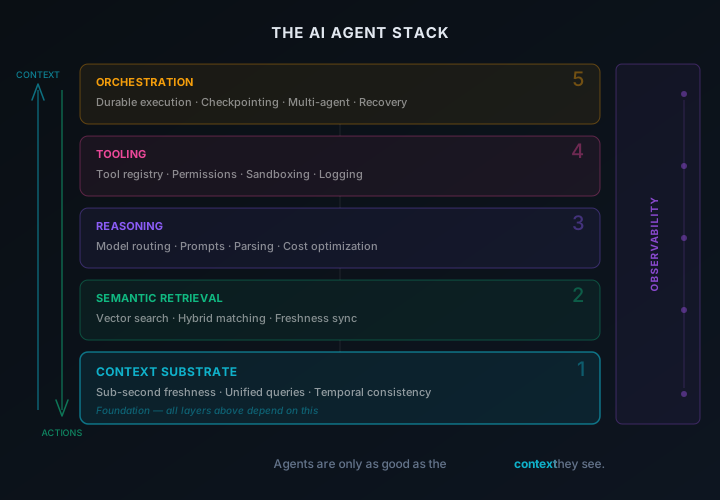
The layers are: Context Substrate, Semantic Retrieval, Reasoning, Tooling, Orchestration (including agent frameworks that orchestrate agent operation and management), and Observability. Let’s walk through each.
The six foundational layers of a 2026-ready AI agent stack. Context is the foundation everything depends on.
Every agent decision depends on context: what does the agent know about the current situation? The context substrate is the foundational layer that provides this knowledge.
This includes structured data (databases, feature stores), unstructured data (documents, logs), and real-time signals (events, streams). The substrate must unify these sources under consistent access patterns. Data sources—such as external repositories, vector databases, and traditional databases—feed into the substrate to enhance agent capabilities and persistent memory. Storage solutions are critical for maintaining conversation history, memories, and integrating external data sources, ensuring agents have access to relevant and up-to-date information.
Without these guarantees, agents operate on fragmented or stale views of reality. Example tools: Redis, Dragonfly, SurrealDB, TiDB, CockroachDB, Tacnode Context Lake, vector databases (for storing and retrieving high-dimensional data).
Agents need to find relevant information, not just query known keys. Semantic retrieval provides this capability through embeddings, vector search, and hybrid keyword/semantic matching.
This layer bridges the gap between ’what the agent is asked’ and ’what the agent needs to know.’ It surfaces relevant context even when the connection isn’t explicit.
Example tools: Pinecone, Weaviate, Qdrant, Milvus, pgvector, Elasticsearch.
The reasoning layer is where language models operate. Given context and a task, the model generates a plan, interprets results, and decides next steps. At the core of this layer are AI models and foundation models—expansive, pre-trained models that enable language understanding, planning, and multimodal processing.
This is the most visible layer—where GPT-4, Claude, or open-source models do their work. But it’s also the layer most dependent on the quality of inputs from below.
Example tools: OpenAI, Anthropic, Google, Mistral, DeepSeek, Ollama, vLLM.
Agents act in the world through tools: APIs, databases, file systems, external services. The tooling layer defines what actions are available and how they’re executed. External tools and AI tools significantly expand agent capabilities by enabling integration with third-party services, no-code/low-code platforms, and supplementary functionalities, allowing agents to reason, plan, and solve problems more autonomously.
Well-designed tool interfaces are critical. They must be discoverable (the model knows what’s available), safe (actions are bounded and reversible where possible), and observable (every action is logged).
Example tools: LangChain Tools, OpenAI Functions, Anthropic Tool Use, custom APIs.
Orchestration manages the agent loop: observe → reason → act → repeat. It handles state persistence, retries, timeouts, and multi-agent coordination. Agent workflows are essential for managing the development, deployment, and observability of AI agents, ensuring that complex and collaborative tasks are executed efficiently. In multi-agent systems, message queues facilitate communication between agents, enabling coordinated workflows and information exchange across both centralized and distributed environments.
This layer is often underestimated. Simple loops work for demos, but production agents need robust state management, graceful degradation, and coordination primitives.
Example tools: LangGraph, CrewAI, AutoGen, Temporal, Inngest, custom orchestrators.
You can’t improve what you can’t measure. Observability spans the entire stack: context freshness, retrieval quality, model latency, tool success rates, orchestration health.
Agent debugging is notoriously difficult. Observability must surface not just what happened, but why decisions were made. Trace-level visibility is essential. Enhanced observability directly improves developer experience by making it easier to diagnose and resolve issues in agent stacks, which in turn leads to more reliable and transparent agent behavior—ultimately resulting in better user experiences through more consistent and trustworthy interactions.
Example tools: LangSmith, Arize, Weights & Biases, Datadog, custom dashboards.
The six layers form a feedback loop. Context flows up through retrieval to reasoning. Decisions flow down through tooling to execution. Orchestration manages the cycle. Observability watches everything. The interaction between these layers is essential for collaborative functions and seamless coordination within the agent stack, enabling efficient data sharing and integrated AI system performance.
Weakness in any layer degrades the whole. Fast retrieval can’t compensate for stale context. Powerful models can’t overcome poor tool design. Elegant orchestration can’t hide missing observability.
The most common failure mode is over-investing in reasoning (models) while under-investing in context and orchestration. Agents are only as good as the data they see and the infrastructure that runs them.
One theme that came up repeatedly at re:Invent: teams are wary of betting everything on a single vendor. Models change. Providers have outages. Pricing shifts.
The emerging pattern is open interfaces with swappable implementations. Agent2Agent (A2A) protocols. Model Context Protocol (MCP). Standard tool schemas. MCP integration is crucial for seamless tool invocation and system interoperability, as it provides a vendor-neutral standard for registering and invoking enterprise APIs across diverse agent frameworks.
Building on open standards—or at least clean abstractions—preserves optionality. The stack should allow swapping models, vector stores, or orchestrators without rewriting the agent. In open agentic architectures, control is maintained through identity enforcement, role-based access, and security postures like zero-trust models, ensuring secure and auditable agent interactions.
Production systems rarely have just one agent. Specialized agents handle different domains: customer support, data analysis, workflow automation. When building agents, technical aspects such as setting up agent state, managing memory, and enabling multi-agent communication are essential for effective deployment and operation.
Integration requires shared context (agents need to see each other’s state), consistent tooling (same actions available across agents), and coordination primitives (handoffs, escalation, parallel execution).
The context substrate becomes the shared memory. Orchestration becomes the traffic controller. Observability ties everything together.
Agents create new infrastructure demands:
Teams building at scale are increasingly looking at containerized deployments, serverless functions, and Kubernetes-based orchestration. The Linux Foundation’s open-source tooling (CNCF projects) provides a solid foundation and is a key supporter of open-source projects in this space. Choosing the right tech stack—including orchestration frameworks, observability tools, and databases—is critical for scalable and efficient AI agent deployment.
As AI agents become more deeply integrated into enterprise operations, ensuring data privacy and security is non-negotiable. These agents often access sensitive data, interact with multiple systems, and communicate across networks—making them potential targets for unauthorized access and cyber threats. To safeguard both users and organizations, AI agents must be developed with security at their core.
Key security measures include end-to-end encryption, strict access controls, and secure communication protocols to protect data in transit and at rest. Developers should implement robust authentication and authorization mechanisms, ensuring that only approved agents and users can access critical data and services. Regular security audits and vulnerability assessments are essential to identify and mitigate risks before they can be exploited.
Compliance with data privacy regulations such as GDPR and CCPA is also critical. AI agents must be designed to handle personal and sensitive data responsibly, with clear policies for data retention, user consent, and transparency. By prioritizing data privacy and security throughout the development process, organizations can build trust with users and ensure that their AI deployments remain resilient against evolving threats.
Even with the right stack, challenges remain:
These aren’t solved problems. They’re active areas of development across the industry, with the community playing a key role in developing solutions and best practices through collaboration and open-source initiatives.
The landscape of AI agents is evolving rapidly, driven by advances in technology and changing enterprise needs. One of the most significant trends is the rise of multi-agent systems, where multiple agents collaborate, communicate, and coordinate to solve complex tasks that would be impossible for a single agent to handle alone. This approach unlocks new possibilities for scalability, resilience, and intelligent decision making.
Cloud infrastructure and containerization are also transforming how AI agents are deployed, enabling effortless deployment, elastic scaling, and seamless integration with existing enterprise technology. As organizations move towards cloud-native architectures, deploying agents across distributed environments becomes more efficient and cost-effective.
Interoperability is another key focus, with industry standards like the Model Context Protocol (MCP) emerging to facilitate consistent communication and data exchange between agents, tools, and services. This push for open infrastructure and standardized protocols helps prevent vendor lock-in and ensures that agentic AI systems can evolve alongside new technologies.
Looking ahead, the development of explainable and transparent AI agents is becoming increasingly important. Enterprises and regulators alike demand greater accountability and insight into how agents make decisions. As a result, future AI agents will not only be more capable and adaptive, but also more transparent, secure, and aligned with organizational goals. The next wave of agentic AI will be defined by intelligent systems that are easy to deploy, manage, and trust—setting a new industry standard for enterprise AI.
No single vendor provides all six layers. Production agent stacks are assembled from components, each chosen for its strengths. The art is in integration: ensuring layers communicate cleanly and guarantees propagate.
Build the foundation first. Fast, fresh, consistent context. Reliable orchestration. Comprehensive observability. Then add model sophistication on top.
The teams I talked to at re:Invent who are succeeding with agents aren’t the ones with the most advanced models. They’re the ones who treat context as a first-class design concern. The protocol layer that connects agents to that context has its own limits — see MCP server: what it is, how it works, and what it can’t do.

Former Cockroach Labs. Tells stories about infrastructure that actually make sense.
Fresh Context Newsletter
The argument behind the posts — what breaks when AI acts on stale data, from the team building the Context Lake. About twice a month.
Book a demo and discover how Tacnode can power your AI-native applications.
Book a Demo