Agent Coordination: How Multi-Agent AI Systems Work Together
Agent coordination is what determines whether multiple AI agents produce coherent results or expensive chaos. Here's how coordination strategies, communication protocols, and fault tolerance actually work — and what breaks in production.
Agent coordination is what separates a capable AI assistant from a capable AI system. A single agent handling a complex research task — reading sources, synthesizing findings, generating a report, validating citations — runs into hard limits: context window pressure, sequential bottlenecks, the impossibility of being genuinely specialized in everything at once.
Effective agent coordination solves this by distributing work across multiple autonomous agents, each specialized, each handling a slice of the problem, all working toward a coherent final answer. But coordination is not free. It introduces its own failure modes: race conditions on shared resources, communication overhead, cascading agent failures, emergent behaviors no single agent would produce alone.
This guide covers the mechanics of agent coordination — what it is, why it matters, the coordination strategies that work in production, how agents communicate, and how fault tolerance is designed in from the start rather than bolted on after the first system failure.
What Is Agent Coordination?
Agent coordination refers to the mechanisms and protocols that allow multiple autonomous agents to work together toward collective goals. At minimum, it applies to any system where two or more agents interact — sharing data, dividing tasks, exchanging information, or competing for shared resources.
In the context of LLM agents and AI systems, agent coordination means something more specific: how multiple LLM-based software programs, each making decisions through tool calls and model inference, cooperate on tasks that exceed what a single agent can handle. This is a fundamental shift from the single-agent paradigm that dominated early AI assistants — from one context window doing everything to many specialized contexts collaborating under defined coordination rules.
The key distinction: a single agent processes tasks sequentially, accumulating context in one thread until it hits a limit or runs out of runway. With agent coordination, that context and those tasks are distributed across specialized agents, each with narrower but deeper scope. Individual agents don't need to know everything — they need to know their slice, and the coordination layer handles the rest.
Agent coordination has roots in academic research on distributed AI going back decades. What's new is the substrate: LLM agents with general reasoning capabilities, arbitrary tool calls, and the ability to communicate in natural language make coordination practical to build without custom software for every domain.
Multi-Agent Systems: Why Single-Agent Systems Fall Short
A single agent handling complex tasks faces three structural constraints that coordination solves.
Context limits. Even as context windows expand to 100K+ tokens, truly complex tasks accumulate more than fits. A research task spanning dozens of sources, a software engineering task spanning hundreds of files, a financial analysis task requiring raw data and derived results — all exceed what one context window holds coherently. Stuffing more in degrades performance; the model attends less effectively to distant content.
Sequential execution. A single agent works one step at a time. When subtasks are independent — retrieve source A, retrieve source B, retrieve source C — there's no reason to work sequentially, but a single agent cannot parallelize its own work. Agent coordination enables parallelism by definition: send three specialized agents after three sources simultaneously, then aggregate results.
Specialization depth. A single agent asked to be simultaneously a code expert, data analyst, writer, and domain specialist produces mediocre results across all dimensions. Specialized agents — each with a focused system prompt, specific tool access, and a narrowly scoped task — produce consistently better outputs. The coordination challenge is routing tasks to the right specialist and assembling the pieces.
In well-coordinated multi-agent systems, individual agents each handle what they're built for. The system performance of the whole exceeds what any single agent could produce.
How Agent Coordination Works
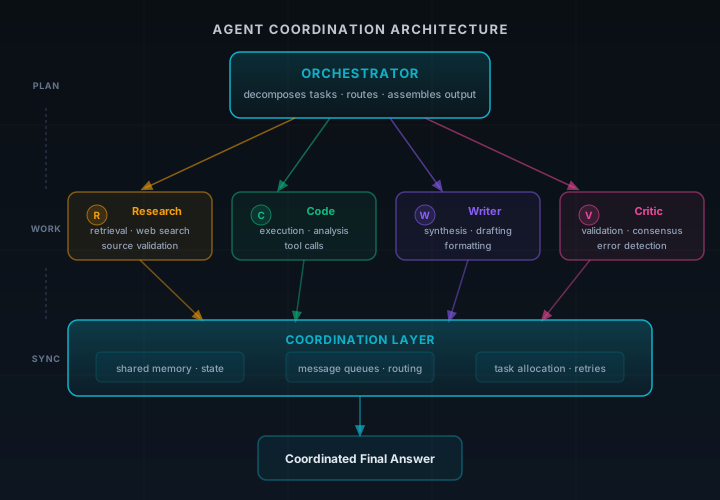
The basic architecture of a coordinated multi-agent system has three layers: the orchestration layer, the agent layer, and the coordination layer connecting them.
The orchestration layer receives a high-level task and decomposes it into subtasks. The orchestrator — itself often an LLM agent — decides what needs to be done, which specialized agents should handle it, in what order or in parallel, and how their outputs will be assembled into a final answer. The orchestrator doesn't execute tasks; it plans and routes.
The agent layer contains the specialized agents. Each is a software program that receives a narrowly scoped task, executes it using available tools — retrieval, code execution, API calls, web search — and returns its output to the orchestrator. Agents may spawn sub-agents for further decomposition, creating hierarchies of orchestrators and executors.
The coordination layer is the shared infrastructure that makes agents work together: shared memory for passing context between agents, message queues for task distribution, and state management for tracking where each agent is in its work. In simple systems, the coordination layer is implicit — the orchestrator holds everything in memory. In production AI systems, it's explicit infrastructure.
Agent coordination works by maintaining a coherent picture of collective state while allowing individual agents to operate independently. The challenge is doing this without coordination overhead swamping the benefits of parallelism.
Coordination Strategies
No single coordination strategy fits all multi-agent systems. The right approach depends on task structure, failure modes, latency requirements, and how much global information agents need to make good local decisions.
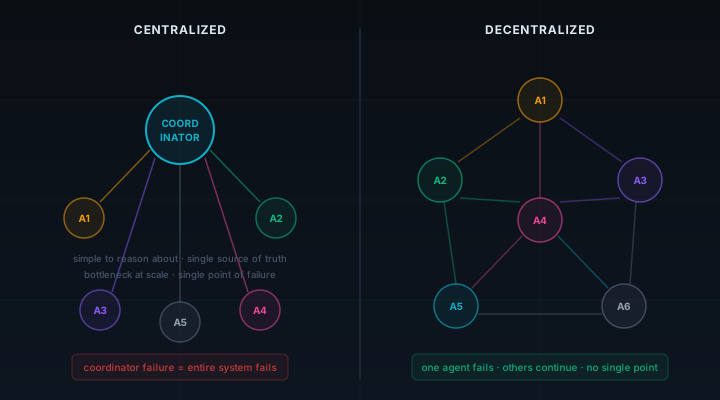
Centralized coordination puts one agent or a fixed orchestrator in control of task allocation and state management. The central coordinator assigns tasks to agents, tracks agent outputs, handles agent failures, and assembles the final result. Centralized coordination is simple to reason about: there's one source of truth, one decision-maker, one point of control.
The limitation is single points of failure. If the central coordinator fails, the entire system fails. Centralized coordination also creates bottlenecks: every task assignment and status check passes through one node, which limits throughput at scale. For systems where coordinator overhead is small relative to agent work, this is acceptable. For systems with many fast-executing agents, it's a scaling constraint.
Market-based coordination: agents bid. A more scalable approach lets agents bid for tasks based on their current state and capabilities. When a new task enters the system, available agents submit bids — offers to complete the task, optionally including estimated cost or confidence. A task allocation mechanism selects a winning bid and assigns the task. Market-based coordination distributes allocation decisions across the agent population rather than concentrating them in one node. It adapts naturally to agent load: busy agents bid conservatively or abstain; idle agents bid aggressively.
Voting systems apply when agents need to reach consensus, particularly on decisions where individual agents might disagree. Multiple agents independently evaluate the same question and vote on an answer. The final answer is determined by majority, supermajority, or weighted vote based on agent confidence. Voting systems reduce hallucination risk: three agents independently producing the same answer via different reasoning paths is more likely to be correct than any single agent's output alone. When agents disagree, the disagreement signals uncertainty and may trigger escalation to human oversight.
Hierarchical coordination organizes agents into layers. Top-level orchestrators manage mid-level agents that manage specialized workers. Each layer handles a different granularity of decision-making. Hierarchical coordination scales naturally to complex problems with a natural decomposition structure — a research task with sub-topics, each sub-topic with specific retrieval and synthesis steps, each step with its own executing agents.
For 8 concrete implementation patterns — from single-writer ownership to checkpoint management — see Multi-Agent Architecture.
Communication Protocols
Agents can't coordinate without communicating. How they communicate shapes what coordination strategies are possible and how the system behaves under load.
Shared memory is the simplest mechanism: agents read from and write to a common state store. An orchestrator writes a task description; the assigned agent reads it, executes the task, writes results back; the orchestrator reads results and proceeds. Shared memory is low-latency and supports complex structured state — agents can exchange partial results and workflow state without serializing everything to messages.
The risk is race conditions. When multiple agents write to the same shared state, writes must be coordinated to prevent conflicts. Without explicit concurrency control, agents can overwrite each other's results, read stale values, or corrupt the shared state the entire system depends on. Shared memory coordination requires careful schema design and transactional writes for correctness under concurrent access. Read conflicts are the quieter half of the same problem: agents that never touch the same row can still act on incoherent context, which is why AI agents act on the wrong context even when writes are perfectly coordinated.
Message passing decouples agents: each processes messages from a queue, does its work, and publishes results to another queue. Agents don't share memory directly — they exchange information through defined message formats. Message passing is more fault-tolerant than shared memory: if one agent fails, its messages stay in the queue until another picks them up. The coordination layer becomes the message broker rather than a shared database. Message passing introduces serialization overhead and latency compared to shared memory, but makes agent interactions explicit and auditable.
Direct agent-to-agent communication allows agents to call other agents directly — one agent's output becomes another's input, passed through a direct tool call rather than through a shared store or queue. This is the model in many LLM agent frameworks: an orchestrator agent invokes a specialized agent as a tool call, receives the result, and continues. Direct communication is natural for tight collaboration between orchestrator and specialist, but harder to scale to many-agent systems with a non-fixed communication topology.
In practice, production multi-agent systems combine all three: shared memory for fast structured state exchange, message queues for task distribution and fault tolerance, direct calls for tightly coupled orchestrator-agent relationships.
Fault Tolerance
Multi-agent coordination introduces failure modes that single-agent systems don't have. Agents fail — they time out, produce errors, hit context limits, or generate outputs that downstream agents can't process. In a coordinated multi-agent system, individual agent failures must not bring down the entire system.
Designing for agent failures. The starting assumption in a robust multi-agent system is that agents will fail. Fault tolerance means remaining agents can continue operating, failed tasks are retried or reassigned, and agent failures are detected quickly rather than silently corrupting downstream work.
Detection is the first requirement: the coordination layer must know when an agent has failed, not just when it has completed. Timeout detection — agents that don't respond within expected latency — and heartbeat mechanisms — periodic liveness signals — are standard. Without detection, a failed agent becomes a silent black hole: tasks assigned to it disappear and the system waits indefinitely.
Retry and reassignment. When an agent fails, its task should be retried — by the same agent if the failure was transient, or reassigned to another agent. For this to work, tasks must be idempotent: retrying a task should produce the same result as running it once, without side effects from the partial first attempt. Non-idempotent tasks require explicit state management to detect and skip already-completed work.
Avoiding single points of failure. Centralized coordination creates obvious single points of failure. If the central coordinator goes down, all agents become uncoordinated — holding in-flight tasks, waiting for assignments that never come, or executing against stale instructions. Distributed coordination strategies reduce this risk by replicating coordination state and allowing any node to take over coordination for failed nodes.
Cascading failures. In tightly coupled multi-agent systems, one agent's failure can cascade: agent A produces bad output that corrupts agent B's state, which causes agent C to fail, which halts the orchestrator. Isolation between agents — through well-defined interfaces, output validation, and error budgets — limits blast radius. Agents should fail clearly and loudly, not silently propagate corrupted state to remaining agents.
Production-grade fault tolerance requires: task queues with at-least-once delivery guarantees, idempotent task execution, explicit timeout and retry logic, health checks with automatic reassignment, and circuit breakers that prevent one failing agent from exhausting system resources.
Decentralized Approaches
Centralized coordination is intuitive but doesn't always scale. Decentralized approaches distribute coordination logic across agents, allowing multi-agent systems to operate without a central authority consulted for every decision.
Local information and local decisions. In a decentralized multi-agent system, each agent makes decisions based on local information — what it knows about its own state and what it can observe from its immediate neighborhood — rather than waiting for a central coordinator. Agents exchange information with neighbors, update local state, and act. Collective behavior emerges from individual decisions made on local information.
This is the model in distributed systems like peer-to-peer networks, and it's what produces emergent behaviors in biological systems: ant colonies, flocking birds, slime molds. Individual agents following simple rules, with access only to local information, produce collective behavior that appears globally coordinated — because it is, just not through explicit top-down control.
Emergent behaviors in multi-agent AI systems. LLM-based multi-agent systems exhibit analogous patterns. When agents are given simple rules — route tasks to the least loaded agent, escalate when confidence falls below a threshold, merge outputs that agree and flag outputs that conflict — the system develops coordination patterns that weren't explicitly programmed. These patterns can be productive (efficient routing, surfaced disagreements) or problematic (coordination loops, deadlocks under load). Decentralized coordination requires careful design of the simple rules agents follow and the local information they can access.
Practical decentralized coordination patterns:
Gossip protocols: Agents share state updates with randomly selected neighbors. State propagates through the system without central coordination — useful for eventual consistency in distributed agent state.
Stigmergy: Agents communicate indirectly by modifying shared state. One agent leaves a result; another reads it and builds on it, without direct agent-to-agent communication. Analogous to how ant colonies coordinate through pheromone trails.
Auction mechanisms: Agents bid for tasks without a central task allocator, using a market mechanism that distributes allocation decisions across the agent population.
Decentralized approaches trade predictability for scalability and fault tolerance. The entire system doesn't fail when one node goes down. But emergent behavior means edge cases are hard to anticipate — which is why thorough testing of agent interactions matters as much as testing individual agents.
Decision Making Across Agents
How do multiple agents reach decisions together? Three patterns dominate production AI systems.
Aggregation. Each agent produces an output; the orchestrator aggregates them into a final answer. Simple aggregation — take the best answer, concatenate results — works when agent outputs are complementary and non-overlapping. Weighted aggregation handles cases where agents have different accuracy characteristics, weighting each agent's output by confidence score or specialization relevance.
Consensus. Multiple agents independently evaluate the same question and must agree on an answer. Consensus mechanisms range from simple majority vote to Byzantine fault-tolerant protocols that work even when some agents produce wrong outputs. For LLM agents, consensus is valuable for reducing hallucination risk: three agents independently producing the same answer via different reasoning paths is more likely to be correct than any single agent's output. When agents disagree, the disagreement signals uncertainty and may trigger escalation to human oversight.
Deliberation. Agents exchange reasoning, not just outputs. One agent produces an answer and shares its reasoning; other agents evaluate that reasoning, critique it, propose alternatives. Deliberation allows agents to build on each other's thinking and catch errors that any single agent would miss. The cost is latency and compute — deliberation rounds take time, and with many agents, deliberation can become the coordination bottleneck.
Effective agent coordination requires choosing the right decision mechanism for each task type. High-stakes decisions with clear right answers benefit from consensus. Creative or generative tasks benefit from aggregation of complementary perspectives. Complex multi-step reasoning benefits from deliberation. In practice, multi-agent systems often use different decision mechanisms at different levels of the coordination hierarchy.
Agent Coordination in Production
Multi-agent systems in academic research and multi-agent systems in production are different problems. Research demos run to completion or fail cleanly; production AI systems must run continuously, degrade gracefully, and recover automatically.
Observability is non-negotiable. Every agent interaction, tool call, state transition, and coordination decision should be logged. Without observability, debugging a multi-agent system that produces wrong outputs is nearly impossible — the error could be in any agent, in the coordination logic, in the communication layer, or in state management. Tracing individual agent executions through a complex workflow requires structured logging with correlation IDs that span agent boundaries.
Latency compounds. Each agent in a coordinated pipeline adds latency. Sequential pipelines with five agents, each taking two seconds, take ten seconds end-to-end. Parallelizing independent agent steps is the primary lever for reducing this. Caching agent outputs for repeated sub-tasks is another. Latency budgets must be established and tested — individual agent latencies compound in ways that aren't obvious from looking at each agent in isolation.
Graceful degradation over silent failure. When agents fail or return low-confidence results, the system should degrade gracefully rather than produce confident-looking garbage. A multi-agent research system where one source agent fails should return a result based on remaining agents' outputs, flagged as incomplete — not fail silently or return a misleading complete-looking answer.
Human oversight at defined checkpoints. Production multi-agent systems handling consequential tasks — financial analysis, code generation, medical triage — need explicit human oversight checkpoints. When agent confidence is low, when agents disagree, or when edge cases arise that agents weren't designed to handle, the system should escalate to human review rather than proceeding autonomously. Tight collaboration between agents and human reviewers at defined points is more reliable than full autonomy for high-stakes decisions.
The Infrastructure Underneath Agent Coordination
The engineering challenge underneath all of this is shared state management. Agent coordination ultimately depends on agents being able to read and write shared state reliably, at low latency, with strong consistency guarantees for critical operations and eventual consistency where appropriate.
Traditional approaches assemble this from multiple stores: Redis for fast shared memory, a message queue for task distribution, Postgres for durable state, a vector database for semantic retrieval. Each store adds operational overhead, latency from network hops between systems, and consistency challenges at the boundaries between stores.
Tacnode Context Lake provides a unified substrate for multi-agent coordination: transactional reads and writes, analytical queries for aggregating agent outputs, vector search for semantic retrieval, and stream processing for real-time coordination events — all in one system with consistent semantics across workloads. For multi-agent systems where coordination overhead is the primary bottleneck, consolidating the coordination substrate reduces both latency and operational complexity.