
Back to Blog
Architecture & Scaling
Context Lake vs. Data Lake: Key Differences Explained
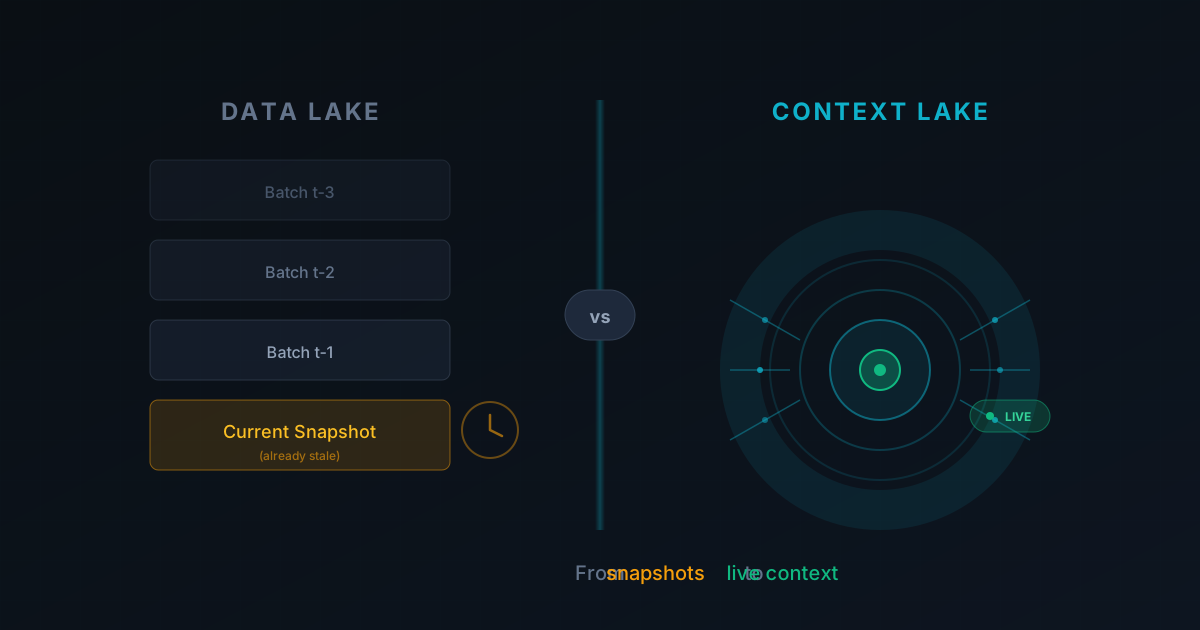
Why the shift from analysis to action demands a new architecture.
Why the shift from analysis to action demands a new architecture.
TL;DR: Data lakes store raw data for batch analytics by humans. Context Lakes serve live, consistent context for AI systems making automated decisions in real time. The key difference isn't storage or query language — it's timing: data lakes operate on stale snapshots, while Context Lakes evaluate context at the moment a decision is made, ensuring every system sees the same reality.
For the last decade, data lakes have been the default answer to a single, important question: how do we store and analyze everything? This era was defined by 'big data', where the scale and complexity of information management led to the rise of large-scale data storage solutions like data lakes.
But modern AI systems are asking a different question entirely: how do we decide correctly, right now?
That shift sounds subtle, but it breaks many of the assumptions data lakes were built on. And it's why a new architectural concept has started to emerge: the Context Lake. A context lake represents a novel data architecture that acts as an intelligent memory layer, integrating real-time data sources to support modern AI applications and enable instant querying of contextual information.
This article explains the difference between a Context Lake and a data lake, not as a feature checklist, but as a change in how modern systems reason about data, time, and decisions—a completely new and superior foundation for modern AI systems.
Data lakes solved a real problem. Organizations had data scattered across operational databases, logs, SaaS tools, and event streams, with no affordable way to bring it together. Organizations also needed to manage and govern their internal data effectively to support business operations. Data lakes made it possible to centralize raw data cheaply, defer schema decisions, and run large-scale analytics.
Crucially, they were designed for humans.
Humans run queries. Humans interpret results. Humans notice inconsistencies. Humans reconcile differences before acting. In that world, it's acceptable for data to be delayed, approximate, or slightly inconsistent across systems. Data lakes enabled organizations to analyze customer data for insights, even if those insights were delayed or only approximate.
That assumption quietly breaks the moment decisions are automated.
AI systems don't wait for reconciliation. They don't pause to ask which dashboard is correct. They act immediately, continuously, and independently.
When multiple AI systems evaluate the same situation using slightly different snapshots of reality, the result isn't just noise. It's contradictory behavior. One system flags fraud while another approves the transaction. One agent reroutes traffic while another optimizes against an outdated state.
These failures aren't caused by bad models. They're caused by stale, fragmented, or inconsistent context. What's missing is a shared memory layer—an intelligent, always-up-to-date memory that consolidates real-time data from across the organization, ensuring AI systems operate with coherent, persistent, and trustworthy information.
This is where the data lake model runs out of road.
A Context Lake is not a rebranded data lake, and it's not just a faster analytics system.
A Context Lake is a shared, live, semantic system of record—a new system class—designed for real-time AI decision-making, which AI systems query directly at decision time.
Instead of storing data primarily for later analysis, a Context Lake exists to answer a much harder question: what is true right now, in the context of this decision? It transforms raw data into a reliable, up-to-date knowledge base that AI can access to provide accurate, grounded responses.
That distinction changes how freshness is handled, how queries are evaluated, and how consistency across systems is enforced. Access to fresh data is critical for accurate, real-time decisions, ensuring that AI and analytics always operate on the most current information available.
The Context Lake architecture represents a fundamental shift in how enterprises manage and operationalize data for AI decision making. Unlike traditional data systems, a Context Lake is purpose-built to enable AI agents and real time AI applications to access the freshest, most relevant context at the exact moment a decision is needed.
At the heart of this architecture is the Data Ingestion Layer, which continuously collects and processes data from a wide range of sources—structured databases, semi-structured logs, event streams, and more. This layer is engineered for real time, ensuring that every piece of data, from user actions to system events, is available as fresh context for downstream AI systems.
Once ingested, data flows into the Transformation Engine. Here, machine learning models and feature engineering pipelines transform raw data into AI-ready, decision-ready context. This step is crucial: it's where context is derived, signals are extracted, and the data is shaped to inform AI agents in real time. Whether it's for fraud detection, dynamic pricing, or autonomous agents, this engine ensures that the current context is always available and relevant.
The Query Layer provides a unified, SQL-compatible interface for accessing this transformed context. AI agents and systems can issue real time queries, retrieving exactly the information they need to act with confidence. This layer is designed for flexibility and speed, supporting both ad hoc exploration and high-frequency, automated decision making.
To meet the demands of real time AI, the Retrieval Engine is optimized for ultra-low latency. AI agents can access the context they need within milliseconds, a critical requirement for applications where every moment counts—such as fraud detection or real time personalization.
Finally, Semantic Operators are built into the architecture, allowing AI agents to reason over both structured and unstructured data. These operators enable the system to understand relationships, context, and meaning across diverse data types, breaking down silos and ensuring that every decision is informed by a coherent, unified view of reality.
By bringing together these components, the Context Lake enables organizations to leverage AI at enterprise scale, providing a single system for real time context, elastic scaling, and consistent, decision-ready data for all AI-driven workloads.
| Layer | Function | Key Capability |
|---|---|---|
| Data Ingestion | Collects and processes data from diverse sources in real time | Structured, semi-structured, and streaming data |
| Transformation Engine | Transforms raw data into AI-ready context via ML and feature engineering | Real-time feature derivation and signal extraction |
| Query Layer | Provides unified SQL-compatible interface for context access | Ad hoc and high-frequency automated queries |
| Retrieval Engine | Serves context with ultra-low latency | Purpose-built for real-time retrieval |
| Semantic Operators | Enables reasoning over structured and unstructured data | Cross-data-type relationship understanding |
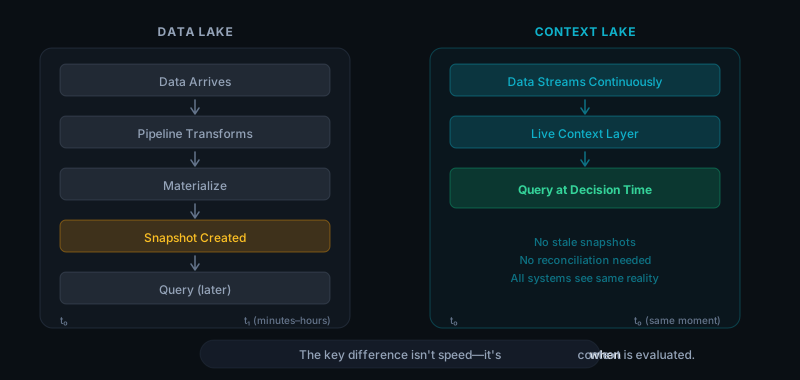
The most important difference between a data lake and a Context Lake isn't storage format or query language. It's timing.
Data lakes are built around a simple flow: data arrives first, queries happen later. Pipelines ingest data, transform it, materialize it, and make it available for downstream consumption. Every consumer operates on a snapshot, whether they realize it or not.
Context Lakes invert that model. Context is evaluated at the moment a decision is made. In this process, derived context—such as new features, aggregations, or insights—is generated in real time from raw data as it is continuously processed and transformed, supporting immediate and accurate decision-making.
Freshness, in this model, isn't about how fast data lands. It's about whether all systems see the same reality when it matters.
In data lake–centric architectures, inconsistency is tolerated. Dashboards disagree. Metrics drift. Teams debate which number is correct. Eventually, someone reconciles the difference.
For AI systems, that tolerance doesn't exist.
A Context Lake enforces a shared view of reality across all consumers. When multiple systems evaluate the same situation, they reach consistent conclusions because they are querying the same live context. This property, often described as decision coherence, cannot be bolted on after the fact. Context lakes are especially critical for multi agent systems, enabling multiple AI agents to coordinate and make consistent decisions by sharing a live, semantic context layer.
It has to be designed into the architecture itself.
Another quiet limitation of data lakes is that they store data, not meaning.
The semantics — what a field represents, how entities relate, which signals matter for which decisions — are reconstructed repeatedly across pipelines, feature stores, and application logic. Over time, those interpretations drift.
A Context Lake treats semantics as first-class. Advanced technology enables semantic reasoning and understanding, so AI systems don't just retrieve rows, vectors, or features; they query interpreted context that already reflects how the system understands the world.
That difference is what allows AI systems to reason, not just retrieve.
Many teams try to compensate for data lake limitations by adding more components: feature stores for models, vector databases for embeddings, streaming systems for freshness, caches for latency.
Each tool solves a local problem, but the system as a whole becomes harder to reason about. Context fragments. Freshness varies by path. No single source can reliably answer what's true right now.
A Context Lake doesn't eliminate every tool, but it removes the need to reconcile them at decision time. The Tacnode Context Lake, for example, provides unified, real-time context for AI systems, enabling seamless integration and consistent data access. This kind of architecture is especially important for supporting generative AI applications that require up-to-date, organized knowledge to operate effectively.
The following table summarizes the fundamental differences between traditional data lakes and Context Lakes across the dimensions that matter most for AI-driven systems.
| Dimension | Data Lake | Context Lake |
|---|---|---|
| Primary purpose | Store and analyze historical data | Provide live context for real-time decisions |
| Designed for | Human analysts running queries | AI systems making automated decisions |
| Timing model | Data arrives first, queries later | Context evaluated at decision time |
| Freshness | Batch or near-real-time updates | Continuous, sub-second freshness |
| Consistency | Eventual; reconciliation expected | Strong; single source of truth |
| Semantics | Reconstructed per pipeline | First-class, shared across consumers |
| Latency tolerance | Seconds to minutes acceptable | Ultra-low latency required |
Implementing a Context Lake at enterprise scale brings powerful capabilities, but it also introduces important trade-offs and considerations that organizations must address to achieve optimal performance and value.
Scalability vs. Complexity is a central concern. While the Context Lake is designed to scale elastically to handle massive volumes of data and support high-concurrency AI systems, this scalability can add architectural complexity. Teams must carefully design the system to ensure it remains manageable, maintainable, and performant as it grows.
Freshness of Data vs. Latency is another key trade-off. Real time AI decision making depends on having the freshest possible data, but constantly updating and synchronizing context can introduce latency. Striking the right balance—so that AI agents always operate on current context without sacrificing inference speed—is essential for applications like fraud detection and autonomous agents.
Security and Governance are paramount, given that the Context Lake often serves as the canonical document of truth for enterprise AI. Robust access controls, encryption, and compliance measures must be in place to protect sensitive data and maintain trust in the system.
Integration with Existing Infrastructure is also critical. The Context Lake must work seamlessly alongside existing data lakes, databases, and AI services. This requires careful planning to avoid incompatible representations and to ensure decision coherence across all systems, so that AI agents and analytical workloads are always working from a consistent, unified context.
Cost and Resource Utilization must be considered, especially as organizations leverage cloud infrastructure for elastic scaling. The resources required to maintain real time context, support high-performance queries, and serve AI inference at scale can be significant. Optimizing for cost-effectiveness while maintaining performance is a continuous process.
AI Model Complexity can impact system performance. As AI models become more sophisticated, they may require more computational resources and introduce additional latency. Techniques like model pruning or simplifying feature stores can help keep the system efficient and responsive.
Finally, Continuous Monitoring and Maintenance are essential. The Context Lake is not a set-and-forget system; it requires ongoing attention to data quality, model updates, and system health. Regular audits and proactive management ensure that the system continues to deliver reliable, real time context for AI decision making.
By understanding and addressing these trade-offs, organizations can fully realize the benefits of a Context Lake—enabling real time AI, maintaining decision coherence, and powering the next generation of enterprise intelligence.
You don't need a Context Lake just because you use AI. You need one when decisions are automated rather than reviewed, continuous rather than periodic, and distributed across multiple systems or agents.
Fraud detection, pricing, recommendations, risk scoring, and autonomous agents all fall into this category. In these systems, incorrect decisions compound quickly, and stale context is not a tolerable failure mode.
Context Lakes don't replace data lakes entirely. Data lakes remain valuable for historical analysis, exploration, and offline learning.
Context Lakes handle the live, shared context required for real-time decisions.
Together, they form a more complete architecture: one that supports understanding the past and acting correctly in the present.
Data lakes helped organizations understand what happened.
Context Lakes help AI systems decide what to do next.
As AI systems move from analysis to action, context stops being an implementation detail and becomes infrastructure. Owning that distinction is how teams move from observing the world to acting on it correctly, at scale.

Former Cockroach Labs. Tells stories about infrastructure that actually make sense.
Fresh Context Newsletter
The argument behind the posts — what breaks when AI acts on stale data, from the team building the Context Lake. About twice a month.
Book a demo and discover how Tacnode can power your AI-native applications.
Book a Demo