Multi-Agent Architecture: 8 Coordination Patterns That Actually Work [2026]
When AI agents conflict, you get duplicate orders, race conditions, and angry customers. Here are 8 production-tested coordination patterns — from simple locks to distributed consensus — with code examples for each.
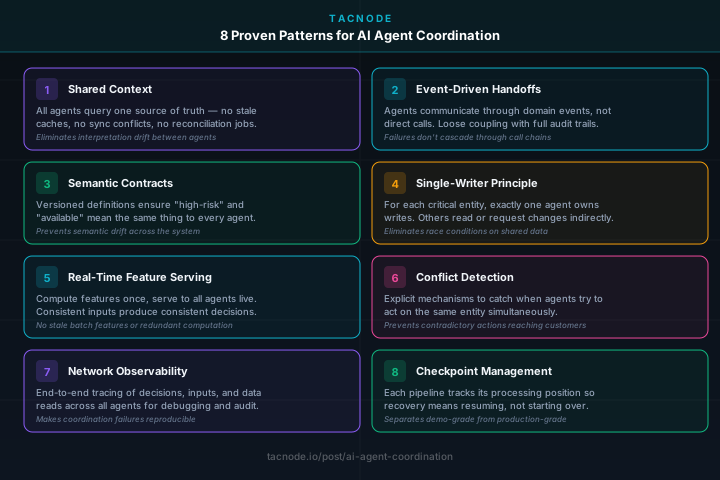
TL;DR: When multiple AI agents operate on the same data without coordination, they contradict each other — pricing voids what fulfillment promised, risk blocks what support already approved. The fix is 8 production-tested patterns: shared context (not shared state), event-driven handoffs, semantic contracts, single-writer principle, real-time feature serving, conflict detection, network observability, and checkpoint management. The foundation underneath all of them is a shared context layer that serves consistent, current state to every agent.
Modern enterprises are already running sophisticated multi agent systems, often without fully realizing it. Imagine a bustling 2026 SaaS or e-commerce tech stack: a support agent resolving customer issues, a pricing agent dynamically optimizing discounts, and a fulfillment agent managing shipments—all making decisions about the same customer within seconds. Add in fraud detection, inventory management, and personalization agents, and you have multiple autonomous agents operating simultaneously in a shared environment, yet without a central conductor.
Without proper coordination mechanisms, these AI agents can easily contradict each other in ways customers notice. Pricing might extend a 20% discount that fulfillment later voids due to out-of-stock inventory. Risk management blocks an order after it has already shipped. Support promises refunds that billing never processes. These aren't rare edge cases—they are the predictable outcomes when specialized agents operate without shared context or clear ownership rules.
This article dives into eight concrete coordination strategies that have proven effective in production systems, especially in real-time, data-intensive environments where multi agent coordination can make or break customer trust. We focus on patterns that enable agents to collaborate harmoniously rather than conflict, emphasizing the infrastructure and design principles that underpin effective coordination. If you’re building systems where multiple agents must work together on complex tasks, these patterns will help you avoid the debugging nightmares common in distributed systems. For the LLM-orchestration framing of the same coordination problem — what LangGraph, CrewAI, and the OpenAI Agents SDK do and don’t coordinate at the framework layer — see LLM orchestration: control flow vs shared state.
1. Shared Context, Not Shared State: The Foundation of Reliable Agent Coordination
In a 2025 retail system we studied, support, pricing, and inventory agents each maintained their own customer and order caches. Support queried a Redis cluster updated hourly; pricing pulled data from a Snowflake warehouse refreshed overnight; inventory checked a Postgres replica lagging by fifteen minutes. The result was predictable chaos: refunds issued for orders already reshipped, discounts applied to items marked out-of-stock elsewhere, and fulfillment promises made against phantom inventory.
What is Shared Context?
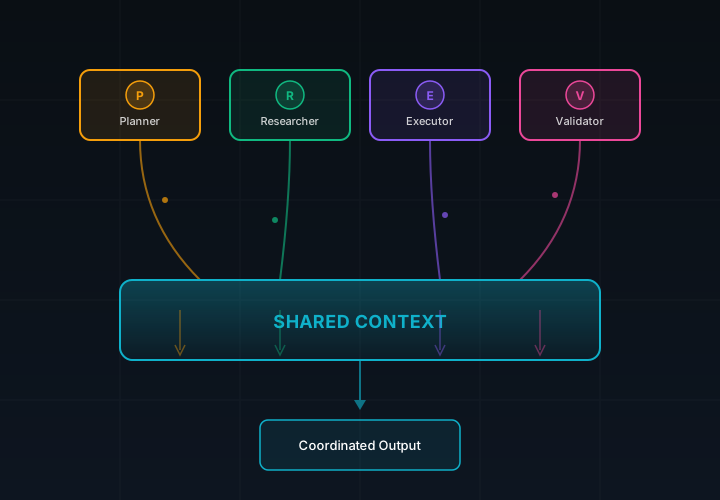
Shared context means that individual agents query a single, authoritative context layer rather than syncing full internal state among themselves. Instead of each agent maintaining its own copy of customer data, cart contents, or inventory levels, all agents read from the same source of truth. This ensures every agent sees the same multi-modal picture (events, documents, vectors, metrics) with low-latency reads whenever it needs to make a decision.
Why Shared Context Works
When agents query a shared context layer, stale caches and sync conflicts are eliminated by design. There's no need for reconciliation jobs running at midnight to merge divergent views. No race conditions where the pricing agent sees inventory at 50 units while fulfillment sees 48. The single-source approach means fresh data on demand, reducing interpretation drift that causes agents to fail in production.
How to Implement Shared Context
All agents should read from a single Postgres-compatible engine that combines operational tables, event streams, and vector search for semantic context. This unified layer lets agents query the truth whenever they need to make a decision, avoiding fragmented systems that cause inconsistency.
Shared context is especially critical in complex multi agent systems where multiple specialized agents operate concurrently and need to align their understanding of the environment. By centralizing the context, the coordination layer can facilitate smoother agent interactions, reducing conflicts and improving overall system performance. This approach contrasts with traditional centralized systems where a single controller dictates state, as shared context empowers individual agents to maintain autonomy while accessing consistent information. For a deeper dive on this architecture, see AI Agent Memory.
2. Event-Driven Handoffs Between Agents: Loose Coupling with Clear Audit Trails
Instead of agents calling each other directly, they communicate primarily through domain events. For example, a pricing agent emits a discount_approved event that fulfillment and invoicing agents subscribe to and react accordingly. This creates a coordination layer that's flexible and auditable.
Why Event-Driven Handoffs Work
Event-driven handoffs create loose coupling between agents while maintaining a clear audit trail. Events stored in a unified log become queryable history, enabling agents to both subscribe to live events and query historical context. This makes the entire system more resilient since agent failures in one area don't cascade through direct call chains.
Implementation Tips
Define a small, domain-focused event schema. Keep events immutable and queryable by time and entity ID. Start with key handoffs where one agent's decision affects another's actions.
Event-driven architectures align well with decentralized approaches to multi agent coordination, allowing agents to self organize around events and respond asynchronously. This reduces bottlenecks associated with centralized coordination and supports fault tolerance by isolating failures to specific event streams. Moreover, event-driven handoffs facilitate scalability in complex supply chains or traffic management systems, where multiple agents must react to dynamic changes in real time.
3. Semantic Contracts Between Agents: Aligning Meaning Across the System
Agents must share versioned definitions of core concepts, so terms like "available item" or "high-risk customer" mean exactly the same thing across the system. This prevents semantic drift that leads to contradictory decisions.
Why Semantic Contracts Work
Consistent definitions ensure decision making is aligned. No single agent defines terms unilaterally, optimizing system performance.
How to Implement Semantic Contracts
Store semantic contracts centrally as documented tables or feature views. Agents access these definitions via SQL or vector search. Run validation tests to confirm consistency regularly.
Semantic contracts are a key coordination strategy to maintain clarity in agent interactions. They help prevent emergent behaviors that arise when agents interpret shared data differently, which can cause unpredictable outcomes. This approach supports robust systems by ensuring that all agents, whether specialized or generalist, operate with a common understanding of terms and data structures.
4. Single-Writer Principle for Critical State: Clear Ownership to Prevent Conflicts
For any critical entity—an order, a payment, a stock item—exactly one agent should be allowed to perform writes. Other agents read or request changes indirectly. This eliminates race conditions.
Why Single-Writer Works
Race conditions between AI agents happen when multiple agents try to update the same entity simultaneously. Single-writer ownership makes write authority unambiguous and agent outputs predictable.
Implementation Tips
Enforce write permissions at the database level. Use per-schema roles and row-level security. Other agents get read-only access.
This principle is essential for task allocation in multi agent systems, ensuring that agents do not bid or compete to modify the same data concurrently. By establishing clear ownership, the system reduces conflicts and improves production reliability. It also allows remaining agents to coordinate their actions based on consistent, authoritative data.
5. Real-Time Feature Serving for All Agents: Consistent Inputs for Consistent Decisions
Compute important ML features once and serve them in real time to all agents. A feature store ensures features like customer lifetime value or risk scores are consistent across agents.
Why Real-Time Feature Serving Works
Consistent inputs produce consistent decisions, enabling effective coordination without complex negotiation.
Implementation Tips
Use streaming ingestion and expose features via SQL and vector search. Avoid batch-only pipelines that cause stale decisions.
Real-time feature serving enhances resource utilization by preventing redundant computations across agents. It supports collaborative capabilities by ensuring that all agents base their decisions on the same up-to-date information, which is crucial in AI systems managing complex problems like traffic flow optimization or financial trading.
6. Conflict Detection and Resolution: Preventing Contradictory Actions
Multiple agents may try to act on the same entity simultaneously. Implement explicit mechanisms to detect and resolve conflicts, such as priority queues, locks, or optimistic concurrency; multi-agent concurrency control compares them under agent timing.
Why Conflict Resolution Matters
Undetected conflicts lead to contradictory actions reaching customers, such as double charges or conflicting approvals.
Implementation Tips
Use transactional semantics, entity-level versioning, and record proposals and final decisions for auditing. Apply resolution rules or escalate conflicts.
Conflict resolution is a sophisticated algorithmic layer that complements coordination mechanisms by ensuring that even when agents fail or produce overlapping outputs, the system can maintain consistency. Voting systems or consensus protocols can be integrated here to harmonize decisions among agents, similar to how autonomous systems negotiate resource allocation in distributed networks.
7. Observability Across the Agent Network: Visibility for Debugging and Reliability
End-to-end tracing of decisions, inputs, tool calls, and data reads across all agents is essential for debugging multi agent systems.
Key Metrics to Track
Decision latency per agent (target: p95 under 200ms for real-time use cases). Context staleness (target: under 50ms for critical paths). Conflict rate (target: under 1%). Rollback frequency. Event processing lag.
Why Observability Matters
Without visibility, coordination failures are hard to debug and reproduce, leading to unpredictable system behavior.
Implementation Tips
Centralize logs and correlation IDs, build dashboards showing agent health, and sample transcripts for review in high-risk domains.
Observability supports fault tolerance and production reliability by enabling rapid detection of system failures and emergent behaviors. It also helps identify security concerns by monitoring agent outputs and communication protocols, ensuring that the entire network operates as intended.
8. Checkpoint Management: Reliable Recovery Without Data Loss
Agent pipelines fail. Networks drop. LLM APIs throttle. The question isn't whether your agent system will crash — it's whether it can recover without losing work or reprocessing everything from scratch. Checkpoint management solves this by tracking each pipeline's processing position independently, so recovery means resuming from the last known good state rather than starting over.
How Checkpoint Management Works
Each agent pipeline maintains an independent checkpoint — a record of the last successfully processed position. Positions can be timestamp-based (for time-series data), ID-based (for ordered records), or window-based (for aggregation pipelines). When a pipeline restarts after failure, it reads its checkpoint and resumes from exactly where it left off.
In Tacnode's two-agent demo system, three pipelines chain together: log parsing, agent-powered summarization, and anomaly detection. Each pipeline writes to append-only tables and maintains its own checkpoint in a dedicated pipeline_checkpoints table. If the summarization agent crashes mid-batch, it restarts from its last checkpoint — no data loss, no duplicate processing of upstream stages, no manual intervention.
Why Append-Only Tables Matter
Checkpoint management works best with append-only data tables. When pipelines only INSERT and never UPDATE, the data is never mutated — which means checkpoints are always valid. There are no dirty reads, no partial updates to roll back, and no conflicts between concurrent consumers. The original data stays clean for replay and debugging.
Multi-Consumer Support
Different consumer groups can maintain independent checkpoints against the same data. This enables parallel processing — multiple workers can shard the workload while each tracks its own position. It also enables data replay: reset a checkpoint to a specific point in time and the pipeline reprocesses from there, useful for fixing bad outputs or rerunning with updated agent logic.
Implementation Tips
Store checkpoints in a small, dedicated table with columns for pipeline name, consumer group, checkpoint type, and checkpoint value. Use at-least-once semantics (process first, then update checkpoint) for simplicity — this may cause occasional reprocessing but never loses data. Monitor checkpoint lag to detect stuck pipelines before they cause downstream staleness.
Checkpoint management is the pattern that separates demo-grade agent systems from production-grade ones. Without it, every failure requires manual investigation and potential data reconstruction. With it, recovery is automatic and the system self-heals.
Common Coordination Failures and How to Avoid Them
Many coordination failures stem from infrastructure and design issues, not agent intelligence.
Batch Pipelines: Overnight ETL causes stale context and inconsistent decisions.
Siloed Databases: Fragmented data stores cause schema drift and reconciliation challenges.
Over-Reliance on Message Queues: Queues alone don't provide freshness or shared context, leading to inconsistent agent views.
These failures highlight the importance of tight collaboration between data engineering, AI development, and operations teams to build robust multi agent systems.
The Infrastructure Foundation: A Shared Context Layer
A shared context layer — where every agent reads from the same authoritative state — is the foundation for robust multi agent coordination.
A unified data engine merges transactional, analytical, search, and vector workloads so agents query a single consistent layer, reducing latency and improving fault tolerance.
Practical Implementation
Platforms like Tacnode provide Postgres compatibility, elastic scaling, streaming ingestion, and native vector search to enable agents to coordinate effectively through shared resources.
This distributed approach to data management supports the fundamental shift from traditional centralized systems to decentralized, autonomous systems that self organize and collaborate efficiently.
Frequently Asked Questions
Conclusion: Building Robust Multi Agent Systems
Coordinating AI agents requires strong data infrastructure paired with thoughtful design patterns. The eight patterns outlined—shared context, event-driven handoffs, semantic contracts, single-writer ownership, real-time feature serving, conflict detection, observability, and checkpoint management—form a solid foundation for building multi agent systems that collaborate effectively.
Start by implementing one or two patterns in your workflows, then scale as needed. Consider platforms offering unified shared context layers to simplify coordination. With the right foundation, your AI agents can work together seamlessly to solve complex challenges and deliver reliable outcomes.
AI AgentsMulti-Agent SystemsCoordinationReal-TimeInfrastructure