Agentic Analytics Explained: Why the Data Layer — Not the Model — Decides If It Works
Agentic analytics replaces the human-driven dashboard loop with AI agents that ask their own questions, run their own queries, interpret results, and take action — autonomously. This guide explains what agentic analytics is, how the reasoning loop works, why it lives or dies on the freshness and coherence of the data layer underneath it, and where it breaks in production.
TL;DR: Agentic analytics is the use of autonomous AI agents to ask analytical questions, run their own queries, interpret the results, and act — replacing the human-in-the-loop dashboard workflow with a self-directed reasoning loop. The hard part isn’t the LLM. It’s the data layer the agent queries: an agent that runs ten queries across a warehouse, a cache, and a vector store reads ten slightly different versions of reality, and the inconsistency compounds across reasoning steps into a confidently wrong answer. Agentic analytics works when the agent queries one coherent, fresh substrate — and breaks when it queries a fragmented stack.
A traditional BI workflow has a human at the center of every loop. An analyst has a question, writes a query or clicks through a dashboard, reads the result, forms a follow-up question, and repeats. The dashboard is a tool; the intelligence — the deciding what to ask next — is human.
Agentic analytics removes the human from that loop. An AI agent holds the goal (“find why margin dropped in the Northeast region last week”), generates its own queries, reads the results, decides what to ask next, and keeps going until it has an answer — or until it has taken an action the goal implied. The dashboard isn’t the product anymore. The agent’s chain of reasoning is.
That shift sounds like a UX change. It isn’t. It’s an architecture change, and the part that breaks first is almost never the model.
This guide explains what agentic analytics actually is, how the reasoning loop works, why the data layer is the real bottleneck, and where these systems break in production.
What Is Agentic Analytics?
Agentic analytics is the application of autonomous AI agents to data analysis: instead of a human writing queries and reading dashboards, an agent receives a goal, generates its own queries, interprets the results, decides what to investigate next, and takes action — iterating through a multi-step reasoning loop without a human driving each step. It differs from a chatbot bolted onto a BI tool in that it is goal-directed and multi-step: it doesn’t answer one question, it pursues an objective across many queries and can act on what it finds.
The word doing the work in that definition is autonomous. A natural-language query interface — “show me revenue by region” rendered as a chart — is not agentic analytics. It’s a better front door to the same human-driven loop. The human still decides what to ask, judges whether the answer is right, and chooses the next question.
Agentic analytics is different in three specific ways:
Goal-directed, not question-directed. You give the agent an objective, not a query. “Figure out why churn spiked” is a goal that might require fifteen queries, three joins the agent decides to run on its own, and a hypothesis the agent forms and then tests.
Multi-step and stateful. The agent’s second query depends on what the first one returned. It carries context forward across steps, the way an analyst holds a mental model while drilling down. This is what separates an agent from a one-shot text-to-SQL tool.
Action-capable. The strongest definition of agentic analytics includes the agent acting on its conclusion — flagging an anomaly, adjusting a budget, opening a ticket, notifying an owner — not just rendering a finding for a human to act on later.
This is why agentic analytics is showing up on the roadmaps of every major data platform at once. The reasoning capability arrived (LLMs can write competent SQL and chain steps), the tooling arrived (agent frameworks and multi-agent orchestration matured), and the demand is obvious — analysts are a bottleneck, and most business questions never get asked because asking them costs a human’s afternoon.
Agentic Analytics vs Traditional BI vs Augmented Analytics
It helps to place agentic analytics against what came before, because vendors blur these lines on purpose.
The last row is the one that matters. In traditional BI, a stale or inconsistent number produces a chart that a human looks at and — often — sanity-checks against intuition. In agentic analytics, that same bad number feeds the next query, which feeds the next, with no human in between to say “wait, that can’t be right.” The cost of bad data doesn’t stay constant as you move right across this table. It compounds.
Dimension
Traditional BI
Augmented Analytics
Agentic Analytics
Who drives the loop
Human analyst
Human, assisted
Autonomous agent
Unit of interaction
A query / dashboard
A natural-language question
A goal
Steps per task
One (human iterates)
One (human iterates faster)
Many (agent iterates)
State across steps
In the analyst’s head
None
In the agent’s working context
Output
A chart
A chart + suggestion
A finding, often an action
Failure mode
Human misreads a chart
Bad suggestion, human catches it
Bad reasoning chain, no human to catch it
How Agentic Analytics Works: The Reasoning Loop
Strip away the framework-specific vocabulary and every agentic analytics system runs the same loop:
1.Plan. The agent decomposes the goal into a first investigative step. “Why did margin drop in the Northeast?” becomes “first, confirm margin actually dropped and by how much, broken out by week.”
2.Query. The agent translates that step into a query — SQL, an API call, a semantic-layer lookup — and executes it against the data layer.
3.Interpret. The agent reads the result, updates its working model of the situation, and forms the next question. “Margin dropped 6 points; revenue held flat, so this is a cost story. Next: which cost line moved?”
4.Decide. Continue investigating, or conclude. If concluding, optionally act — write to a system, notify an owner, adjust a parameter.
Then it repeats from step 2 with the new question. A single business goal might run this loop ten or twenty times.
The critical property hiding in this loop is that step 3 of one iteration becomes step 1 of the next. The agent’s interpretation is only as good as the result it’s interpreting, and its next query is built on that interpretation. Errors don’t stay local. A wrong number in query 4 doesn’t produce one wrong answer — it sends the agent down a wrong investigative branch for queries 5 through 12. This is the decision-time version of garbage-in-garbage-out, and it’s far more dangerous than the dashboard version because there’s no human reading each intermediate chart.
The Hidden Requirement: The Data Layer the Agent Queries
Most writing about agentic analytics focuses on the agent — the model, the prompt, the planning strategy, the framework. That’s the visible part. But the part that determines whether agentic analytics works in production is the part nobody demos: the data layer the agent queries against.
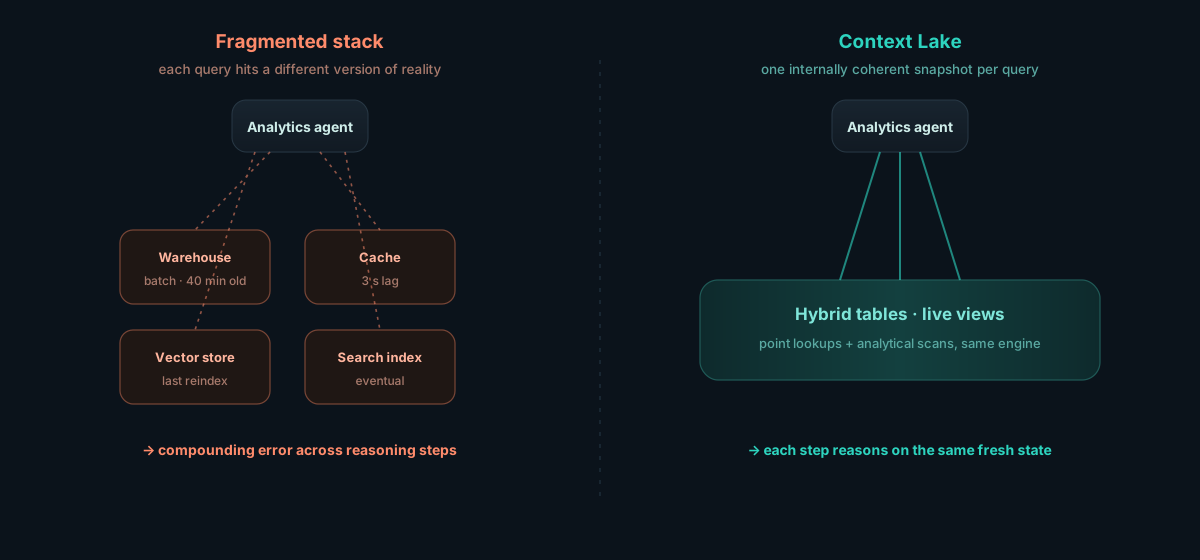
Here’s the problem. A real analytics agent doesn’t query one neat table. Over a single reasoning loop it might pull aggregates from a warehouse, look up a specific entity’s current state from an operational store, fetch a similar-cases set from a vector index, and check a recent-events count from a cache. In a typical modern data stack, those four reads hit four different systems, each at a different stage of freshness.
The warehouse is forty minutes behind because it’s fed by a batch job. The cache is three seconds behind. The vector store reflects whenever it was last reindexed. The agent has no idea these are different versions of reality — it treats every query result as ground truth and reasons across all of them as if they describe the same moment. They don’t. This is the cross-system context gap: context split across systems that can’t be queried under one consistent snapshot. For a human analyst it produces an occasional confusing chart. For an agent running a twenty-step loop, it produces a chain of reasoning built on a world that never actually existed.
There’s a second, subtler problem: stale data. Even a single consistent source is useless to an agent acting in real time if it’s serving forty-minute-old aggregates. If the agent’s goal is to catch a margin problem as it develops, or flag an anomaly while it’s still actionable, batch-fresh data means the agent reasons confidently about a situation that has already moved on. Autonomy raises the stakes on data freshness — the agent acts, so stale context becomes a stale action, not just a stale chart.
The architectural answer is to give the agent one coherent substrate to query instead of a fragmented stack. This is the Context Lake pattern: ingest changes from systems of record via CDC, maintain the derived state the agent needs (aggregates, live views, embeddings) continuously, and serve every kind of read — point lookup, analytical scan, vector similarity — from one engine under one internally coherent snapshot.
Two properties make this work for agents specifically:
Hybrid tables serve both the agent’s point lookups (“what is this customer’s current balance?”) and its analytical scans (“aggregate margin by week across the region”) from the same store. The agent doesn’t fan out across an OLTP database and a warehouse and try to reconcile them — both query shapes hit one place. Many of the aggregates an agent asks for (sums, counts, velocities) can be computed on-demand at query time against committed data, so the agent gets a current answer without waiting on a pre-built pipeline.
Internally coherent reads. Because the agent’s queries resolve against the same set of ingested events, query 4 and query 5 describe the same moment in time. The compounding-error problem doesn’t disappear because the model got smarter — it disappears because the agent’s reasoning steps are no longer built on mismatched snapshots.
This is the unglamorous truth of agentic analytics: the ceiling on how good your agent can be is set by the coherence and freshness of what it queries, not by the model. A frontier model reasoning over a fragmented, stale stack is a brilliant analyst working from four reports printed on four different days and told they’re all current.
Where Agentic Analytics Breaks in Production
Beyond the data layer, four failure modes show up repeatedly when teams move agentic analytics from demo to production:
Confident wrong answers with no audit trail. The agent produces a plausible narrative (“margin fell because of shipping costs”) that’s built on a misread join or a stale aggregate. Because the output reads like an analyst’s conclusion, nobody re-derives it. Production agentic analytics needs every conclusion to carry its query lineage — which queries ran, against what, returning what — so a human can audit the chain, not just the headline.
Semantic ambiguity the agent resolves silently. “Revenue” means three different things across three tables. A human analyst knows which one the CFO means. An agent picks one — often the wrong one — and never surfaces the choice. A governed semantic layer that pins definitions is not optional once an agent is writing its own queries.
Unbounded query cost. An agent that decides to scan a billion-row table to answer a side question can run up a serious bill, or saturate the warehouse and degrade everything else. Agentic analytics needs query budgets and guardrails the way autonomous agents need action limits.
Action without reversibility. The moment the agent can act on a conclusion — adjust a budget, pause a campaign, flag an account — a wrong reasoning chain becomes a wrong action. The strongest deployments keep the agent in propose-mode for consequential actions and reserve autonomous action for low-stakes, reversible ones until the reasoning track record earns more rope.
Each of these is a real constraint, but notice that three of the four trace back to the same root: the agent reasoning on context it can’t fully trust. Fix the substrate and the blast radius of the rest shrinks.
Agentic Analytics Use Cases
The use cases where agentic analytics earns its keep share a shape: questions that are valuable, repetitive, and currently bottlenecked on analyst time.
Continuous anomaly investigation. Instead of an alert that says “margin dropped,” an agent that investigates why the moment it drops — running the drill-down an analyst would run, and arriving with a probable cause attached.
Self-serve business questions at scale. The long tail of questions every operator has (“is this SKU’s return rate normal for the season?”) that never get asked because each one costs an analyst’s time. An agent answers them on demand.
Monitoring and triage. An agent watching a metric tree, investigating the branches that move, and escalating only the ones that need a human — turning a wall of dashboards into a short list of investigated findings.
Pre-meeting briefings. An agent that assembles the relevant cuts before a business review, having already chased down the obvious follow-up questions.
What these have in common, and why the data layer keeps mattering: they’re most valuable when the agent acts on current state. An anomaly investigation that runs on forty-minute-old data investigates a problem that may have already changed shape. The value of agentic analytics and the freshness of its substrate are the same axis.
How to Get Started with Agentic Analytics
The teams that get value from agentic analytics don’t start by pointing an agent at their whole warehouse. They start narrow and earn autonomy. A workable order:
Start with a bounded, repetitive question. Pick one investigation an analyst runs over and over — weekly margin variance, a churn drill-down, an anomaly triage — where the steps are well-understood. A narrow scope makes the agent’s reasoning auditable and the wins legible.
Pin the semantics first. Before the agent writes a query, define the metrics it’s allowed to use in a governed semantic layer. “Revenue,” “active user,” and “margin” each need exactly one definition the agent can’t reinterpret. This is the single highest-leverage step — most bad agent conclusions trace back to a silently wrong definition, not bad reasoning.
Keep the agent in propose-mode. For the first weeks, the agent investigates and proposes; a human approves any action. You’re building a track record of its reasoning before you let it act unsupervised. Reserve autonomous action for low-stakes, reversible outcomes until that record exists.
Instrument the reasoning chain. Log every query the agent runs, against what, returning what. When a conclusion looks wrong, you want to audit the chain, not just the headline. This is also how you catch the compounding-error failures described above before they reach a stakeholder.
Fix the data layer before you scale. An agent that works on one curated dataset will produce compounding errors the moment you let it roam across a fragmented stack of warehouse, cache, and vector store at different freshness stages. Consolidating the agent’s reads onto one coherent, fresh substrate is what turns a promising pilot into a system you can trust in production.
The pattern across all five: constrain the agent until its reasoning has earned trust, and invest in the data layer before breadth. Capability scales with how much of your context the agent can query coherently — not with how clever the model is.
Frequently Asked Questions
Key Takeaways
Agentic analytics replaces the human-driven dashboard loop with an autonomous agent that takes a goal, runs its own queries, interprets results, decides what to investigate next, and often acts — multi-step and stateful, not one-shot question-answering.
The hard part is the data layer, not the model. An agent fanning out across a warehouse, cache, and vector store at different freshness stages reads different versions of reality and reasons across them as if they describe the same moment.
Errors compound across the reasoning loop. Without a human reading each intermediate result, a wrong number in query 4 sends the agent down a wrong branch for the rest of the investigation — and may end in a wrong action.
Freshness and autonomy are the same axis. The more autonomous the agent, the more a stale snapshot becomes a stale action rather than a stale chart.
A coherent substrate is the fix. Serving the agent’s varied reads from one engine under one internally coherent snapshot — hybrid tables for point lookups and scans, derived state maintained continuously — removes the compounding-error problem at its root and sets a higher ceiling than any model upgrade.