
Why AI Agents Fail at Scale: Context Is a Data Layer Problem
95% of AI projects return no measurable value to the business, and when you ask the teams why, the answer is always the same word: context. This session is about what that word means once you're precise about it — the meaning attached to data, not more data — and why the stores underneath most agent stacks can't supply it. Boyd Stowe traces fifty years of data architecture from the mainframe through Codd's split to polyglot persistence, showing how each step solved a real problem and left one more system to keep in sync, then works through what a data layer would have to do to serve agents natively. Closes with a live demo: three real-time feeds, derived signals over a 120-day lookback, and five agents detecting stock manipulation as the data arrives.
Overview
Recorded live for InfoQ on August 27, 2026. An engineering case that agent context is an infrastructure problem rather than a prompting or framework problem — covering the definition of context, why agent workloads violate the assumptions human-driven architectures were built on, the historical pattern that produced today's sprawl, and a requirements list for an agent-ready data layer. Includes an extended Q&A on concurrent-agent latency, coherent shared state, governance in regulated environments, and migration.
Topics Covered
- •What "context" means once you're precise about it — meaning attached to data, not more data
- •Why agents consume data differently than humans: people infer across sources, agents treat a timestamp mismatch as disqualifying
- •The research on data curation and semantic layers — and the gap between the 21% who say they're ready and the 5% who succeed
- •Fifty years of data architecture: mainframe, Codd's split, ACID, document stores, polyglot persistence, and the sync tax each step left behind
- •What an agent-ready data layer has to do — ACID at scale, elasticity, row and columnar work on the same data, workload isolation, freshness, history
- •Live demo: five agents detecting stock manipulation across three real-time feeds
Key Takeaways
- ✓More context is not better context — the right context is, and every extra input lengthens the engineering cycle
- ✓A human reads two records a minute apart and assumes they describe the same moment; an agent treats the mismatch as disqualifying
- ✓Every database in production was designed for humans to read, and agent workloads break that assumption
- ✓Batch and micro-batch pipelines create a context gap with real consequences — a card declined seconds after it was issued, because the pipeline hadn't caught up
- ✓The sprawl was rational: each specialised store solved a real problem, and each one added another system to keep coherent
Technical Highlights
- →Why a semantic layer addresses what data means but not when it is — meaning-consistency and state-consistency are different axes
- →Row-oriented writes and columnar analysis against the same dataset, concurrently, without a second system
- →Workload isolation so ingestion, agent reads, and BI don't restart the sprawl
- →Query concurrency as a first-class requirement — agents issue far more reads per decision than a human ever did
More Product Demos
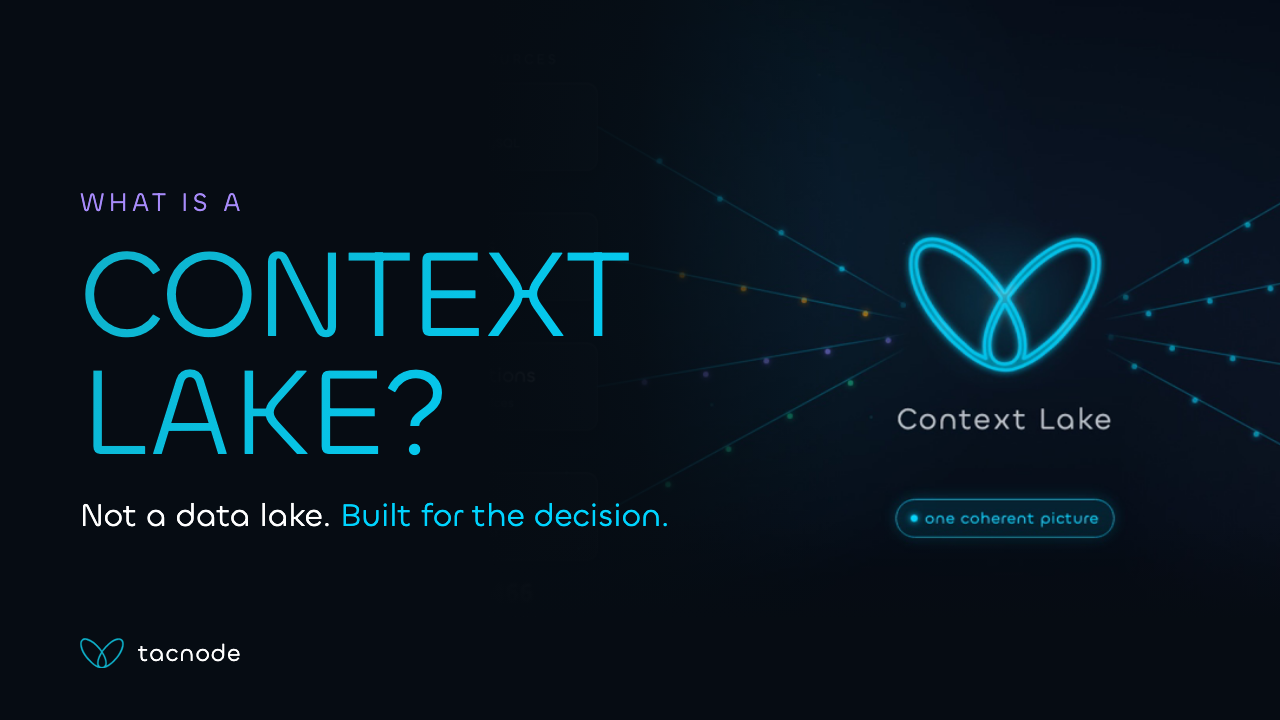
What Is a Context Lake? The Data Layer Behind Real-Time AI Decisions
A 3-minute explainer that builds the context lake as one diagram — where the data comes from, what it serves, and why the usual middle leaves decisions acting on a reality that has already moved.
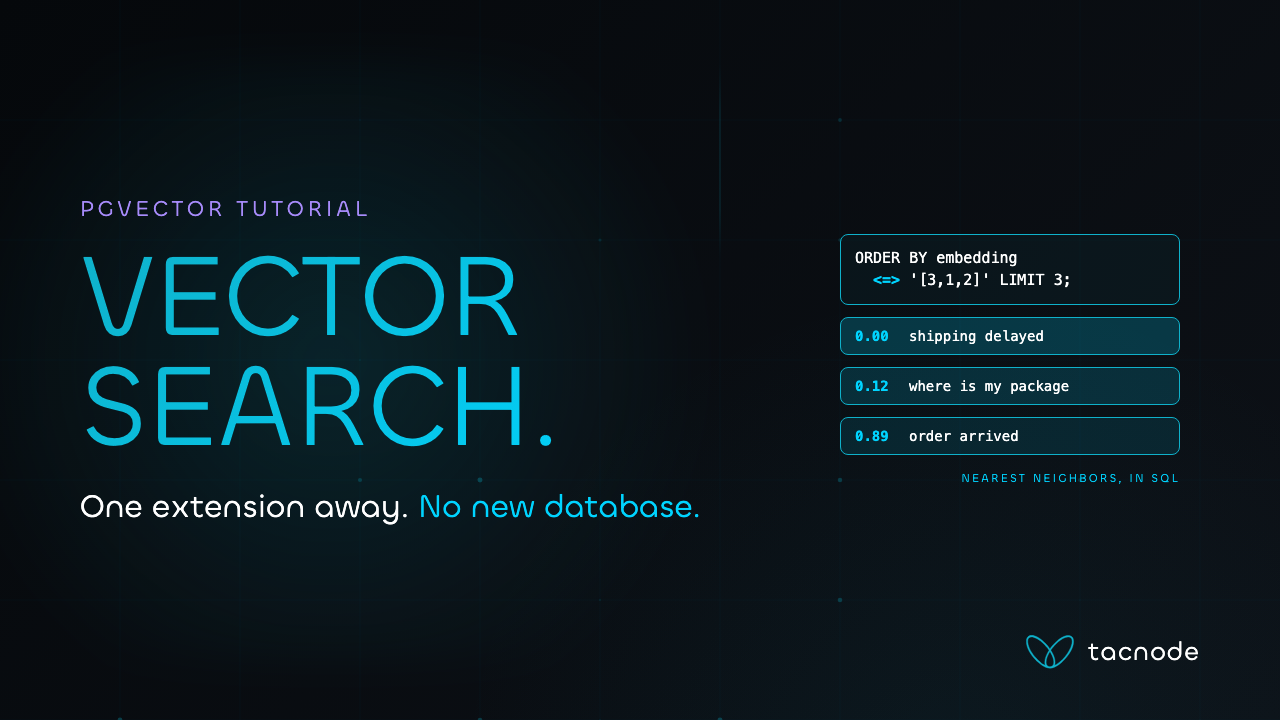
pgvector Tutorial: Vector Search in Postgres from Scratch
A 3-minute pgvector walkthrough — enable the extension, store embeddings, query nearest neighbors, and index with HNSW or IVFFlat, all in the Postgres you already run.
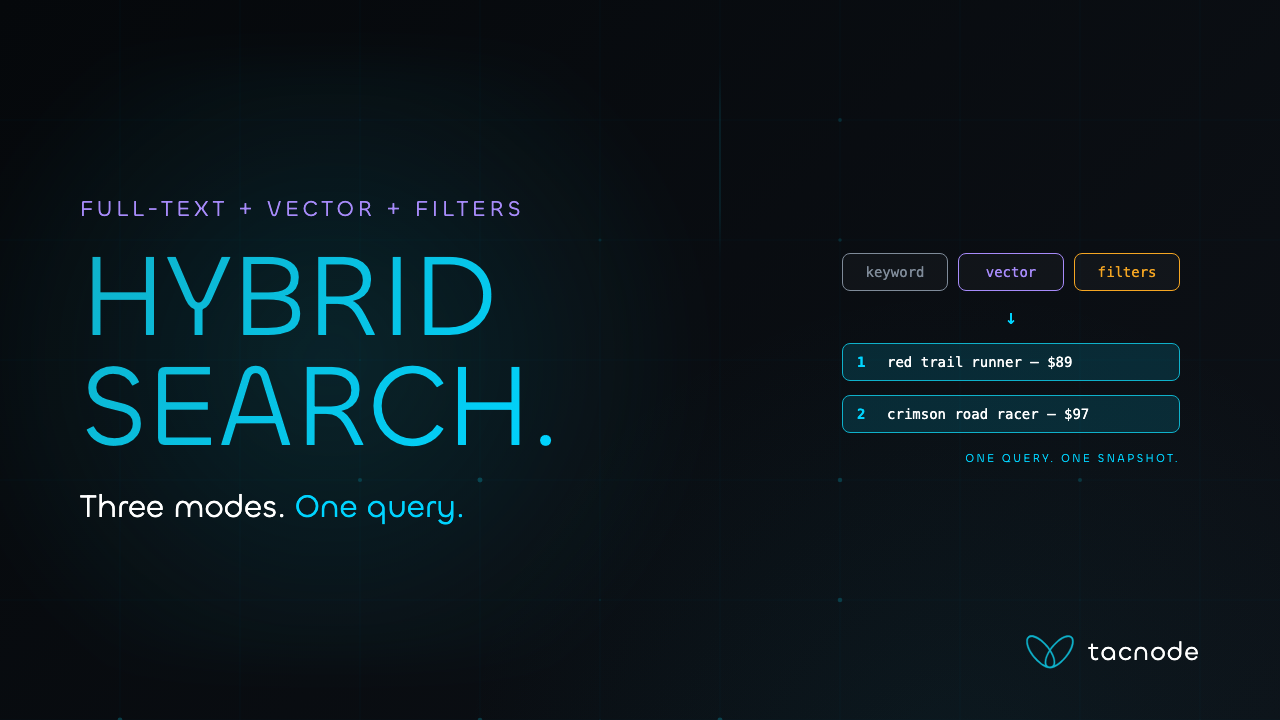
Hybrid Search in SQL, Explained
A 3-minute walkthrough of hybrid search — why keyword, vector, and filters each fail alone, and how to combine all three in one SQL query with reciprocal rank fusion.
Ready to get started?
Book a demo to see how Tacnode can power your real-time data infrastructure.