
Hybrid Search in SQL, Explained
"Red running shoes under $100" defeats every single retrieval mode on its own: keyword search misses synonyms, vector search ignores hard constraints, filters don't rank. The usual fix is three engines and a merge layer in application code — three systems, three sync pipelines, three versions of the truth. This walkthrough builds hybrid search as one SQL query instead: full-text plus vector plus structured filters, combined with reciprocal rank fusion, against a single snapshot.
Overview
An entry-level walkthrough of hybrid search: the query that beats each retrieval mode on its own, why the three-system merge layer is the default answer and what it costs, and how full-text, vector similarity, and structured filters combine in one SQL query via reciprocal rank fusion — plus the harder part, keeping that snapshot fresh under concurrent reads.
Topics Covered
- •Why keyword, vector, and filters each fail on a real query
- •The three-system trap — three engines, three sync pipelines, three versions of the truth
- •One engine: full-text, vectors, and structured data in the same query surface
- •The hybrid query zone by zone — reciprocal rank fusion (RRF) over BM25 and vector ranks
- •One snapshot: keeping retrieval coherent while the underlying state changes
Key Takeaways
- ✓No single retrieval mode answers a real query — keyword misses synonyms, vectors ignore hard constraints, filters don't rank
- ✓Merging results in app code means maintaining three systems and their sync pipelines
- ✓Reciprocal rank fusion combines the rankings in standard SQL — one query, one result set
- ✓Every retrieval mode reads the same snapshot, so results stay coherent instead of drifting per system
More Product Demos
What Is a Context Lake? The Data Layer Behind Real-Time AI Decisions
A 3-minute explainer that builds the context lake as one diagram — where the data comes from, what it serves, and why the usual middle leaves decisions acting on a reality that has already moved.
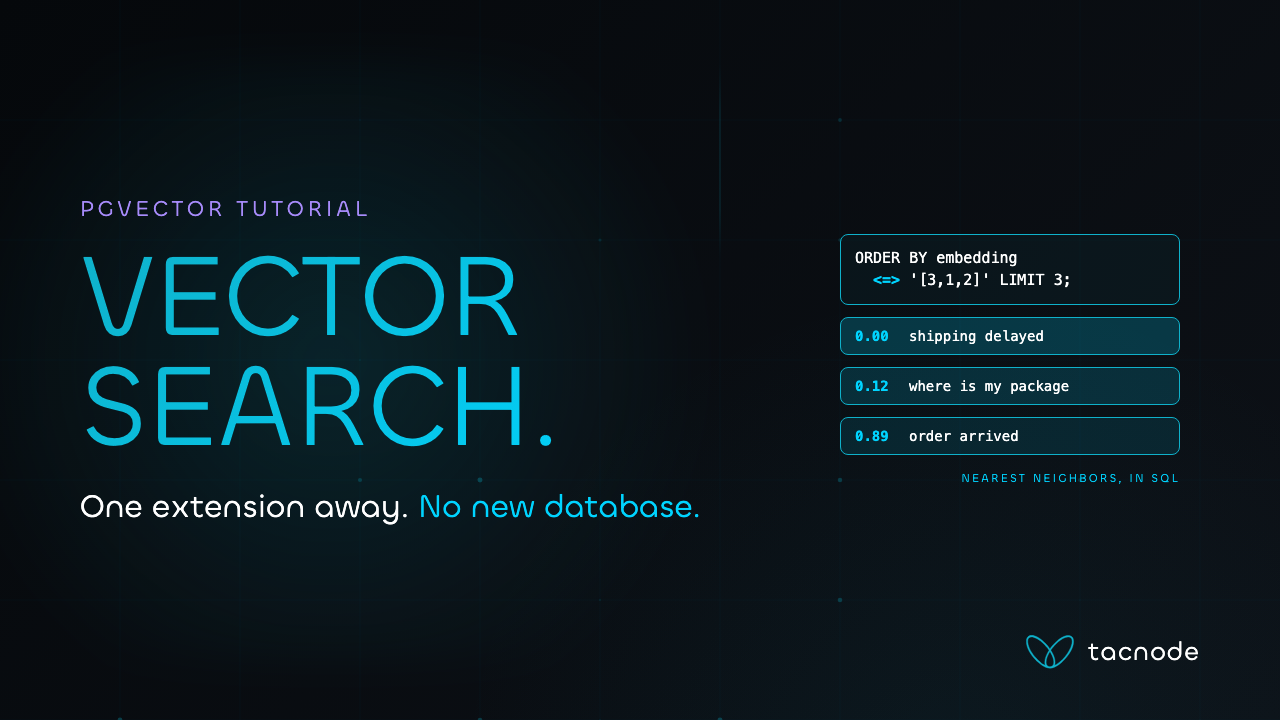
pgvector Tutorial: Vector Search in Postgres from Scratch
A 3-minute pgvector walkthrough — enable the extension, store embeddings, query nearest neighbors, and index with HNSW or IVFFlat, all in the Postgres you already run.
Why AI Agents Fail at Scale: Context Is a Data Layer Problem
A full InfoQ session on why agents that demo beautifully struggle in production — what "context" actually means, why agents read data differently than people, and what an agent-ready data layer has to do.
Ready to get started?
Book a demo to see how Tacnode can power your real-time data infrastructure.