
What Is a Context Lake? The Data Layer Behind Real-Time AI Decisions
A context lake is one place in the middle of your architecture: everything flows in once as it happens, raw records and the signals derived from them live together, and every automated decision reads that same picture at the moment it has to decide. This explainer starts with the usual middle — a streaming job feeding a cache for fraud, a nightly batch for pricing, a vector store bolted on for the agent — and shows how each path leaves its decision on a different, older version of the truth. That distance is the context gap. The last third covers what closes it: shared, live, and semantic.
Overview
A short, diagram-first explainer of the context lake: what sits on either side of it, what the composed middle looks like today, where the context gap comes from, and the three properties that define a context lake.
Topics Covered
- •More data than ever, from more sources, arriving all the time
- •Everything it serves: fraud checks, pricing, recommendations, agents
- •The usual middle — streams, caches, nightly batches, a bolted-on vector store
- •The context gap: decisions acting on a version of reality that has already moved
- •What a context lake is, and how it differs from a data lake
- •Shared, live, semantic
Key Takeaways
- ✓Each path in a composed stack runs on its own schedule, so each decision sees a different, older picture
- ✓A context lake takes everything in once, keeps raw records and derived signals together, and serves one picture to every decision
- ✓A data lake is built to analyze later; a context lake is built to answer at the moment a decision is made
- ✓Shared, live and semantic are the three properties that close the context gap
More Product Demos
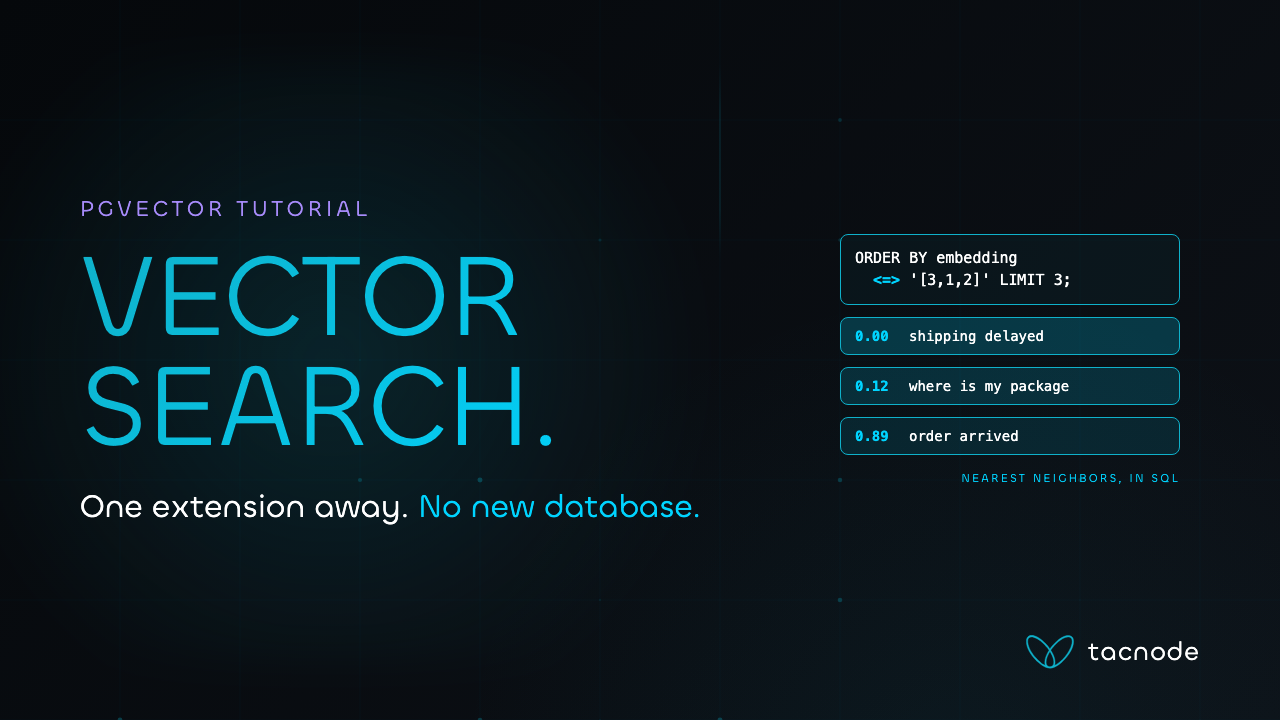
pgvector Tutorial: Vector Search in Postgres from Scratch
A 3-minute pgvector walkthrough — enable the extension, store embeddings, query nearest neighbors, and index with HNSW or IVFFlat, all in the Postgres you already run.
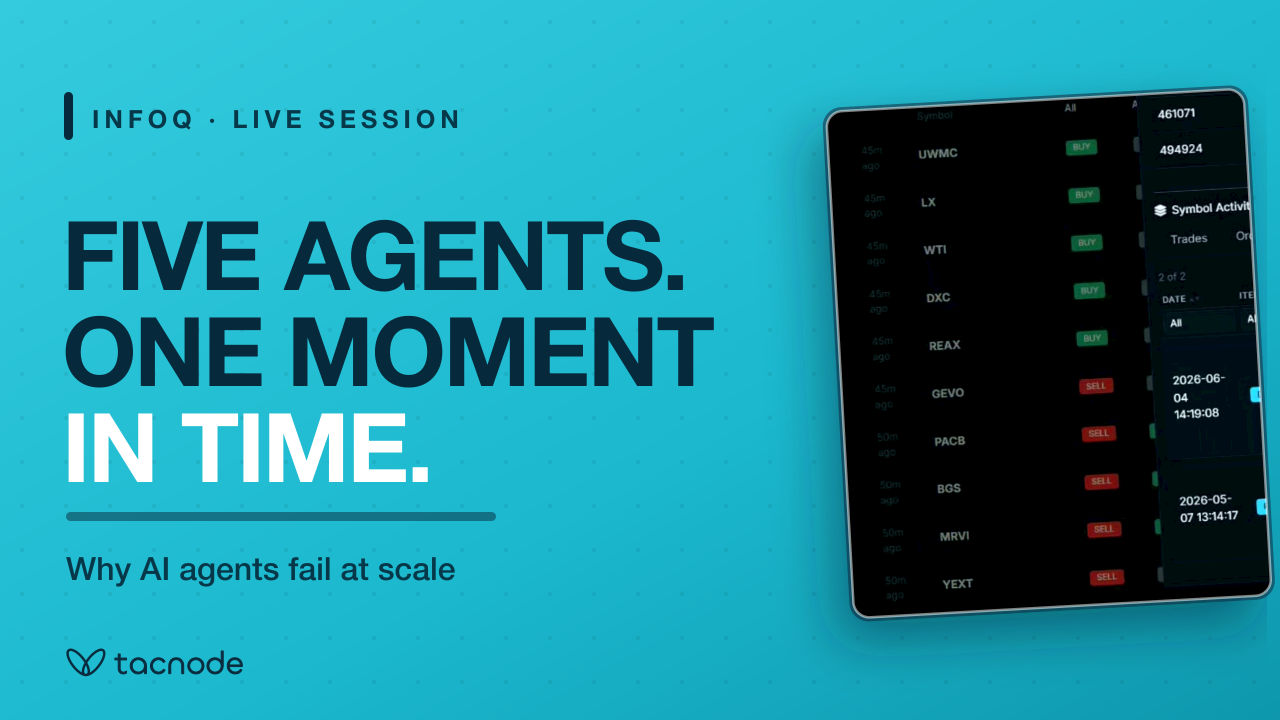
Why AI Agents Fail at Scale: Context Is a Data Layer Problem
A full InfoQ session on why agents that demo beautifully struggle in production — what "context" actually means, why agents read data differently than people, and what an agent-ready data layer has to do.
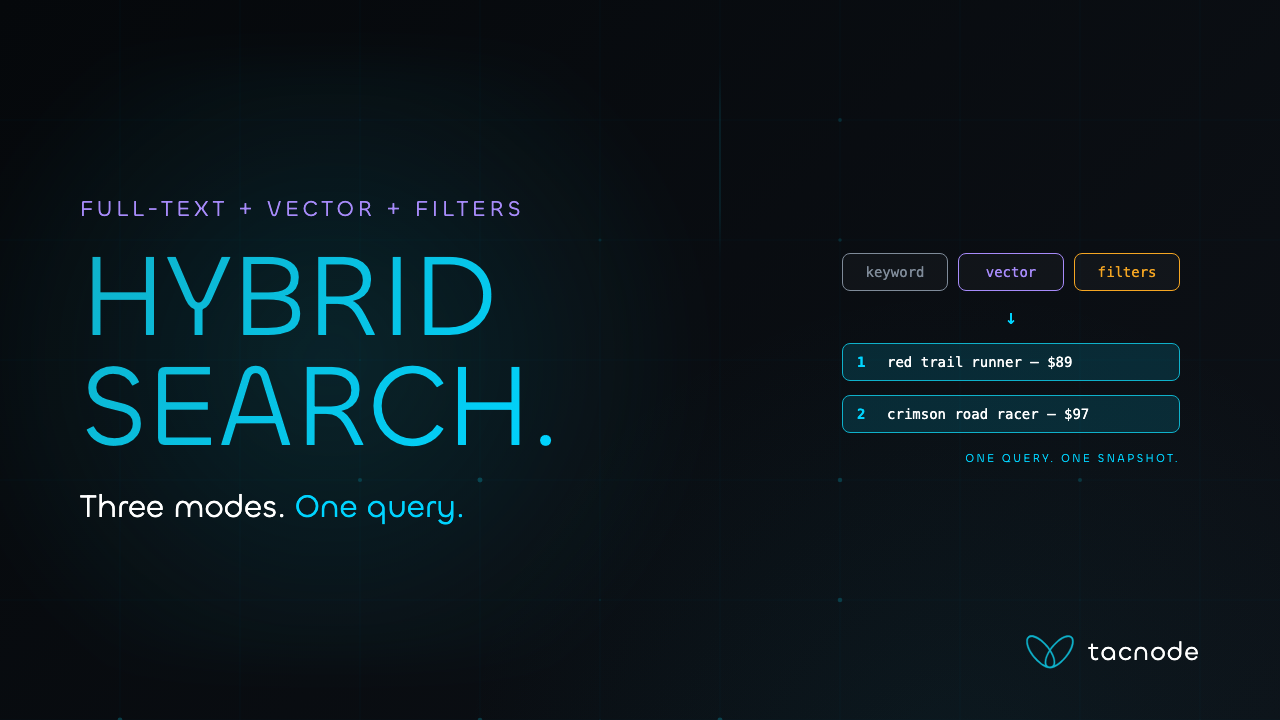
Hybrid Search in SQL, Explained
A 3-minute walkthrough of hybrid search — why keyword, vector, and filters each fail alone, and how to combine all three in one SQL query with reciprocal rank fusion.
Ready to get started?
Book a demo to see how Tacnode can power your real-time data infrastructure.