
Postgres Full-Text Search, Explained
Most engineers reach for LIKE when they need text search. It works on small data, then breaks — slow at scale, no stemming, no typo tolerance, no relevance ranking. Postgres has a real full-text search engine built in: tsvector, tsquery, GIN inverted indexes, weighted fields, all behind standard SQL. Tacnode ships BM25 ranking natively on top — the same algorithm Elasticsearch uses, no extra service to deploy.
Overview
An entry-level walkthrough of Postgres full-text search: where LIKE breaks (linear scan + no stemming + no typos + no ranking), the three pieces that make FTS work (tokenize / inverted index / match), and how Tacnode's native BM25 ranking lands on top of standard Postgres syntax.
Topics Covered
- •Why LIKE queries break at scale and don't really do search
- •Postgres tokenization, stemming, and stop-word handling
- •GIN inverted indexes — word → rows that contain it
- •Setup: tsvector columns with weighted fields + GIN index
- •Native BM25 ranking in Tacnode via the <@> operator and plainto_bm25query
Key Takeaways
- ✓Postgres has a production-grade full-text search engine — no Elasticsearch needed for most workloads
- ✓Setup is one tsvector column + one GIN index
- ✓Tacnode adds BM25 ranking natively — the same algorithm Elasticsearch uses, in your Postgres
- ✓FTS, vector search, and structured filters all share one engine — hybrid retrieval in a single SQL query
More Product Demos
What Is a Context Lake? The Data Layer Behind Real-Time AI Decisions
A 3-minute explainer that builds the context lake as one diagram — where the data comes from, what it serves, and why the usual middle leaves decisions acting on a reality that has already moved.
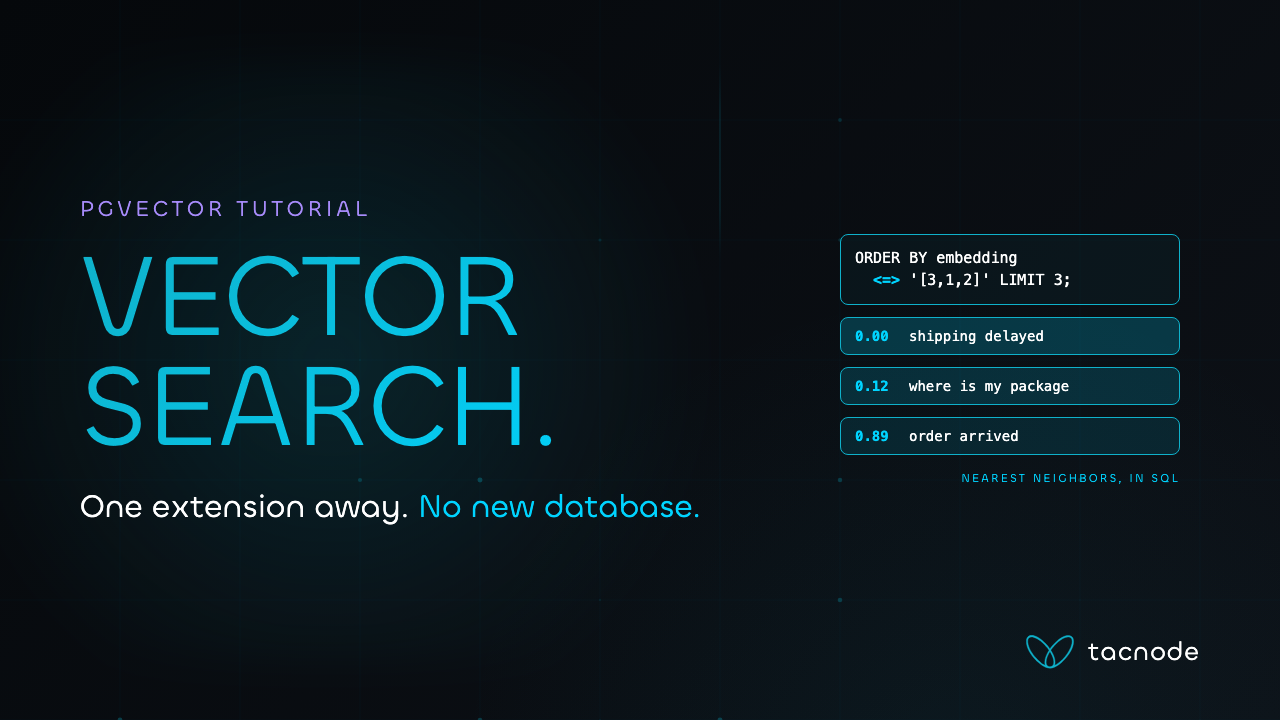
pgvector Tutorial: Vector Search in Postgres from Scratch
A 3-minute pgvector walkthrough — enable the extension, store embeddings, query nearest neighbors, and index with HNSW or IVFFlat, all in the Postgres you already run.
Why AI Agents Fail at Scale: Context Is a Data Layer Problem
A full InfoQ session on why agents that demo beautifully struggle in production — what "context" actually means, why agents read data differently than people, and what an agent-ready data layer has to do.
Ready to get started?
Book a demo to see how Tacnode can power your real-time data infrastructure.