Stateful Stream Processing for Decisions: Where Flink Stops Being Enough
Flink gives you stateful stream processing. It does not give you a decision-coherent serving layer. The gap is what teams discover when they put Redis or Postgres in front of Flink to serve decisions — and hit the same split-state problem Flink was supposed to have solved.
TL;DR: Flink’s state — RocksDB-backed operator state, checkpointed for fault tolerance, with exactly-once semantics inside the job — is excellent for streaming analytics: high throughput, large windows, replay safety. Decision-time workloads need something different: point-in-time reads across entities under concurrency, native K/V serving at decision-rate, mutation support, and cross-entity consistency between structured, derived, and semantic context. Flink provides none of these natively. The popular answer — put Redis, Postgres, or a feature store in front of Flink for serving — reintroduces split state between Flink’s operator state and the external store, and read incoherence appears at the interface. The fix is not to tune the serving store; it is to replace it with an incrementally-maintained, snapshot-coherent layer — what Tacnode calls a Context Lake — that absorbs what Flink’s state was already doing and what the external serving store was supposed to provide.
Flink gives you stateful stream processing. It does not give you a decision-coherent serving layer. The gap is what teams discover when they put Redis or Postgres in front of Flink to serve decisions — and hit the same split-state problem Flink was supposed to have solved.
This post walks what Flink’s state is actually good at, what decision-time workloads require that Flink doesn’t provide, and why the popular Flink + Redis / Flink + Postgres pattern reintroduces the context gap that stateful stream processing was supposed to close. It describes what a decision-coherent architecture does differently — not to replace Flink, but to move the serving layer to somewhere Flink’s state model was not designed to live.
What Stateful Stream Processing Actually Is
Stateful stream processing is the pattern where the stream processor maintains durable, queryable state as events arrive — windowed aggregates, session accumulators, running counts, enrichment lookups, watermarked timers — so that downstream logic can react to the stream against more than just the current event. Flink, Kafka Streams, Spark Structured Streaming, and Materialize all implement some version of this. The state lives alongside the processor, is recoverable on failure, and advances as the stream advances.
Before stateful stream processing, real-time pipelines were largely stateless. Events flowed through transformations and aggregations lived in a downstream OLAP system (Druid, Pinot, ClickHouse) that ingested the stream and answered queries against its own materialized state. That split was acceptable for monitoring and dashboards. It broke for any workload that needed to react to the stream based on the state the stream had produced so far.
Flink changed the shape of what was buildable. Keyed state scoped per entity, operator state scoped per operator, value state and list state and map state, broadcast state for configuration joins, windowing semantics that respect event time and handle late arrivals, savepoints and checkpoints for operational control — all of it opened real-time use cases that previously required a separate online database doing duplicate work. The DataStream API, Table API, and Flink SQL gave teams three entry points into the same state model.
The question this post is about is not whether stateful stream processing is good. It is whether stateful stream processing inside Flink is the serving layer a decision-time workload can read from directly — and the answer, structurally, is no.
Stateful vs Stateless Stream Processing: Key Concepts
Stream processing engines split into two modes: stateful and stateless. Stateless stream processing transforms each individual event without reference to past events — filter, map, project, enrich from a static lookup. Each event passes through independently. Stateless processing is easy to parallelize, easy to scale, and contributes nothing to decisions that depend on what has happened across multiple events. For continuous monitoring of streaming data, stateless enrichment is enough. For fraud detection, anomaly detection, or real time decision making, it is not.
Stateful processing maintains state across events. A stateful operator holds a running count, a windowed aggregate, a session accumulator, or an input-stream join state, and advances that state as new data arrives. Stateful operators are the foundation of windowed aggregation, event correlation, and the kind of derived context that decisions need. The cost is operational: stateful streaming systems have to handle state storage, fault tolerance, checkpointing, and recovery — complexity that stateless processing avoids.
Within stateful streaming, there is also a distinction between short-window state (recent events in a sliding window or tumbling window) and long-lived session state that persists across many events, potentially until the session ends. Modern streaming systems handle both. The longer the state horizon, the more the state store itself — RocksDB in Flink, RocksDB in Kafka Streams — becomes the operational center of the system. Unbounded data streams produce unbounded state if the processing node keeps every data point; the defined window semantics — defined start, defined end — are how streaming systems bound the state at all.
What Flink’s State Is Optimized For
Flink’s state is a streaming state store. Every design choice in the state backend reflects that target workload.
RocksDB-backed keyed state is optimized for single-key writes and reads inside an operator, keyed by the event’s routing key, with an LSM-tree on disk for durability and an in-memory cache for hot keys. The access pattern is “the operator that owns this key reads and writes its own state per event.” It is not designed for arbitrary cross-key reads from outside the operator; it is not designed for cross-entity transactional reads; and it is not designed for high-concurrency point lookups that don’t route through Flink’s own task operators.
Checkpoints snapshot the state consistently across operators at a stream barrier, so the job can recover exactly-once semantics after failure by restoring all operators to the same aligned barrier. Exactly-once in Flink is a property of the stream: every event is processed once and its effect on state is committed once, even in the presence of operator restarts. Savepoints extend this for operational state management — job upgrades, state migrations, scale-out — and preserve the barrier semantics.
Windowing — tumbling, sliding, session, global — lives on top of keyed state and advances with watermarks that represent the progress of event time. Late arrivals are handled through allowed lateness and side outputs. Flink’s CEP library sits on the same state foundation for complex event pattern matching. The Table API and Flink SQL project windowed aggregations into queryable virtual tables, driven by the same underlying keyed state.
Kafka Streams, Flink, and the State Management Landscape
Apache Flink and Kafka Streams are the two dominant stateful stream processing frameworks in production. They share the core primitives — keyed streams, windowing, exactly once processing, fault tolerance via checkpoint barriers, state management backed by RocksDB — but differ in deployment model, data lake integration, and how the state store is exposed.
Flink runs as a distributed system on its own cluster, processes unbounded data streams from any source, supports DataStream, Table, and SQL APIs, and integrates with data lake and warehouse systems for downstream analytics and real time analytics. Its state management model — keyed state backed by RocksDB, operator state scoped per processing node, checkpoint barriers that align across operators to ensure fault tolerance — scales to very large windowed aggregations and complex operations on past events. Flink’s state store is queryable inside the job through Flink SQL, and emitable to external stores through sinks. Keyed streams plus sliding windows and tumbling windows cover most of the windowed-aggregation surface teams need for low latency decisions.
Kafka Streams runs embedded in the application JVM, ties state management tightly to Kafka topics (state stores are backed by compacted topics as changelogs stored asynchronously), and scales through Kafka’s partition model. Kafka Streams applications are simpler to operate than a Flink cluster but inherit Kafka’s constraints on topic count, partition count, and consumer-group rebalance behavior. The state store, the input stream, and the processing node all live in the same JVM — which is convenient for developers and complicated for operators running large streaming applications.
Apache Spark Structured Streaming takes a different approach: micro-batch processing over structured streaming data, with stateful operations supported but less primitive than Flink or Kafka Streams. Spark wins when the same workload needs both streaming and batch processing with shared semantics, and when the state store can tolerate micro-batch latency rather than strict real time processing.
Materialize and Flink SQL both project stateful stream processing through SQL, making stateful streaming systems buildable by analytic engineers rather than requiring JVM programming. The underlying state management is similar — windowed aggregates, keyed streams, defined window logic with defined start and defined end semantics — but the developer surface is different.
For decision-time workloads, the choice between these similar technologies matters less than where the serving layer sits relative to them. All four produce state that must be served somewhere decisions can read. The architectural question is not “which stream processing engine” but “where does the state decisions read from live” — and that question is what the rest of this post answers.
The Flink + Serving-Layer Pattern
The canonical production response to Flink’s gaps as a serving layer is to put an external store in front of it. The three dominant patterns: Flink → Redis for K/V serving, Flink → Postgres for structured queries, Flink → a feature store (Tecton, Feast) for ML feature vectors. Sometimes all three, with Flink writing to more than one serving store depending on the access pattern.
This is a reasonable architecture. Each store serves what it is optimized for. Redis handles hot K/V reads. Postgres handles relational queries and structured account state. A feature store handles model inference vectors with training/serving parity. The Flink job maintains operator state, projects windowed aggregates through Flink SQL, and writes the outputs to the appropriate downstream store.
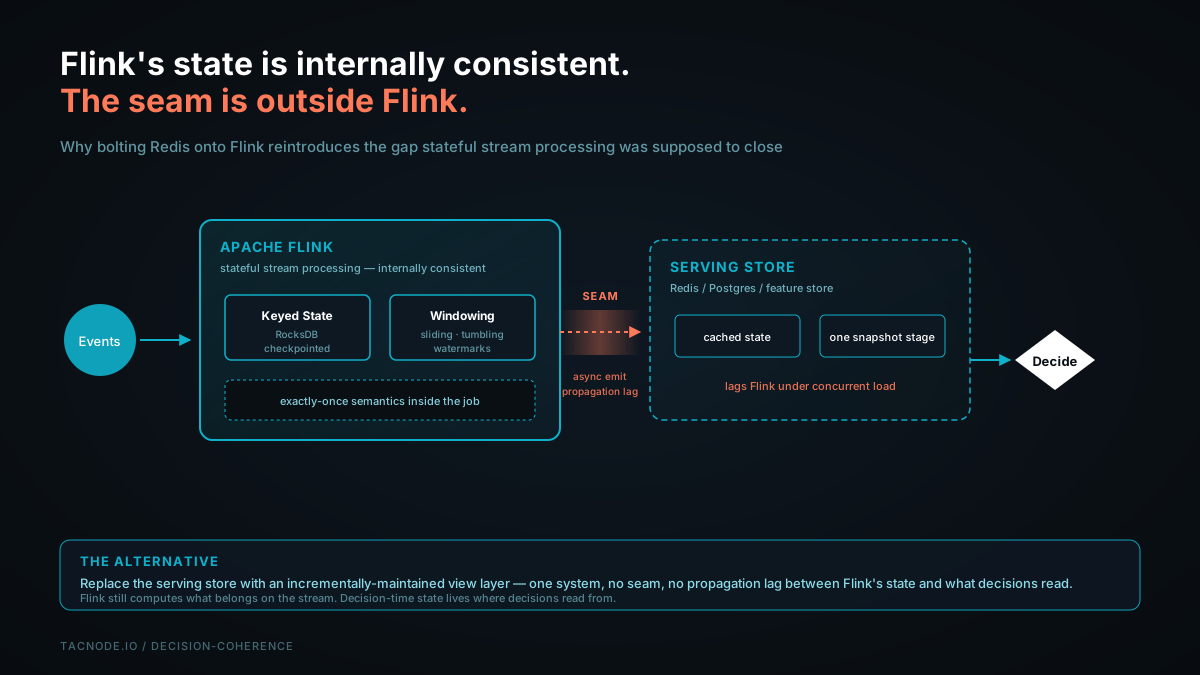
The pattern works in benchmarks. It breaks under concurrent production load at the interface between Flink and the serving store. Flink emits the updated aggregate to Redis; the emit has propagation delay; Redis serves the previous value for the window between the state changing in Flink and the update landing in Redis. Under burst traffic, that window widens because Flink has more events to process before it can emit. Context under concurrency describes the mechanic in detail.
The coherence problem is not inside Flink. Flink’s state is internally consistent — the operator’s view of its own key is always correct. The coherence problem is at the seam between Flink and Redis, and between Redis and Postgres, and between all three and any additional serving stores. Each pair has its own propagation delay. Each is at a different propagation stage at any given moment. A decision that reads the velocity counter from Redis, the balance from Postgres, and a risk feature from the feature store composes three reads that were never coherent with each other in the first place.
This is the incoherent-read problem. Why real-time decisions fail walks the three failure modes — incomplete, stale, inconsistent — and this pattern produces inconsistent most aggressively: not a single stale read, but a composite of reads from pipelines at different propagation stages.
Why Bolting Redis (or Postgres) Onto Flink Reintroduces the Gap
The original promise of stateful stream processing was that the state and the computation would live in the same system, removing the old gap between a streaming processor and an external database. Flink delivered on that for the STREAM. It did not deliver it for the SERVE.
When a team adds Redis in front of Flink to serve decisions, the split-state problem comes back in a new shape. The state now lives in Flink (RocksDB-backed operator state) AND in Redis (cached serving state). The two are not the same. The two do not update simultaneously. Flink emits to Redis asynchronously. Under load, Redis lags Flink. Any decision read from Redis sees a version of the state from before Flink’s last emit. Under concurrent decisions, multiple decisions read the same pre-emit value and each commits against it, even though Flink’s internal state has already advanced.
The same mechanic applies to Flink → Postgres. Flink emits an aggregated row to Postgres via a JDBC sink or a CDC push; Postgres lags Flink by the sink’s flush interval plus the database’s own write path; decisions reading the row via Postgres see stale state. Teams working around this with shorter flush intervals, faster Redis pipelines, or more replicas discover that each tuning pass helps at the margin and does not change the structural gap — the split between Flink’s state and the external serving store is architectural, not configuration-dependent.
A feature store in front of Flink has the same problem with more layers. Flink computes features and writes them to the feature store’s offline storage; the feature store promotes features from offline to online on a schedule; the online store serves to the model; the model’s output feeds into the decision. Every layer adds propagation delay. “Training-serving skew” is the name feature-store operators give to the case where the offline and online views disagree; the analogous “stream-serving skew” is what happens when Flink’s state and the online feature store disagree. Both are coherence failures at system seams.
The pattern’s critics often blame the serving store — “Redis isn’t consistent enough,” “Postgres is too slow,” “the feature store lags.” That diagnosis misses the structural cause. The serving store is doing the job it was designed for. The gap is that the state exists in two places — Flink and the serving store — that propagate independently, and the decision reads from the one that is not the most current.
Incremental Materialized Views: The Alternative
The alternative to Flink + serving layer is not “don’t use Flink”; it is “move the serving layer to somewhere that does not have a seam with Flink’s state.” An incrementally-maintained materialized view (IMV) inside a single serving system closes the seam by keeping the derived aggregate and the serving path inside the same transactional boundary.
An IMV is a view definition — typically declared in SQL — that the system maintains incrementally as the underlying data changes. When a base event arrives, the view is updated atomically within the same storage engine that serves reads. There is no “emit to a downstream store” step because the aggregate is already in the serving layer. There is no “two systems to keep consistent” problem because there is only one system.
The capability matches a subset of Flink’s stateful stream processing — windowed aggregations, running counts, session state, rolling sums — that is exactly the subset most decision-time workloads need. For those workloads, an IMV layer inside the serving system absorbs what Flink was doing and what the downstream serving store was doing, in one layer, with one coherent snapshot. The decision reads the aggregate directly from the same system that served every other read it needs.
This does not replace Flink’s full capability surface. Flink still wins on long event-time windows with complex CEP patterns, on jobs where the processing is the product (stream-to-lake ETL, real-time data transformation pipelines that feed downstream analytics), and on workloads where the processor’s throughput or exactly-once semantics to a specific sink are the dominant requirement. What it replaces is the specific case where Flink is being asked to do serving as well as computation, via a downstream K/V store, and is serving incoherent reads as a result.
On-demand computation extends the IMV model. For aggregations that can’t be usefully pre-maintained — arbitrary windows, cross-entity joins, vector similarity over a live index — the query runs at decision time against state that is itself coherent. This closes the case Flink couldn’t close cleanly: the arbitrary-window aggregation that Flink could compute but not serve consistently to external readers.
When Flink Is Still the Right Answer
Flink remains the right answer for several workloads that should not be folded into a serving layer.
Stream ETL and transformation pipelines where events flow from sources (Kafka topics, CDC streams) to sinks (lakes, warehouses, downstream Kafka topics) and the computation is the product. Flink’s throughput, fault tolerance, and exactly-once semantics to specific sinks are exactly what these workloads need. There is no decision reading from the state; the state is a means to the transformation, not an end.
Complex event pattern matching (CEP) over long event-time horizons with complex temporal logic. Flink’s CEP library is purpose-built. A serving layer isn’t trying to compete here.
Large-window analytics where the window is hours or days, windowing semantics matter, and the consumer is a downstream analytical store or dashboard. This is what streaming + OLAP was built for.
High-throughput event transport with in-flight computation — filter, enrich, route — where the output is another stream, not a point-lookup serving layer. Flink’s DataStream API plus Kafka sinks is the canonical pattern.
What changes for decision-time workloads specifically is that the STATE Flink maintains needs to be readable under concurrent decision load, at decision-rate, under a coherent cross-entity snapshot. That set of requirements is outside what Flink’s state model targets. The right pattern is: Flink for transformation and sink-bound stream computation, and a unified serving layer (IMV + native K/V + structured + vector in one system) for decision reads.
Vertical Patterns
The Flink-plus-serving pattern shows up across verticals with different surface symptoms but the same underlying seam.
Fraud detection: Flink maintains velocity counters and feature aggregates for fraud detection; emits to a key-value serving store (Redis) or a feature store; the authorization service reads from the downstream store; under fraud-burst load, the decision reads a pre-burst snapshot and fraud slips through. This is the canonical fraud detection application of stateful stream processing — and the canonical place the Flink-plus-Redis seam produces fraudulent activity that slips past the rule it was supposed to trigger. Anomaly detection workloads running on the same Flink pipeline inherit the same gap. Real-time fraud detection architecture walks this in detail.
Credit decisioning: Flink maintains exposure aggregates and velocity counters; emits to Redis and/or a feature store; the credit decision engine reads a composite that may reflect three different propagation stages. Real-time credit decisioning architecture covers the three-pipeline divergence pattern.
Real-time ML inference: Flink computes feature aggregates; the feature store promotes them to online serving; the model reads features; the decision commits. Every promotion step is a propagation stage, and the training-serving skew / stream-serving skew both surface here. Real-time ML: feature freshness at decision time walks the freshness budget decomposition that makes this the ML Platform team’s binding constraint.
Personalization enforcement (where the session itself is the validity window): Flink maintains session state and behavioral counters; emits to Redis for decision lookup; the enforcement decision reads a state that lags the current session. The gap is smaller than fraud or credit because session windows are shorter, but the structural seam is the same.
Across all of these, the common signature is: Flink does its computation correctly, the serving store serves what it has correctly, and the decision that composes reads across them is still wrong because what it reads is not what Flink’s state actually contains at decision time.
What to Measure
If the architecture is “Flink + serving store,” the telemetry that diagnoses the coherence gap is not what most teams are measuring.
Stream-to-serve propagation delay. The time between Flink processing an event and the effect of that event being readable by a decision in the serving store. Under quiet traffic, this is milliseconds. Under burst traffic, it can widen to seconds. This is the metric that should live inside the decision’s validity window.
Cross-store read skew. When a decision reads from Redis AND Postgres AND a feature store, the maximum time skew between when each read reflected its source of truth. In a serving layer with an IMV model inside one system, this is zero by construction. In a composed stack, it is the right telemetry to surface — and it is usually the first place architecture-level failures become visible.
Unexpected reconciliation delta. The rate at which post-hoc reconciliation finds a decision that, against the state actually effective at decision time, should have committed differently. This is the business-outcome version of the coherence gap. In Flink + serving-store architectures, this number is often elevated enough to hide in overall loss metrics but significant enough that individual incidents drive policy tightening that over-corrects.
Frequently Asked Questions
Where Stateful Stream Processing Goes From Here
Flink is not going away. Stream transformation, stream-to-lake ETL, complex event processing, and high-throughput event pipelines are workloads Flink remains well-suited for, and the foundation it provides — stateful stream processing as a first-class primitive — is one of the most important shifts in real-time infrastructure over the last decade.
What is changing is where the serving layer lives. In the canonical architecture, Flink plus an external serving store was the default. In the decision-coherent architecture, the derived aggregates that used to live in Flink’s operator state and get emitted to Redis now live as incrementally-maintained views inside a serving layer that also handles structured point lookups and semantic retrieval. Flink still computes; it computes what is on the path to the lake, or to the downstream stream, or to a sink that needs exactly-once delivery. Decision-time derived state lives where decisions read from.
The question is not “is Flink good” — it is. The question is “where should the state decisions read from live.” For decision-time workloads at production scale, the answer is: not in Flink, and not in a cache in front of Flink, but in a serving layer that absorbs both.