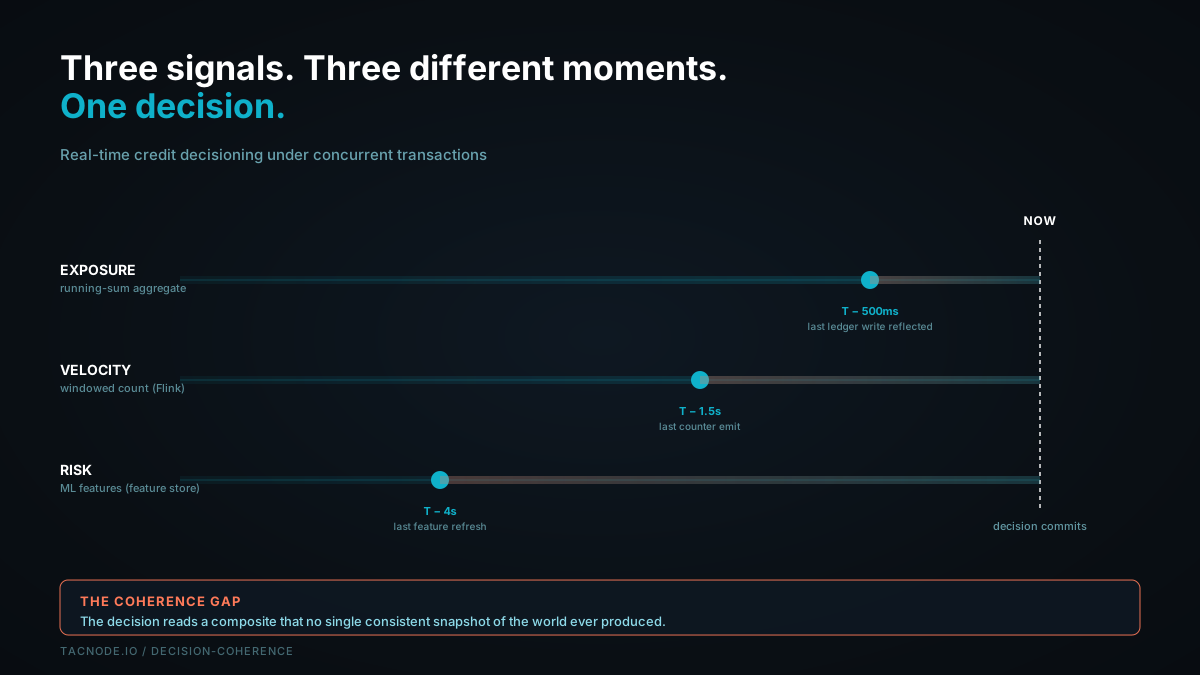
Real-time credit decisioning is not batch underwriting with a faster SLA. Every transaction reads three derived signals — exposure, velocity, and risk — from separate pipelines that drift under concurrent load. The composite a decision reads is a chimera, correct only in the sense that each part was correct against its own snapshot.
TL;DR: Real-time credit decisioning is not batch underwriting with a faster SLA. Every transaction reads three derived signals — exposure (how much the customer already owes), velocity (transaction rate across channels), and risk (model score with recent features). Each signal lives in its own pipeline with its own propagation delay. Under concurrent transactions across merchants or channels, the three signals are from three different moments, and the decision commits against an incoherent composite. The fix is a unified serving layer that holds exposure, velocity, and risk state continuously coherent under load — not a faster feature store, not a better cache.
Batch underwriting scores an application once and persists the outcome. Real-time credit decisioning scores every transaction — and has to read exposure, velocity, and risk state that changes every time another transaction commits. The difference is not latency. It’s that three separate derivation pipelines feed the same decision, and under concurrency they drift apart.
Every BNPL approval, revolving-credit authorization, and charge-card limit check has the same shape at decision time: read current exposure, read rolling velocity, read the risk score, compose a decision, commit inside a 100–400 millisecond window. This post walks the architecture those decisions actually run on, names where it fails under concurrent load, and describes what a decision-coherent architecture has to do differently.
What Real-Time Credit Decisioning Actually Is
Real-time credit decisioning is the architectural category where every transaction — not just the account-opening application — triggers an automated credit decision that must commit before the transaction completes. BNPL checkouts, revolving credit authorizations, charge-card per-transaction limits, and trade-finance per-draw approvals all follow this shape: read derived context (exposure, velocity, risk), compose an approve/decline, and act inside a sub-second window.
The terminology collapses two different architectures that have been sharing a name. The first — traditional underwriting — evaluates an applicant once, produces a line of credit, and persists it. That decision runs on batch data, happens rarely per customer, and has hours-to-days of latency budget. The second — real-time credit decisioning — evaluates every individual transaction against that line, and must reflect all transactions that committed since the last decision. That decision runs on streaming-fresh derived state, happens many times per customer per day, and has milliseconds of latency budget.
When financial institutions build BNPL, per-transaction credit, live exposure checks, or charge-card authorizations on top of infrastructure designed for the first pattern, the seams show up under concurrent load. The batch pipeline that was acceptable for applicant underwriting and loan origination is not acceptable for per-transaction decisioning, and the gap is not about speed — it is about which transactions the derived state reflects.
From Credit Bureaus to Real-Time Data
Traditional credit decisioning ran on a narrow set of data sources: credit bureau reports, credit history spanning months or years, credit scores aggregated from historical data, and manual reviews for edge cases. Financial institutions evaluated loan origination against bureau data, assigned a credit score, issued a line or declined. The decision window was days. The data window was months. Bureau data updated monthly at best, and credit teams relied on static data to inform credit applications.
Modern credit decisioning extends this base with alternative data. Cash flow data pulled from open-banking APIs. Payment behavior captured from transaction history. Device, session, and geolocation signals. Employment and income verification through payroll data sources. Behavioral data from the customer’s direct interactions with the lender. Alternative data sources turn traditional thin-file cases into approvable customer segments by giving risk models signals bureau data alone cannot provide. AI-powered predictive analytics over combined historical, bureau, and real-time data enables customer-lifecycle risk assessment that legacy systems were not built to deliver.
What changes in real-time credit decisioning is not the addition of data sources — credit decisioning software has been aggregating alternative data for a decade — it is the window in which those sources must reflect reality. Per-transaction credit decisions run against a composite of bureau data, alternative data, cash flow data, and real-time transaction history that has to arrive coherent at decision time. Traditional credit scores are computed against historical data on a periodic cycle. Real-time credit decisions are computed against up-to-date information every time a customer transacts, combining real-time data with bureau-grade depth. That shift is the one legacy lending processes were not built for.
The Three Derivations Every Real-Time Credit Decision Reads
Every real-time credit decision reads some combination of three derived signals. They are computed by different pipelines, stored in different places, and propagate at different rates.
Exposure is the running sum of what the customer already owes across all merchants, channels, and commitments. For a BNPL provider this is the total of outstanding installments plus in-flight authorizations. For a charge-card program it is the aggregate of unbilled transactions. For revolving credit it is current balance plus pending authorizations. Exposure is shared state: every new transaction increments it, every payment decrements it, and the decision must reflect every commit that landed before it.
Velocity is the rate of transactions, across dimensions the underwriting model cares about. Per-merchant velocity. Per-channel velocity. Per-category velocity. Cross-device velocity. These are rolling windowed counts, typically maintained by a stream processor against event data. Velocity is the signal that distinguishes a legitimate spending pattern from a cascade that suggests loss of control, fraud, or card-testing — the three failure modes credit operations actually pay to prevent.
Risk is the model’s output: a score produced by an AI-powered machine learning model trained on labeled credit outcomes, scored by predictive analytics over the customer’s payment history, payment behavior, and behavioral data. The feature vector combines static customer attributes (credit tier, tenure, employment, credit score), dynamic behavioral signals (recent payment history, recent velocity deltas, recent device-and-location patterns), alternative data inputs (cash flow data, bureau data, external data sources), and derived indicators (embedding similarities to known fraud rings, cross-channel risk propagation). Modern risk models increasingly include AI models trained on non-traditional credit signals to enhance risk assessment for existing customers and low-risk customers alike. The score is one number, but the features it ran against came from a feature store that refreshes on its own cadence — and that cadence is where concentration risk and portfolio risk decisions that should have caught a pattern instead commit against a stale composite.
At decision time, the authorization service reads all three. It composes them against the credit policy — is the transaction within available exposure, does velocity stay within risk-tier bounds, does the risk score clear the approval threshold — and commits an outcome. The logic is correct. The problem is that the three signals arrive from three different pipelines at three different propagation stages, and under concurrent load those stages diverge.
Why Each Derivation Has Its Own Pipeline
In production credit decisioning stacks, exposure, velocity, and risk live in separate systems because each has different compute and freshness requirements that no single system handles well.
Exposure is maintained against the source-of-record transaction ledger. When a transaction commits, the ledger records it; a CDC stream emits the change; a running-sum job consumes the stream and updates an exposure aggregate; the aggregate lands in a fast serving store (Redis, a dedicated counter service, or a feature store). The pipeline is short but has multiple hops, and each hop has propagation latency. Under normal load the exposure the authorization service reads is a few hundred milliseconds behind the ledger. Under concurrent load, the lag widens because the running-sum job has more events to process. Context under concurrency explains the mechanics of why.
Velocity is maintained by a stream processor — almost always Flink or Kafka Streams — that holds per-dimension windowed counts in operator state (RocksDB-backed) and emits updates to a serving store. Flink’s state is excellent for stream computation. Reading that state from outside Flink requires emitting it to a downstream store, which introduces its own propagation delay. The velocity counter the authorization service reads is the last emitted value, not the current state inside Flink’s operator.
Risk is computed by a model server that reads features from a feature store. The feature store (Tecton, Feast, Redis-backed custom, or DynamoDB) is optimized for low-latency reads of pre-materialized features. The refresh cadence — how often a feature is recomputed from upstream events — is typically seconds to minutes depending on the feature. A feature vector read at time T reflects the feature-store’s state at T, which may reflect upstream events from several seconds prior.
Three systems, three pipelines, three propagation delays. The architecture is correct for the problem as each pipeline was originally framed. The decision that composes all three reads is where coherence breaks.
Where the Derivations Diverge Under Concurrent Transactions
The failure mode is not latency. The failure mode is that concurrent transactions against the same customer each read a version of the three signals that is frozen at a different moment, and each commits against a composite that no coherent snapshot ever produced.
A concrete walkthrough. A BNPL customer has a $2,000 line. They begin checkout at Merchant A for $800 at 2:14:05 pm. Simultaneously, on a different device, they begin checkout at Merchant B for $1,500 at 2:14:05 pm. Both checkouts hit the BNPL provider’s authorization service within the same 400ms window.
The authorization service for Merchant A’s request reads: exposure $400 (reflecting past transactions), velocity 1 per hour (normal), risk score 0.12 (low). Policy: approved exposure + new transaction ≤ $2,000, velocity ≤ 5 per hour, risk ≤ 0.4. $400 + $800 = $1,200 ≤ $2,000. Velocity 1 ≤ 5. Risk 0.12 ≤ 0.4. Approve.
The authorization service for Merchant B’s request reads within the same window: exposure $400 (unchanged — Merchant A’s authorization has not propagated to the exposure aggregate), velocity 1 per hour (unchanged — velocity counter has not incremented), risk score 0.12 (unchanged). $400 + $1,500 = $1,900 ≤ $2,000. Approve.
Total approved exposure: $2,700 on a $2,000 line. Both authorizations committed against a correct reading of the exposure aggregate as of 2:14:04pm. The exposure aggregate had not absorbed either authorization before either decision read it. By the time the aggregate reflects $1,200 (after Merchant A propagates), Merchant B’s approval has already committed. By the time it reflects $2,700, both have cleared.
No individual decision was wrong against what it could see. The architecture correctly prevented anything above $2,000 once the aggregate was current — but the aggregate was never current during the window when both decisions were making their call. This is pipeline lag under concurrent load, and it is identical in shape to the velocity counter failure that breaks real-time fraud detection. Fraud detection is the most-studied instance. Credit decisioning is the one with direct regulatory and customer-financial consequences.
The same pattern plays out across channels. A customer with a $5,000 revolving line has $3,000 of utilization visible in Redis cache. A card-present transaction for $1,500 authorizes (total $4,500, approved). Simultaneously, an ACH pull for $800 initiates from the same account. The ACH system reads its own utilization cache, sees $3,000 (the card authorization has not yet propagated), passes the available-credit check, and commits. Total authorized: $5,300 against $5,000 available. No cross-channel event bus was fast enough to surface the card authorization to the ACH pipeline before the ACH decision ran.
Why Batch Underwriting Doesn’t Transfer
Teams building real-time credit decisioning often start with the infrastructure that handled batch underwriting — a nightly pipeline that ingests transaction data, recomputes exposure and risk features overnight, lands them in a feature store, and serves them to an authorization service the next day. This works when the decision window is hours and the risk tolerance is loss-rate-based. It breaks when the decision window is milliseconds and the risk tolerance is per-transaction.
The batch pipeline has two structural properties that disqualify it for per-transaction decisioning. The first is refresh cadence: overnight batch means every decision made between midnight and the next batch runs against yesterday’s state. For applicant underwriting that is fine — the line is persistent, and the next batch catches up. For per-transaction decisioning it is catastrophic, because transactions that committed after midnight are invisible to the decision.
The second property is coherence guarantees. Batch pipelines typically do not guarantee that the exposure aggregate, the velocity counter, and the risk features are computed against the same set of transactions. Different jobs run on different schedules, read from different upstream offsets, and land their outputs independently. When the decision composes all three, the composite is a chimera — correct only in the sense that each part was computed correctly against its own snapshot.
Teams often respond to the refresh problem by running the batch pipeline faster: micro-batches, incremental updates, CDC-driven refresh. Each speedup helps. None of them closes the coherence gap, because the gap is architectural — multiple pipelines propagating independently — not about how fast any single pipeline runs. Why real-time decisions fail walks the three failure modes that recur regardless of how fast each pipeline gets individually.
A Decision-Coherent Credit Architecture
If the three-pipeline stack has structural coherence problems, what replaces it? Not a faster version of the same stack. A single serving layer that holds exposure, velocity, and risk state continuously under one coherent snapshot — what Tacnode calls a Context Lake.
Four properties define it.
One read path for all three derivations. When the authorization service reads exposure, velocity, and the risk feature vector, it reads all three from the same serving layer under one logical snapshot. There are no inconsistent reads because there is not a separate exposure cache, a separate velocity counter store, and a separate feature store to drift from each other. Every composite read is internally coherent because it comes from the same set of ingested events.
Incremental maintenance of exposure and velocity. When a transaction commits upstream, the exposure aggregate and the velocity counter update incrementally in sub-second time — not on a Flink checkpoint, not on a feature-store batch refresh. The pipeline lag collapses to the propagation latency of the change, which is bounded by the system’s own ingest path rather than by a downstream pipeline’s schedule.
On-demand computation against coherent data. Some credit signals can’t be usefully pre-maintained because they are defined against arbitrary windows or entity combinations: a BNPL provider may need “exposure across this customer’s related-party accounts in the last 30 days” or “velocity of this device across our merchant network this hour.” These resolve at query time against the same snapshot the rest of the decision reads — not against a separately-materialized view that drifts from the live aggregate.
Write semantics that match the decision’s concurrency model. When Tacnode is authoritative for an aggregate, concurrent writes to the same exposure record serialize at the storage layer — two simultaneous authorizations cannot both commit against a stale read of the shared aggregate. The system surfaces conflicts that matter, rather than hiding them behind independent pipelines that each see a pre-conflict snapshot.
The production shape is that exposure, velocity, and per-entity risk features live as incrementally-maintained views in the context layer. The authorization service’s read path becomes a single query against that layer, returning a consistent snapshot the policy engine evaluates. The Kafka and stream-processing layer upstream still exists — it is how events enter the system — but the downstream divergence between exposure cache, velocity store, and feature store is eliminated.
Where This Fits in the Credit Decision Waterfall
Real-time credit decisioning is rarely a single check — it is a waterfall. A typical authorization flow runs identity verification first, then eligibility and KYC/KYB status, then available exposure, then velocity rules, then the risk score, then fraud checks, and finally the credit approval composition. Each step reads state. Most operators route between orchestration platforms — Alloy, Provenir, Taktile, LendAPI — that sequence the calls: identity from one provider, KYC data from another, exposure from the ledger, velocity from the stream processor, risk from the model server, fraud signals from a separate scoring service.
The coherence argument lives in the middle of this waterfall. Identity and KYC are typically static enough to cache effectively — changes propagate in minutes, not milliseconds. Exposure, velocity, and risk are the three reads that change with every transaction, and they are the three where composed-stack pipelines diverge under load. An orchestration platform that sequences the waterfall cannot fix the coherence gap inside those reads; it can only sequence the requests against whatever the underlying state stores return. Decision modeling tools that define the waterfall logic assume the state reads are trustworthy at the moment they run — an assumption that breaks down exactly where the three-pipeline composite drifts.
Placing the context layer at the state-reading step of the waterfall — between the orchestration engine that sequences the checks and the pipelines that used to serve each check independently — is where the architecture change has leverage. The orchestration engine still waterfalls identity → eligibility → exposure → velocity → risk → fraud → approval. The difference is that exposure, velocity, and risk come from one coherent snapshot instead of three independently-propagating stores.
Vertical Patterns
The shape of real-time credit decisioning changes by product. The underlying context-coherence requirement does not.
BNPL / point-of-sale installments. Decision window: 100–400ms at checkout. Derived context: installment-weighted exposure across active plans, velocity across merchants and devices, a risk score incorporating recent-payment-history features. The canonical failure is the multi-merchant concurrent checkout walkthrough above — two simultaneous approvals against a customer line that should only support one.
Revolving credit (cards and lines of credit). Decision window: 100–300ms for authorization. Derived context: current utilization including pending authorizations, velocity across channels (card-present, card-not-present, ACH, wire), risk score for fraud-adjacent signals. Canonical failure: cross-channel approvals that each see a stale utilization number, cumulatively exceeding the line.
Charge-card per-transaction authorization. Decision window: 100–400ms. Derived context: cardholder exposure against the corporate program’s credit policy, merchant-category velocity, per-employee spending pattern risk. Canonical failure: concurrent authorizations across merchants of the same employee racing against a stale exposure total. Similar in shape to BNPL multi-merchant but typically with higher transaction values and tighter corporate-policy constraints.
Trade finance per-draw. Decision window: seconds to minutes (longer than retail). Derived context: facility utilization across all draws, counterparty exposure aggregated across linked facilities, collateral-coverage ratios computed against live valuation. Canonical failure: concurrent draws from multiple borrowers within a related-party structure exceeding the facility’s counterparty limit because each draw read utilization before the prior draws propagated.
Each vertical has the same structure: three derivations, three pipelines, one decision, one window. The architecture that replaces three pipelines with one coherent serving layer applies identically — the constants differ, the pattern does not.
Credit Decisioning Software vs Context Infrastructure
The credit decisioning software market is crowded. Credit decisioning platforms — Provenir, Zest AI, FICO’s decisioning automation, GDS Link, Temenos, Taktile, Alloy — offer end-to-end decisioning platforms with credit decision engines, credit decision tools, and business rules management for credit policies. Cash-flow-underwriting platforms like Pinwheel, Plaid, and MX provide alternative data aggregation. Each of these products solves specific pieces of the credit decision process: business rules, AI model scoring, data aggregation, credit policies orchestration, approval thresholds governance, regulatory compliance workflows, customer segments management, manual reviews escalation.
None of them solve the coherence problem across the full composition. A decisioning platform returns a credit decision against whatever exposure state, velocity counter, and risk score you feed it. The exposure still comes from your ledger’s downstream aggregate. The velocity counter still comes from your stream processor’s feature store. The risk score still comes from an AI model reading a feature vector from somewhere. Under concurrent load, those upstream sources diverge — and the decisioning platform commits a correct decision over an incoherent input. The right credit decisioning software, no matter how well it governs approval thresholds and business rules, cannot observe the cross-read coherence gap upstream of it.
A decision-coherent architecture does not replace the decisioning platform, the AI model server, or the risk management policy engine. It replaces the serving layer they all read from. Credit teams still author credit policies, business rules, and approval thresholds. AI models still score credit applications and transactions, supporting automated credit scoring and instant credit decisions. The credit decision engine still composes them for the final credit approval. But the exposure, velocity, payment history, and risk features the engine reads come from one snapshot at decision time — not from four independently-propagating pipelines whose composite the engine cannot verify. The result is more informed decisions, fewer manual reviews, and higher customer satisfaction — because legitimate transactions that legacy systems would decline for safety are now approvable under risk controls that actually reflect current state.
Explainability, Adverse Action, and the Compliance Surface
Automated credit decisions sit under a regulatory framework that predates real-time infrastructure. The Equal Credit Opportunity Act (ECOA), Regulation B, and the Fair Credit Reporting Act (FCRA) require lenders to explain adverse decisions, produce adverse action notices citing specific reasons, and show that the decision process is consistent, non-discriminatory, and reconstructible. AI-powered credit decisioning amplifies these requirements: regulators and auditors increasingly expect explainable AI (XAI), model fairness audits, feature-importance attribution, and auditable model-to-decision traceability. Capgemini’s AI-powered credit decisioning research and McKinsey’s next-generation credit-decisioning models both center on governance and explainability as first-class architectural concerns.
A composed stack makes these requirements harder. The decision that fired against a specific exposure number, velocity counter, and risk score must be reconstructible against the exact state at decision time. When those inputs came from three pipelines at three different propagation stages, the audit trail has to reconstruct each pipeline’s state independently — and the reconstructed composite may not match what the decision actually saw. Adverse action notices that cite “high velocity” can end up citing a velocity value the decision never actually read, which is the kind of gap that surfaces in regulatory examinations and class-action discovery.
A decision-coherent architecture produces a cleaner compliance surface by design. The snapshot the decision read is a single versioned point in the serving layer. Reconstructing a decision means reading the same snapshot version — one read, one state, one trace. Model governance, feature lineage, adverse action generation, and regulatory compliance reporting all run against the same coherent state the decision ran against. Explainability becomes a property of the architecture, not a separate downstream reconciliation effort — and fair-lending audits stop having to reverse-engineer what three independent pipelines collectively saw at a specific millisecond.
What to Measure
The instinct in credit operations is to measure loss rate, false-positive rate, and authorization p99 — the outcome metrics. These are necessary but not sufficient. Architectures that break under concurrency hide inside those aggregates: the failures look like noise until someone traces a specific loss back to a specific pair of decisions that committed against a composite that never existed.
A decision-coherent credit architecture exposes two diagnostic metrics per decision path.
Aggregate propagation freshness. The time between a transaction committing to the ledger and the corresponding exposure aggregate reflecting it, measured at peak concurrent TPS. This number should live inside the authorization validity window with headroom. In a composed stack it is typically 500ms–several seconds under load; in a decision-coherent stack it should be ~100ms.
Cross-read coherence. For every authorization that composes exposure, velocity, and risk reads, the maximum time-skew between the three reads. In a decision-coherent architecture this number is zero by construction, because all three come from the same snapshot. In a composed stack it is the right telemetry to expose — and it is usually the first place architecture-level loss patterns surface.
A third metric worth tracking specifically for credit: unexpected-approval rate, the rate at which post-hoc reconciliation identifies an authorization that, against the exposure state actually in effect when the decision ran, should have been declined. This is the rate at which the context gap produces a specific business outcome. In a composed stack it is usually low enough to hide in loss aggregates but high enough that individual incidents become the source of policy tightening — and that tightening typically over-corrects, declining legitimate transactions to stay under the unexplained approvals.
Frequently Asked Questions
Where Credit Architectures Go From Here
Credit products are getting more real-time, not less. BNPL volume is growing. Charge-card programs are moving from monthly billing cycles to transaction-level enforcement. Revolving credit is being used in more high-velocity channels. Every one of these trends tightens the decision window and widens the concurrency exposure — and every one of them exposes the three-pipeline architecture more severely.
The architectures that succeed at this scale do not treat real-time credit as batch underwriting run faster. They treat it as a composed decision over live derived state that must remain coherent under the concurrency the business operates at. Exposure, velocity, and risk become views over one serving layer, not outputs of three independent pipelines. The credit decision engine reads one snapshot, evaluates the credit policies, commits the outcome — with no divergence between what the risk models saw about the customer’s current state and what that state actually was. Real-time decisioning at this level, fed by AI-powered predictive analytics over bureau data and alternative data sources under one consistent snapshot, is what modern lending requires and what legacy credit decisioning platforms cannot deliver on their own.