LLM Orchestration: How Frameworks Coordinate Control Flow Across Multiple LLM Instances
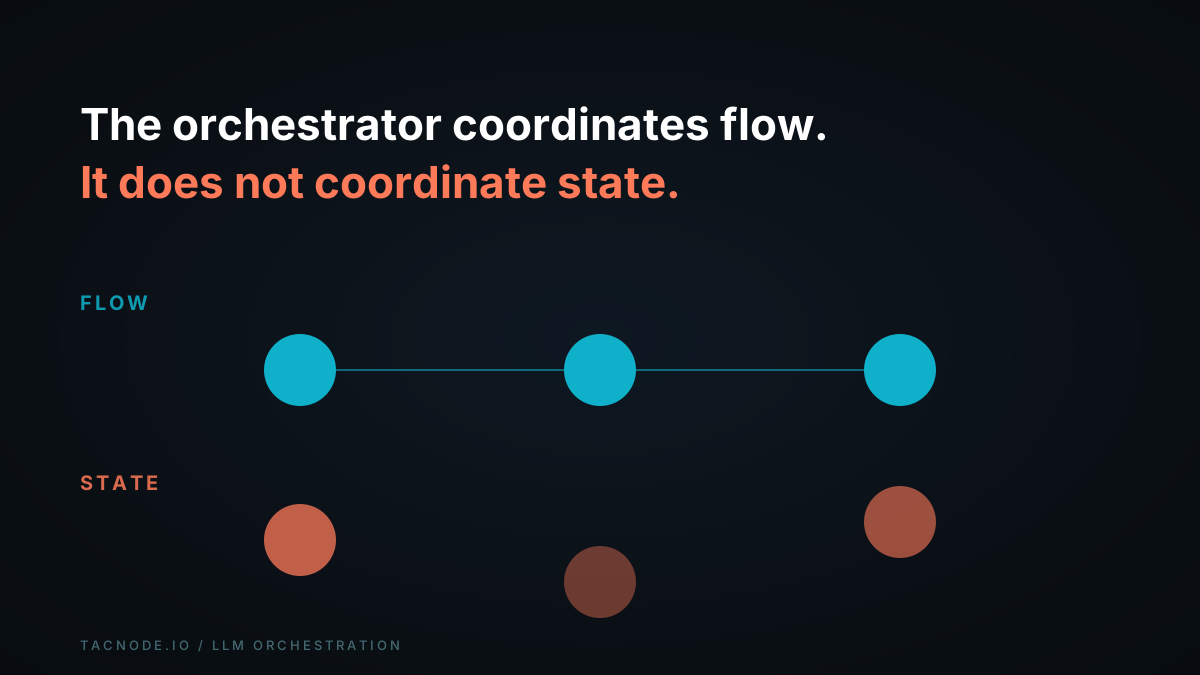
LLM orchestration frameworks — LangGraph, CrewAI, OpenAI Agents SDK, LangChain — coordinate which agent runs next and how handoffs happen. They do not coordinate the shared state every agent reads and writes. Production multi-agent failures are usually state-coherence failures, not workflow failures, and the orchestrator can’t catch them.
TL;DR: LLM orchestration frameworks coordinate control flow across multiple LLM instances and AI agents — which model runs next, how a graph or chain of LLM calls advances, how handoffs happen, how prompt templates render, how multiple LLM providers get load-balanced, how fault tolerance and performance monitoring work. They do not coordinate the shared state every AI agent in the orchestration layer reads from and writes to. When step 3 of a multi-agent LLM orchestration flow reads context that step 1 already invalidated, the orchestration framework cannot catch it. The popular workaround — a Redis cache or vector database in front of the orchestrator — reintroduces the same stale-read problem that hits Flink+Redis stacks. The fix is a state-coherent serving layer under the orchestration layer: structured account state, derived agent state, plan state, and semantic context from vector stores, all served under one snapshot. The LLM orchestration framework keeps owning flow; the Context Lake owns state.
A planner LLM kicks off a three-step underwriting flow inside an LLM orchestration system. The verifier confirms eligibility against the customer’s account. The decision agent approves a credit line. By the time the decision commits, the same customer has already drawn against another line at a different merchant in the last 600 milliseconds — and the verifier read its eligibility against a snapshot that didn’t include it. The orchestration framework routed the graph correctly. Every AI agent in the LLM orchestration pipeline did its job. The decision was wrong because no two LLM instances in the orchestration layer ever saw the same state at the same moment.
This post walks what LLM orchestration is doing in production AI applications, what LLM orchestration frameworks like LangGraph, CrewAI, the OpenAI Agents SDK, LangChain, Semantic Kernel, Autogen, IBM watsonx Orchestrate, and AWS Bedrock Agents each coordinate, and the dimension none of these LLM orchestration systems address: shared state across multiple LLM instances and agent orchestration flows. (For the broader background on AI agents in production, see LLM agents: a complete guide.) It describes what a decision-coherent architecture does differently — not by replacing the orchestration layer, but by giving every LLM call in the orchestrated flow one internally coherent snapshot to read from and one transactional layer to write to.
What Is LLM Orchestration?
LLM orchestration is the pattern of coordinating multi-step or multi-agent LLM interactions across one or more large language models — chaining individual LLM calls, routing between AI agents, managing handoffs, parallelizing tool invocations against external systems and external APIs, retrieving relevant context from vector databases, composing planner-executor-reviewer structures, monitoring performance metrics, and managing prompt templates — so a single user request resolves through a coordinated sequence of LLM calls rather than a single inference. LLM orchestration frameworks provide the orchestration layer that handles this coordination across multiple LLM providers, vector stores, and data sources.
The shape of LLM orchestration became necessary as soon as production LLM applications stopped being single-shot. Once a request requires a planner LLM to decompose a complex task, a tool agent to execute one or more sub-steps against external systems, and a reviewer to validate the LLM outputs, the LLM-powered application is no longer one inference call — it is an LLM orchestration pipeline with branches, retries, parallelism, and handoffs across multiple models. Hand-rolling that pipeline in application code works for the first version. By the third or fourth iteration, teams reach for an LLM orchestration framework.
What every LLM orchestration framework coordinates is the flow: which node runs next, what happens on a tool failure, how a parallel sub-tree of LLM calls merges back, how a graph terminates, how the orchestration layer manages timeouts and retries, how prompt management and version control over prompt templates work. What no LLM orchestration system coordinates natively is the state the AI agents in that flow read from and write to.
How LLM Orchestration Frameworks Work
An LLM orchestration framework sits between the application and the underlying language models. The orchestration layer acts as the control plane: it accepts an incoming request, decides which LLM call to make first, formats LLM inputs through prompt templates, routes the request to one of multiple LLM providers based on cost efficiency and the most suitable models for the task, parses LLM outputs and LLM responses, decides what to do next based on those LLM responses, fires parallel API calls or tool invocations as needed, retrieves relevant data from data sources or vector databases, and composes the final result.
A modern LLM orchestration system typically integrates with multiple LLM providers — OpenAI, Anthropic, Google, open-source language models served via vLLM or Ollama, fine-tuned ai models on internal infrastructure — and routes between them based on the complex task at hand. Some flows route simple classification through cheaper models and reserve the most suitable models for harder reasoning steps. Others run multiple models in parallel for ensemble decisions. The orchestration framework is what makes routing across multiple LLM providers tractable; without it, every LLM-powered application has to hand-roll model-selection logic, prompt management, retry policy, and output parsing.
Beyond routing, a production LLM orchestration system handles prompt engineering through reusable prompt templates with version control, manages memory across LLM interactions and past interactions, retrieves relevant context from vector databases or vector stores via retrieval augmented generation (RAG), provides fault tolerance against transient LLM API failures, supports load balancing across multiple LLM instances for high-throughput workloads, exposes performance monitoring that tracks key metrics around latency and cost, manages computational resources and resource utilization, and integrates with external APIs and data storage for tool use. The orchestration layer acts as the cohesive system that ties prompt management, memory management, data retrieval, api integration, and model interactions together into one developer surface.
LLM Orchestration Frameworks: A Survey of the Major Options
The LLM orchestration framework landscape is crowded. The right LLM orchestration framework for a given team depends on language preferences, deployment model, the shape of the application’s complex workflows, and which external systems and data sources the AI agents need to integrate with.
LangGraph models the LLM orchestration flow as a graph of nodes connected by edges, with explicit state threaded through each node. Cycles are first-class — iterative refinement, plan-execute-replan, hierarchical supervisors. The state object passes through every node in the orchestration layer. LangGraph handles prompt management through prompt templates, integrates with vector databases for RAG, and provides observability hooks for performance metrics. LangGraph does not provide concurrency control over shared state when parallel nodes mutate it.
CrewAI models the LLM orchestration flow as a crew of role-defined AI agents with goals and tasks, sequential or hierarchical. Shared context flows through task descriptions and LLM outputs, not an explicit shared state schema. CrewAI is positioned as a generative AI collaboration platform for multi-agent workflows and supports tool use, memory management, and integration with external APIs.
OpenAI Agents SDK centers on a handoffs primitive — one AI agent transfers control to another, the SDK traces it. Function calling is native, model context protocol support is emerging, and the SDK is intentionally minimal. Shared state across the LLM orchestration flow is application-defined.
LangChain is the original LLM orchestration framework — chain composition, retrieval augmented generation patterns, tool calling, AI agent abstractions, integrations with most vector databases, vector stores, and LLM providers. Modern LangChain pushes stateful flows into LangGraph and keeps the chain layer for non-cyclic LLM applications and the broad integration ecosystem covering data sources and external systems.
Semantic Kernel is Microsoft’s plugin-based LLM orchestration framework with a planner concept and native .NET and Python support. Plugins expose functions to the language models; the planner composes a sequence of plugin calls to satisfy a goal.
Autogen is Microsoft Research’s conversational multi-agent LLM orchestration framework where chat history is the medium of state transfer between AI agents.
IBM watsonx Orchestrate is the enterprise wrapper for LLM orchestration — low-code agent assembly, prebuilt automations, integration with IBM’s broader stack of AI systems and data sources. IBM watsonx Orchestrate emphasizes workflow automation and api integration with existing enterprise applications.
AWS Bedrock Agents is the managed LLM orchestration offering on AWS. Action groups define what tools an AI agent can call; knowledge bases provide retrieval; the runtime handles the agent loop.
Beyond these mainstream LLM orchestration frameworks, emerging orchestration frameworks include Haystack, LlamaIndex Agent Workflows, DSPy for prompt optimization, Portkey as an LLM gateway and orchestration layer, and platform-specific tools from major cloud providers. Each makes different tradeoffs around prompt management, memory management, fault tolerance, and integration with vector stores and external systems.
Across all of them, the orchestration layer is the layer that knows what should run when. It is not the layer that knows what each running LLM call should see.
Core Capabilities of an LLM Orchestration System
A production-grade LLM orchestration system has to handle several capabilities beyond just routing LLM calls. Each capability is what separates a hand-rolled prototype from a robust LLM orchestration framework.
Prompt engineering and prompt management. Prompt templates are the unit of LLM input definition. Mature LLM orchestration frameworks provide prompt management with version control so that prompt changes can be reviewed, tested, and rolled back without redeploying application code. Prompt templates parameterize each LLM input with relevant context retrieved at runtime, enabling consistent LLM responses across thousands of model interactions per day.
Memory management and past interactions. For multi-turn LLM interactions and AI agents that need continuity across sessions, the orchestration layer maintains memory — short-term working memory for the current conversation, long-term memory across past interactions, and intermediate memory for the current orchestrated flow. Memory management directly affects how AI agents handle complex tasks that span multiple LLM calls.
Retrieval augmented generation. RAG is the dominant pattern for grounding LLM responses in relevant data and reducing hallucination. The LLM orchestration framework integrates with vector databases or vector stores to retrieve relevant context for each LLM call. Common vector databases include Pinecone, Weaviate, Milvus, Qdrant, and pgvector. The orchestration layer composes the data retrieval step with the LLM call so that retrieved relevant information appears as part of the LLM input. This is the dominant pattern in context augmented LLM applications today.
API integration with external systems. Most useful LLM applications make API calls to external APIs and external systems — CRMs, ERPs, ticketing systems, internal databases, third-party data sources. Tool use lets the AI agent trigger these API calls based on context. The LLM orchestration framework handles the api integration layer, exposing a uniform tool-call interface across heterogeneous external apis.
Fault tolerance. LLM API providers occasionally return errors, hit rate limits, or time out. A production LLM orchestration system handles transient failures with retry policies, circuit breakers, and graceful degradation across multiple LLM providers — falling back to a different provider or a different model when the primary one fails.
Load balancing. When LLM-powered applications scale to high request volume, the orchestration layer load-balances LLM calls across multiple LLM instances or multiple LLM providers, optimizing for cost efficiency, latency, and resource utilization.
Performance monitoring and key metrics. Production LLM orchestration systems track key metrics — latency per LLM call, cost per request, token usage, error rate per provider, retrieval relevance, end-to-end success rate. Performance monitoring closes the feedback loop on cost efficiency and resource management.
Resource management and computational resources. LLM workloads consume serious computational resources. Resource management means routing the right LLM call to the right model — the most suitable models for the task, not always the largest — for cost and resource utilization gains. The right LLM orchestration framework gives ops teams visibility into resource utilization across the whole stack.
Data retrieval and data sources. Beyond vector databases, LLM orchestration frameworks integrate with structured data sources — databases, APIs, files, data storage layers. Data retrieval has to be coordinated with the LLM call so that the model sees the relevant information at the right point in the flow.
These capabilities are what every LLM orchestration framework provides in some form. They are necessary. They are also not sufficient — and the part that is missing is what this post is about.
What LLM Orchestration Frameworks Don’t Coordinate: Shared State
Every step in a multi-agent LLM orchestration flow does two things: it reads context (customer balance, recent transactions, prior agent outputs, tool results, retrieved relevant context) and it writes context (its own decision, an updated plan, a new fact, an action against external systems). The orchestration layer coordinates which step happens when. The orchestration layer does not coordinate which version of state each LLM call reads, nor whether one step’s writes are visible to subsequent steps before they run.
For a single-agent LLM application with no parallelism and no concurrent users, this is invisible — the orchestration framework’s state object passes through cleanly between LLM calls. It becomes visible the moment any of three things is true: the orchestrated flow has parallel branches, the flow reads from external systems whose state changes during the flow, or multiple users hit the same LLM-powered application concurrently against shared resources. In production AI applications, all three are usually true.
The state an AI agent flow needs to read divides into four shapes — structured authoritative state in transactional databases, derived state from streaming aggregations, agent-internal state the orchestration system itself produces, and semantic context from vector databases and vector stores. A production multi-agent LLM orchestration flow typically composes reads across all four. Correctness depends on those reads composing into one coherent view of the world. Orchestration frameworks do not produce that coherence.
This is where most production agent orchestration deployments quietly fail. The framework runs the AI agents correctly. The vector databases return relevant data correctly. The prompt templates render correctly. The fault tolerance handles transient failures correctly. The performance monitoring shows green across all key metrics. And the decisions the orchestrated flow commits are wrong because each LLM call in the multi llm orchestration saw a different version of state.
Three Failure Modes in Multi-Agent LLM Orchestration
Three failure shapes recur across production LLM orchestration deployments. They look different in the application logs but share the same underlying mechanic — AI agents in an orchestrated flow reading from state that has drifted between when one LLM call saw it and when the next did. Multi-agent architecture covers the broader coordination-pattern landscape; this section walks the failure shapes that show up specifically inside agent orchestration flows where each step is an LLM call.
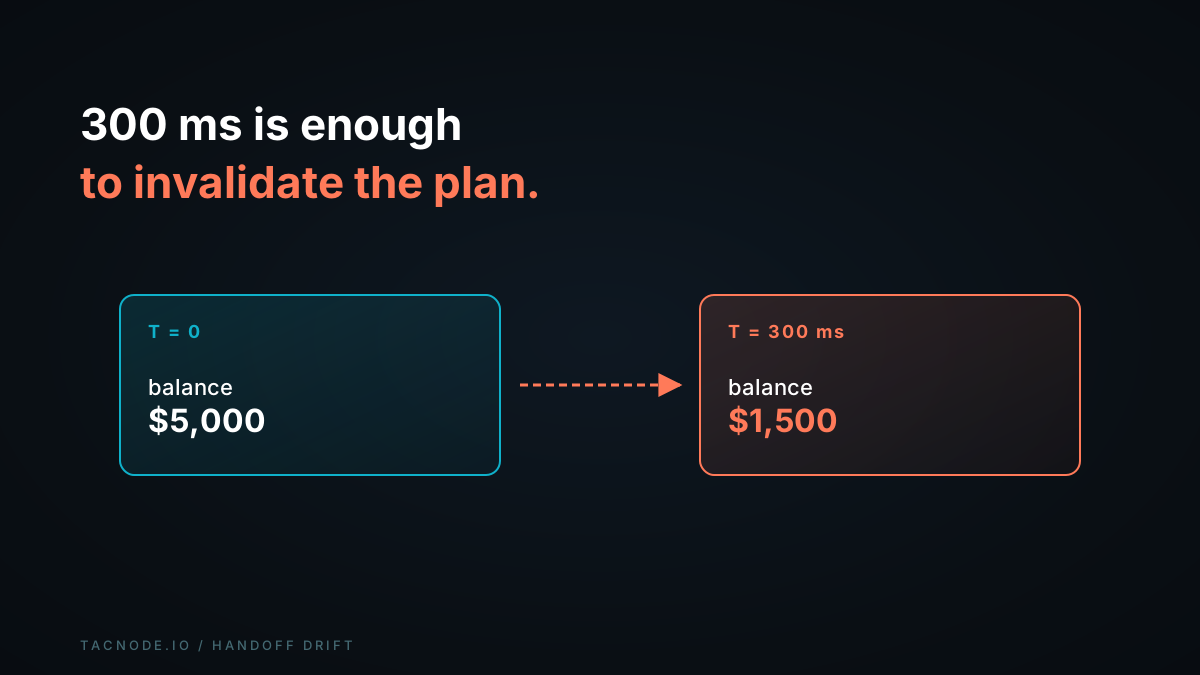
The canonical failure: 300 ms between Planner and Executor is enough for the underlying state to move, and the orchestrator has no visibility into the gap.
The Cache-in-Front Pattern (and Why It Fails)
The canonical production response to “AI agents need shared state” is to put a cache or database in front of the LLM orchestration framework and have every agent read from it. Redis is the most common choice; Postgres for structured state; sometimes a feature store or a vector database in the same role.
This pattern produces the same stale, divergent reads that hit Flink + Redis architectures. The cache is downstream of the actual source of truth, and propagation between source and cache is asynchronous. Writes from upstream systems land in the cache after a delay that varies with load. Writes from one agent flow land in the cache after a delay that varies with the cache’s write path. Reads from another agent flow see whatever the cache has at the moment of the read — a snapshot of the past.
Under concurrent multi-agent LLM orchestration activity, the cache hosts state that is internally consistent with itself but inconsistent with the source. Two parallel agent flows read the same value from the cache even though the source has already advanced; both make decisions against the same stale view; both commit. The cache’s lag becomes the system’s coherence floor. The LLM orchestration framework’s fault tolerance does not catch it — the framework has no visibility into the cache’s lag, only into LLM responses and tool call results.
Stateful stream processing for decisions walks the same mechanic for Flink+Redis. The orchestrator+Redis version is the same gap at a new layer. The fix is also the same: derived aggregates and the serving path live inside one transactional layer, not in a cache the orchestration layer emits to.
A State-Coherent LLM Orchestration Architecture (and Agent Orchestration Architecture)
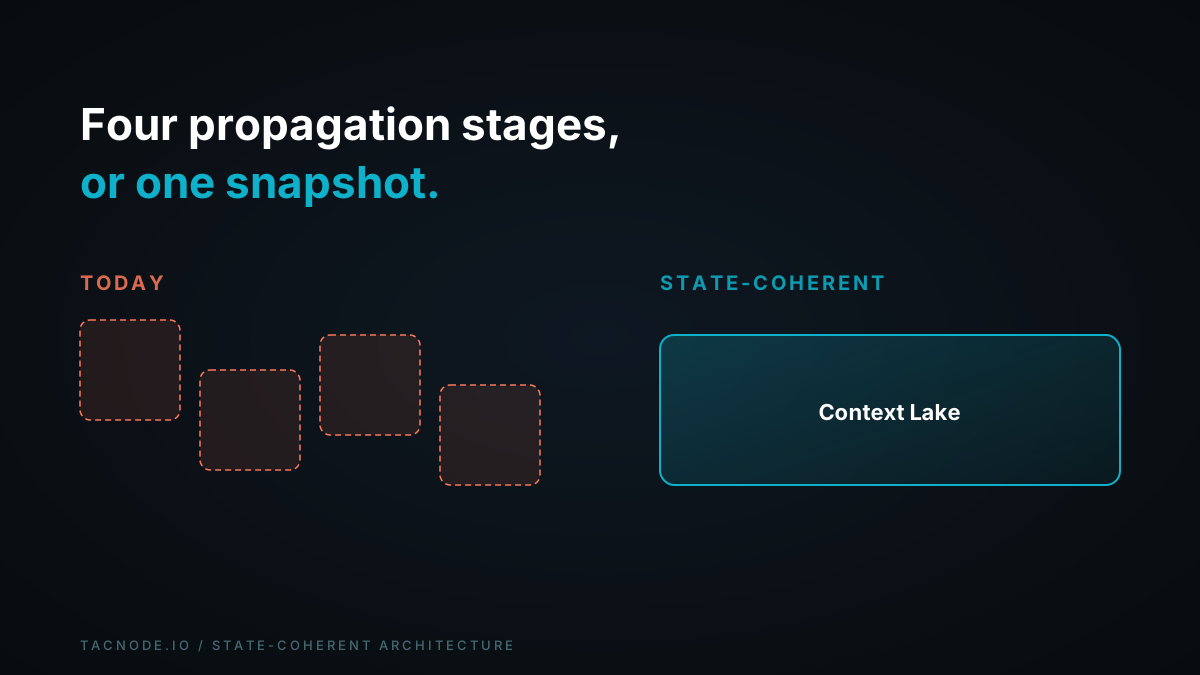
The orchestration framework’s API is unchanged. What changes is what each agent’s reads and writes pass through underneath.
What changes is not the LLM orchestration framework. LangGraph still owns the graph. The OpenAI Agents SDK still owns handoffs. CrewAI still owns roles and tasks. IBM watsonx Orchestrate still owns workflow automation. AWS Bedrock Agents still owns action groups. The orchestration framework keeps every responsibility it currently has — composition, tracing, retries, parallelism, prompt management, performance monitoring, fault tolerance, load balancing across multiple LLM providers, the developer API.
What changes is the layer underneath. Shared state moves from “Redis cache plus maybe Postgres plus maybe a feature store plus maybe a vector index” to a single serving layer that holds all four shapes — structured authoritative state, derived state, agent-internal state, semantic context from vector stores — and serves them under one internally coherent snapshot to every LLM call in the orchestrated flow. This is the cohesive system the LLM orchestration framework was always supposed to be sitting on top of.
For state Tacnode itself owns — agent state, plan state, intermediate tool outputs, decision audit trails — ACID transactions apply. Parallel tool calls writing to the same plan state get serialized; supervisor reviews see a consistent post-write view of subordinate work; concurrent flows competing for the same shared resource get the conflict resolution a transactional system provides. This is the Pattern 2 framing in Tacnode’s architecture: when Tacnode is the authoritative store, write-conflict prevention is real and direct. ACID for agents walks the broader case for transactional semantics under agent orchestration in detail.
For state read from external systems-of-record via CDC or Kafka, Tacnode is not in the write path; the source ledger remains the source of truth. What Tacnode provides is an internally coherent view across all the derived signals computed against that stream. The AI agent reads the customer’s balance, the velocity count, and the exposure aggregate as they all stood relative to the same set of ingested events. The reads are coherent with each other — and for cross-agent decision-making across a multi-agent LLM orchestration flow, cross-signal coherence is what matters.
The LLM orchestration framework’s API does not change. A LangGraph node still defines its inputs and outputs. A CrewAI agent still has its role and goal. The OpenAI Agents SDK still hands off. What changes is what each LLM call’s reads and writes go through — one layer, one snapshot, one transactional boundary for state the layer owns. The orchestration layer continues to handle complex workflows, smooth transitions between LLM calls, and api integration with external apis and data sources; the state layer underneath handles coherence.
LLM Orchestration in Production: Use Cases
LLM orchestration powers production AI applications that have to act in dynamic environments where stale predictions miss the decision window. The use cases span verticals; the orchestration concerns are shared across all of them.
Multi-agent fraud assessment. A fraud-investigation flow decomposes a single suspicious transaction into a planner that identifies what to check, specialist tool agents that pull velocity, exposure, device signal, and recent-activity views from data sources, and a reviewer that composes the findings into a decision. Every specialist’s read needs to be coherent; the reviewer’s composition is wrong if the velocity read is from 30 seconds ago and the exposure read is from 5 seconds ago. Real-time fraud detection architecture covers the underlying single-decision version of the same problem.
Multi-step credit underwriting. An LLM-orchestrated flow validates identity, pulls bureau data, computes exposure, runs an internal model, and commits a decision. Each step makes API calls to external systems and reads relevant data. Concurrent applications by the same applicant expose handoff drift across the LLM orchestration flow.
Customer-support copilots. These orchestrate retrieval from data sources, account lookup, account-action tool calls, and supervisor-style review. The state surface includes the customer’s account record, recent ticket history, the partial conversation, and any in-flight account changes — all read through prompt templates that compose retrieved relevant context with conversational past interactions. Production support copilots run thousands of LLM interactions per hour and quickly surface the shared-state gap under concurrent load.
Workflow automation in enterprise SaaS. Tools like IBM watsonx Orchestrate are positioned as workflow automation layers built on top of LLM orchestration. The orchestration layer composes complex processes across data sources, external apis, approval gates, and AI agents that handle subsets of the broader business workflow.
Code-generation and code-review AI agents with shared workspace state run into parallel-tool-call inconsistency: two agents writing to the same file, two parallel test runs against an evolving test suite, a supervisor reviewing a diff against a workspace that has already advanced. The orchestration framework parallelizes correctly; the workspace’s lack of a serialization point produces the inconsistency.
Across all of these, the underlying shape is the same: the LLM orchestration framework is doing its job; the gap is at the state layer the orchestration layer does not own.
What to Measure in an LLM Orchestration System
If the architecture is “LLM orchestration framework plus shared cache or shared store,” the telemetry that diagnoses the state-coherence gap is rarely instrumented by default — even though most LLM orchestration systems already track key metrics for latency, cost, and LLM API success rate.
Inter-step state divergence. For consecutive LLM calls in a flow that read overlapping state, the time skew between when each step’s read reflected its source. Surface per (step pair, state key) so specific seams become visible.
Parallel-read skew across multiple LLM instances. When a flow fires multiple tool calls or sub-agents in parallel, all reading the same key, the maximum delta between the values each one observed. In a single-snapshot serving layer, this is zero by construction. In a cache-in-front architecture, it is the signal that cache lag is producing inconsistent reads.
Plan invalidation rate. Of plans built by a planner agent, the fraction that, by the time the executor begins, are no longer valid against the current state. This is the operational measure of how often handoff drift is corrupting the LLM orchestration flow.
Post-hoc reconciliation delta. For a sample of completed multi-agent LLM orchestration flows, the rate at which a reconciled view of state at decision time would have produced a different decision than the orchestrated flow committed. The business-outcome version of the coherence gap.
Concurrent-write conflict rate on agent-internal state. For state the LLM orchestration system itself owns, the rate at which two concurrent agent flows attempt to write to the same key. Without a transactional layer, last-write-wins; with one, conflicts are detected and resolved.
These are key metrics most LLM orchestration deployments do not track key metrics for yet. Adding them is the first step in moving from “we have an LLM orchestration framework that runs flows” to “we have an LLM orchestration system that produces correct outcomes.”
Frequently Asked Questions
Where LLM Orchestration Goes From Here
The trajectory of LLM orchestration is toward orchestrated flows that run faster, span more AI agents, fire more parallel LLM calls, and operate against state that changes more frequently. Each of these trends widens the gap the orchestration layer does not close. Emerging orchestration frameworks add capabilities like model context protocol support, more sophisticated prompt management, better integration with vector stores and data sources, and improved performance monitoring — but none of them address the shared-state coherence problem on their own.
The architectures that succeed at scale do not treat the shared-state layer as a downstream concern of the cache. They treat it as a first-class part of the LLM orchestration story — and especially of the agent orchestration story, where the multi-agent surface compounds the gap. The orchestration framework stays where it is — coordinating control flow across multiple LLM instances, handling prompt templates, managing fault tolerance, balancing across multiple LLM providers. The state layer underneath becomes the part of the LLM orchestration system that holds structured account context, derived signals, plan state, and semantic context together under one snapshot, with a transactional model for what the system itself owns. This is the natural endpoint for agent orchestration architectures that have outgrown the cache-in-front pattern, and the architectural shift the broader AI orchestration category is moving toward.