Claude for Commerce Ships the Agent. You Still Own the Data Layer.
Claude for Commerce gives merchants an agentic commerce build in weeks. Its guardrails stop the agent from inventing a price. Nothing in the blueprint stops it from quoting a real price that stopped being true ninety seconds ago.
TL;DR: Anthropic released Claude for Commerce, an open-source reference implementation for consumer and merchant shopping agents. It is a genuinely good answer to the agent layer — skills, tool loops, and structural safeguards so an agent can’t invent a product or exceed its refund authority. What it does not and cannot ship is your data layer: the blueprint connects to your catalog, your inventory, your checkout through configurable backends. The guardrails prevent fabricated context. They don’t prevent stale context — a real price, real stock count, or real promo balance that was accurate when the pipeline last ran and isn’t at the moment the agent commits. That failure passes every safety check, returns HTTP 200, and gets worse exactly as the agent succeeds.
Anthropic has released Claude for Commerce: an open-source blueprint for building shopping agents, forkable rather than managed, with consumer-side skills (catalog search, planning, cart, checkout, service) and merchant-side skills (sales analytics, inventory and catalog management, promo campaigns). You can build on the Messages API, the Agent SDK, or Managed Agents, and there’s a Claude Code plugin so the whole thing lands in a developer’s existing loop. Shopify, Priceline, Klaviyo, Intuit, Wix, Square, Zomato, Visa, and Mastercard are named as adopters. Anthropic reports that retailers running shopping agents on Claude have seen carts up to 35% larger and shoppers 60% more likely to complete a purchase.
Take the release at face value, because it deserves it. The hard part of a commerce agent used to be the agent: the tool schemas, the multi-turn planning, the refusal behavior, the authority boundaries around a refund. A blueprint that collapses that from months to weeks is a real contribution, and the safety architecture is the part most in-house builds get wrong — agents that cannot invent prices or products, cart and refund actions with explicit authority limits, human review before anything reaches production.
Which is why the interesting question is the one the blueprint deliberately leaves open. Read the integration section again: it connects to merchant catalogs, inventory systems, and checkout flows through configurable backend connections, and developers choose which systems to wire in. That’s the correct design decision — Anthropic shouldn’t be opinionated about your ERP. But it means the blueprint’s guarantees end precisely where your architecture begins, and everything that goes wrong from there is yours.
The guardrails stop invention, not staleness
“Agents cannot invent prices or products” is a strong and necessary property. It closes the failure mode everyone fears: a fluent model hallucinating a $40 discount into existence and a customer screenshotting it.
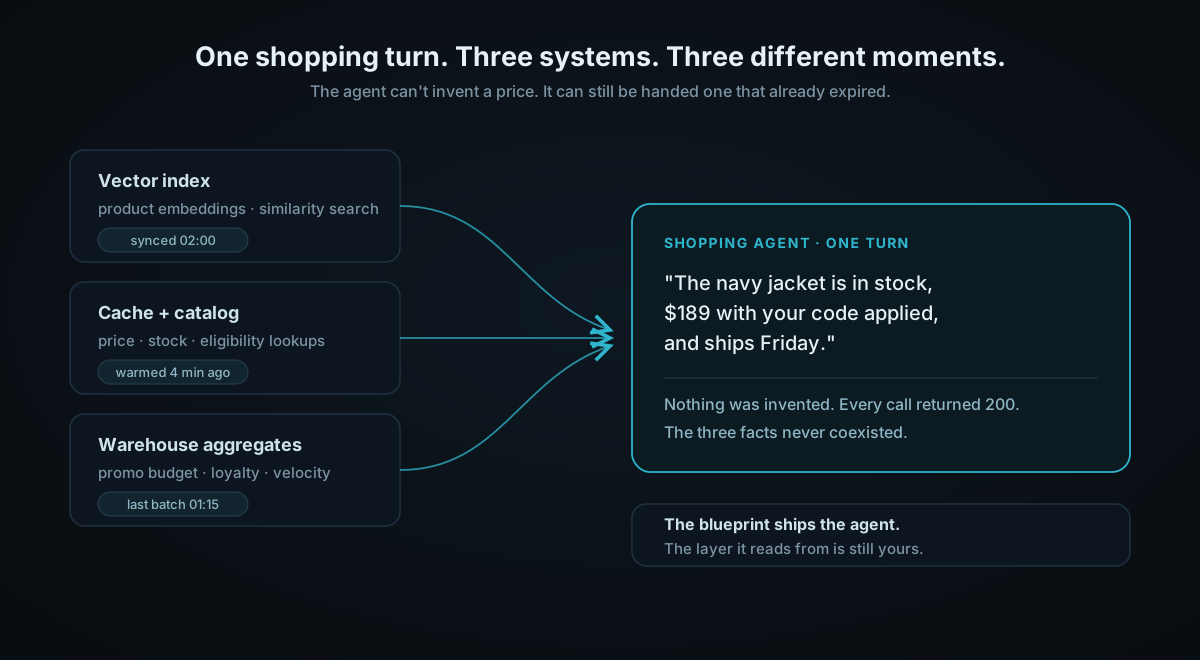
It says nothing about the other failure mode, which is quieter and more common. The agent asks your pricing service for the price. The service answers. The answer is a real number that your system genuinely returned — and it reflects the state of the world as of the last cache write-through, or the last stream window close, or the last catalog sync. The agent didn’t invent anything. It faithfully reported a fact that had already expired.
Same shape everywhere else in the shopping turn:
Stock. The inventory read returns 3 units, which was true when the availability index last refreshed. Two of them were committed to other carts in the intervening seconds. The agent tells the shopper it’s in stock, because as far as every system in the trace is concerned, it is.
Promotions. A budget-capped offer has room in the counter the agent reads. The counter is an aggregate maintained downstream of the events that consume the budget. The agent applies the code. So did everyone else in that window.
Loyalty and store credit. The balance is fetched from a store that trails the ledger. The agent applies more credit than the customer has.
Eligibility. BNPL terms, regional availability, age gates — each read from a different system, each with its own refresh cadence, all assembled into a single confident answer.
None of these are model failures, and none of them are things a better prompt, a stricter tool schema, or a human-review gate on deployment can catch. The values were retrieved successfully. Every call succeeded. This is context lag, and it is invisible in a trace precisely because nothing broke.
The distinction that matters for a commerce agent: a fabricated price is a model problem, solved at the agent layer, and Claude for Commerce solves it. A stale price is a data problem, solved underneath the agent layer, and no blueprint can solve it for you because the blueprint doesn’t own your stack.
Three retrieval patterns, three different moments
One shopping turn is not one query. “Find me a waterproof jacket under $200 that ships by Friday” fans out into at least three distinct retrieval patterns:
a similarity search over product embeddings to find candidates that match the intent,
point lookups for current price, current stock, and this customer’s eligibility,
In most merchant architectures those three patterns live in three different systems: a vector index, an operational store fronted by a cache, and a warehouse or feature store fed by a pipeline. That’s the composed stack, and its defining property is that each element has its own freshness characteristic. Each reflects a different moment.
The agent receives all three as one context block and reasons over them as though they coexisted. They didn’t. The recommendation is built from a product that matched last night’s index, a price from a cache warmed a few minutes ago, and a loyalty balance computed in the last batch. Nothing is flagged, because there’s nothing in the payload that carries an age. That’s the context gap: the decision executes against context that is incomplete, inconsistent, or outdated at the moment it acts. See also our breakdown of what retrieval actually means for agents — the pattern count is the thing most teams under-plan for.
Under human-paced commerce this was survivable. A person browsing tolerates a slightly stale count, notices when a price looks wrong, and takes twenty seconds between page loads. Agents remove all three properties. They read far more per decision, they don’t sanity-check the number against intuition, and nothing between the read and the action pauses.
Agentic commerce changes the concurrency profile
Here’s the uncomfortable reading of Anthropic’s own numbers. Carts up to 35% larger and shoppers 60% more likely to convert are exactly the conditions under which a lagging data layer stops being a rounding error.
Bigger carts mean more items per decision, so more independent reads have to be simultaneously true for the cart to be correct. Higher conversion means more of those carts reach checkout, where the reads turn into commitments against shared state. And an agent population shops with a different concurrency profile than a human one: burst-shaped, machine-paced, and — once agents are checking availability on behalf of shoppers who never opened a tab — capable of hitting the same SKU from many sessions inside the same second.
That’s the concurrency condition, and it’s the one that separates a nuisance from an incident. Multi-tenancy isn’t concurrency; partitioning customers across shards doesn’t create contention. Contention is many actors committing against the same mutable state in a tight window with no human gate. A limited-stock SKU during a drop, a budget-capped promo code, a flash-sale price, a store-credit balance — these are shared, they’re unmergeable, and agent traffic is precisely the traffic that makes them contentious.
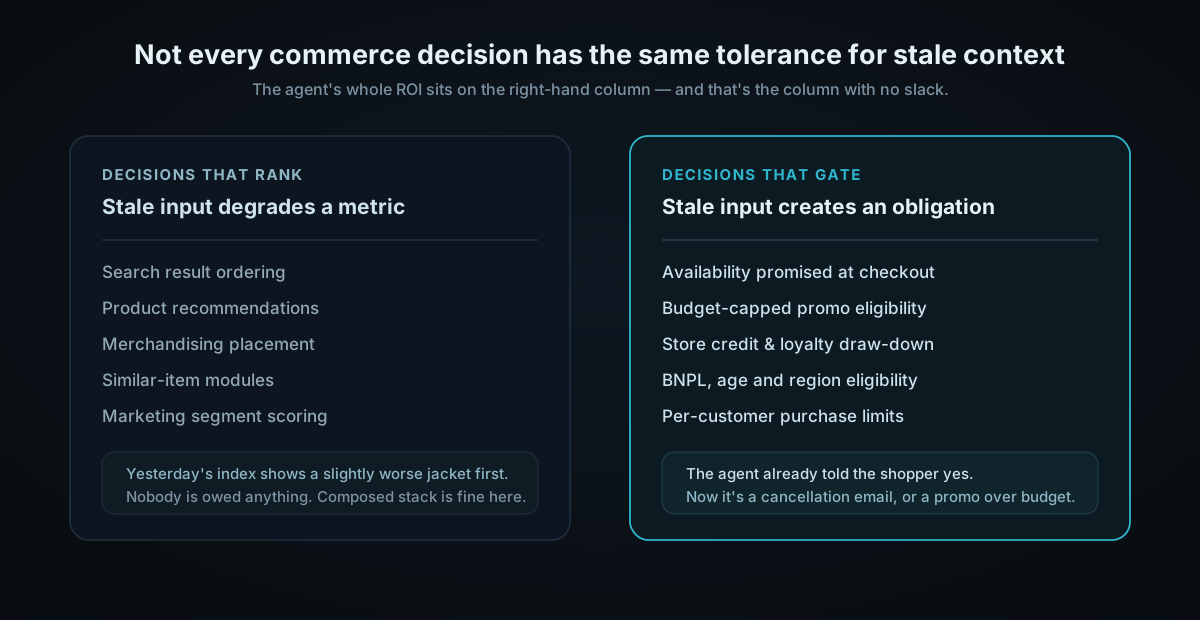
And it matters which kind of decision is reading them. Ranking a list of jackets is forgiving: stale inputs degrade a metric. Deciding whether this cart can have the last unit, whether this promo still applies, whether this customer is eligible — those gate. A gate that fires on expired context has a business consequence, not a metric consequence: an oversell that turns into a cancellation email, a promo that blows its budget, a credit applied twice. The whole ROI of the agent is in the gating decisions, and those are the ones with the tightest tolerance for lag.
What the layer under a commerce agent has to do
Every decision has a validity window — the span in which its context is still true enough to act on. Merchandising has a wide one. A checkout gate inside a live session has a narrow one. Lag is only a failure when it exceeds that window, and agent traffic exceeds it in places human traffic never did.
If you’re forking the blueprint this quarter, the agent work is the visible half. The half that determines whether it survives contact with a peak-traffic Friday is what you point those configurable backends at. Four properties are worth designing for explicitly:
Serve the turn’s retrieval patterns from one system, on one snapshot. Not for the aesthetics of consolidation, but because it’s the only way similarity search, point lookups, and aggregates can be guaranteed to reflect the same moment. Three systems means three moments, and no orchestration layer above them repairs that.
Compute derived context where the data lives. Velocity counters, promo consumption, loyalty aggregates, and behavioral features built in an external pipeline arrive at the agent already behind. Maintaining them as incremental materialized views against the same state removes the hop and the lag that comes with it. (What derived context is, if the term is new.)
Ingest continuously from your systems of record.Change data capture from the commerce platform, the OMS, the ledger — so the serving layer tracks the source rather than catching up to it on a cadence. A scheduled refresh guarantees you’re behind by design; the only question is how far.
Separate the reads that need accuracy from the commits that need a guarantee. A stock count on a single row is something your commerce database already serializes correctly — that’s not the gap. The gap is everything the agent reads around it: the availability index, the promo-budget counter, the loyalty aggregate, the eligibility signal. Those are derived, they live outside the source system’s transactional boundary, and no row lock protects them. Decide per decision, up front, which of them need to be current at execution time and which need one authoritative place where the commit either happens or doesn’t — that’s much cheaper than discovering it from a cancellation queue.
There’s a fifth, less architectural one: instrument the age of every value in a decision, not the target age — the observed one. Teams that don’t measure freshness distribution find out about lag from customer support tickets.
Where the Tacnode Context Lake™ fits
This is the layer we build, and the argument is that it deserves to be designed as context infrastructure rather than assembled per integration. The Tacnode Context Lake™ is real-time, multi-modal data infrastructure that ingests operational state from systems of record via CDC, maintains derived context as incremental materialized views, and serves vector search, point lookups, full-text, and aggregates from one consistent snapshot — so the agent’s turn is coherent by construction rather than four independent timelines stitched together after the fact.
Two honest distinctions, because they change what you can claim:
For the common case — Tacnode serving context while your commerce platform remains the system of record — it isn’t in the write path, and the value is precise: the agent decides against context that reflects current state, so it doesn’t promise what it would have declined had it seen the world as it actually is. Incremental views are asynchronous with sub-second lag, not transaction-time. That’s the difference between an agent that oversells regularly and one that oversells at the margin of a very narrow window.
For datasets where Tacnode is the system of record — a promo-budget ledger, an allocation or entitlement table, an agent-session state store — it’s ACID, and write conflicts are genuinely prevented at commit. That’s the shape to reach for when a contended derived counter needs a hard guarantee rather than merely accurate context: the capped offer is drawn down as many times as the budget allows, not as many times as the agents read it.
Most merchants end up with both: Pattern one for the catalog and customer state that already lives in a platform they’re not replacing, pattern two for the small set of contended datasets where an agent population is about to create contention that human traffic never did.
The part worth getting right this quarter
Claude for Commerce makes the agent cheap to build. That’s real, and teams should take it — the blueprint is better than what most retailers would assemble in six months, and the safety architecture in particular is the kind of thing that’s obvious in hindsight and rare in practice.
What it changes downstream is where the risk sits. When building the agent took two quarters, the data layer’s staleness was hidden behind a longer runway. When the agent takes three weeks, the data layer becomes the schedule, and the first real load test is a shopper being told a jacket is in stock.
The agent layer is now a solved-enough problem with a reference implementation. The layer under it is still yours, and it’s the one that decides whether a 35% larger cart is revenue or a cancellation email.
Frequently Asked Questions
Agentic CommerceAI AgentsEcommerceConcurrencyContext Lake