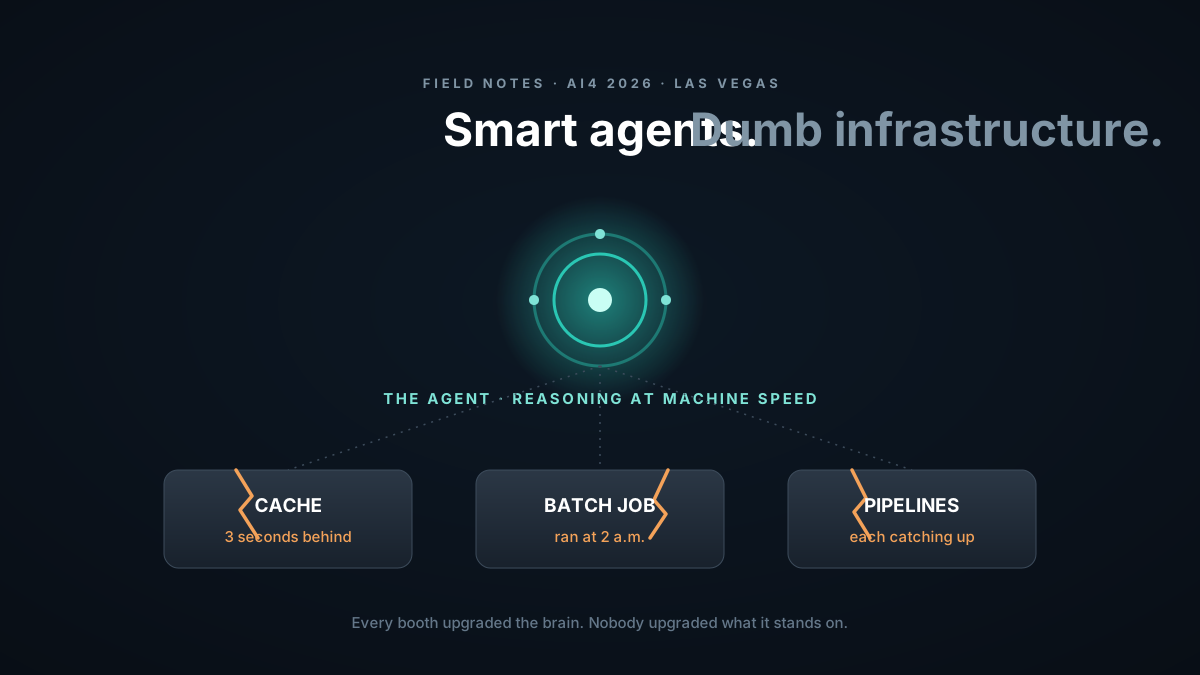
Every booth at AI4 2026 was selling a smarter agent. Ask what the agent reads at the moment it decides, and the demo gets quiet. Field notes on the industry’s blind spot.
TL;DR: The model layer has consolidated — intelligence is now a utility, and every vendor differentiates on the agent wrapped around it. But the data layer those agents act on hasn’t moved: caches seconds behind, features from last night’s batch job, pipelines that each catch up on their own clock. The industry spent AI4 chanting that context decides outcomes, then defined context as prompt assembly. The hard problem isn’t what you put in the window. It’s whether the state underneath is fresh, shared, and coherent when the agent reads it.
AI4 2026 wrapped a couple of weeks ago. Three days at the Venetian Expo in Las Vegas: a six-foot startup kiosk (K723 — black drape, concrete floor, two chairs we never sat in), one twenty-minute talk, and a few hundred conversations with the people who actually run AI at banks, insurers, and asset managers.
Walk the floor and you saw one product, repeated a few hundred times: a smarter agent. Better planner, bigger context window, more tools, tighter harness, an orchestration layer over the orchestration layer. Then ask any of them the only question that matters in production — what does your agent read at the moment it decides, and how stale is it? — and the demo gets quiet.
That’s the post. Everything else is supporting evidence.
Everyone is selling intelligence. Nobody is selling ground truth.
AI4 2026 in one line: the industry is racing to make agents smarter while the data layer those agents act on stays dumb — stale, scattered, and seconds behind the world it describes.
Two years ago every booth had a proprietary model. This year every booth had a system prompt.
Ask vendors what’s under the hood and the stock answer was Claude. The runner-up was “we’re model-agnostic,” delivered over an open Claude Code terminal on the demo laptop. Nobody was pitching their model anymore. They were pitching what they’d built around somebody else’s — which tells you the model layer has consolidated into a utility, and when everyone runs the same models, intelligence stops being the differentiator.
So the differentiation moved up the stack: the agent. Smarter planning, deeper tool use, longer horizons. All real progress. But an agent’s decision is only as good as the facts it decides on, and the layer that supplies those facts got no keynote, no booth backdrop, and no upgrade. The industry is fitting a better brain onto a nervous system it built in 2015.
The demo lies about the data
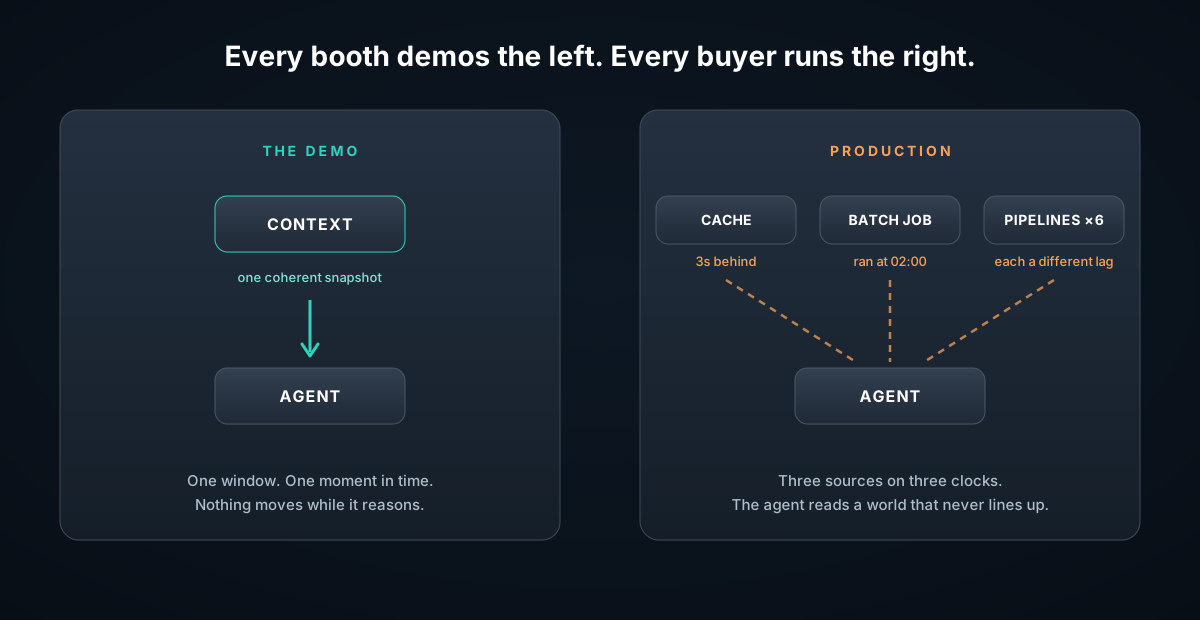
On stage, an agent gets a clean context window: one coherent snapshot, handed to the model, nothing moving while it reasons. In production, that same agent reads a cache that’s three seconds behind, features from a job that ran at 2 a.m., and a fan-out of pipelines each at a different stage of catching up. It gets worse under concurrency, when many agents read the same fast-moving state at once and each sees a different version of the world. No existing system closes that gap on its own — the Shared, Live, Semantic grid is why the composed stack always leaves one property out.
This was the argument of Xiaowei’s talk — “Why AI Agents Act on the Wrong Context.” For decades the split held: machines got speed without context (the database), humans got context without speed (the warehouse). An agent is an application with human capability — both consumers in one body, needing rich context at machine speed. Nothing in the standard stack was built to serve that. Which is why every production agent architecture we heard described at the booth was a bespoke pile of caches, pipelines, and apologies.
“Context” was the word of the conference. Everyone meant the prompt.
If you’d played a drinking game with the word “context” at AI4, you wouldn’t have made it to lunch. Session titles, booth backdrops, every third hallway sentence. A year ago the industry’s favorite word was “prompt.” This year it’s context — and the consensus underneath the buzzword is correct. Once the model is a utility, what you feed it decides the outcome. Same model, different context, different decision. The industry has located the right problem.
But listen closely and almost everyone means the same narrow thing: prompt assembly. Retrieval, summarization, memory files, tool descriptions — what goes in the window. Context as copywriting for machines. Far fewer people are talking about the layer underneath: where that state actually lives, how fresh it is at the moment the agent reads it, and whether two agents acting at the same time see the same world. Context engineering got a thousand mentions on the floor; context infrastructure got a mumble and a slide full of pipelines.
When nobody reads the output, the input is the safety guarantee
Xiaowei ran a two-part poll from the AI Agents stage. Raise your hand if you used a coding agent this week — most of the ballroom went up. Keep it up if you still read every line it writes. I watched the hands come down.
That’s the stakes, in one gesture. When the human stops checking the output, the input becomes the safety guarantee. And here’s the part the smarter-agent arms race misses: a smart agent on dumb infrastructure doesn’t make dumb decisions. It makes confident, well-reasoned, fully-audited decisions about a world that no longer exists.
AI4 2026 named the right problem — context decides outcomes. It’s just solving it at the wrong altitude: in the prompt, when the hard part is in the infrastructure. The agents will keep getting smarter; that curve is spoken for. The gap between what they know and what’s true right now is the curve nobody on that floor was working on.
That’s the bet we drove to Vegas with. A few hundred conversations later, we like it more, not less.