

Back to Blog
Customer Stories

How Cider Delivers Fresh, Queryable Data at Global Scale

A global etailer needed speed at scale. Tacnode delivered.

Tacnode Staff
Team
8 min read
Share:
Cider e-commerce platform architecture showing before and after Tacnode implementation for real-time analytics

Overview

Cider, a global e-commerce brand serving customers in over 100 countries, faced significant challenges as its data volumes grew exponentially. With operations spanning sourcing, logistics, fulfillment, and digital channels, teams struggled to access fast, reliable insights—especially during peak demand periods. Slow queries, fragmented systems, and delayed data hindered real-time monitoring and timely decision-making.

Modern e-commerce operates at machine speed. Inventory decisions, dynamic pricing, fraud detection, and personalized recommendations all depend on data that reflects the world as it exists right now—not as it existed minutes or hours ago. For a company like Cider, operating across multiple time zones with continuous order flow, even small delays in data availability compound into significant operational blind spots.

To overcome these obstacles, Cider adopted Tacnode on AWS, enabling a unified, real-time data architecture that delivers low-latency querying, seamless streaming ingestion, and elastic scalability.

Challenges

As Cider expanded internationally, its legacy data infrastructure encountered multiple issues:

  • Slow Query Performance: Critical operational queries, particularly in logistics, slowed dramatically as data volumes grew. Routine maintenance tasks like PostgreSQL VACUUM further degraded performance, discouraging historical data analysis.
  • Fragmented Data Systems: Multiple databases and query engines—including PostgreSQL, MySQL, and Elasticsearch—created complex synchronization pipelines. This fragmentation led to inconsistent data across services and increased operational overhead.
  • Scalability Limits During Peak Traffic: Sudden spikes in traffic during global promotions and seasonal events overwhelmed legacy systems. Slow scaling and performance degradation risked customer experience during critical moments.

These challenges are symptomatic of a broader pattern in fast-growing e-commerce: as transaction volume scales, the data infrastructure that worked at startup scale becomes a bottleneck. Teams begin building workarounds—read replicas, caching layers, ETL pipelines—that add latency and introduce consistency gaps. What starts as a performance problem becomes an accuracy problem, as different systems report different versions of truth.

The Solution: Unified Real-Time Data Architecture on AWS

Cider implemented Tacnode's unified data platform to consolidate transactional databases, data warehouses, search engines, and stream processors. This architecture enabled:
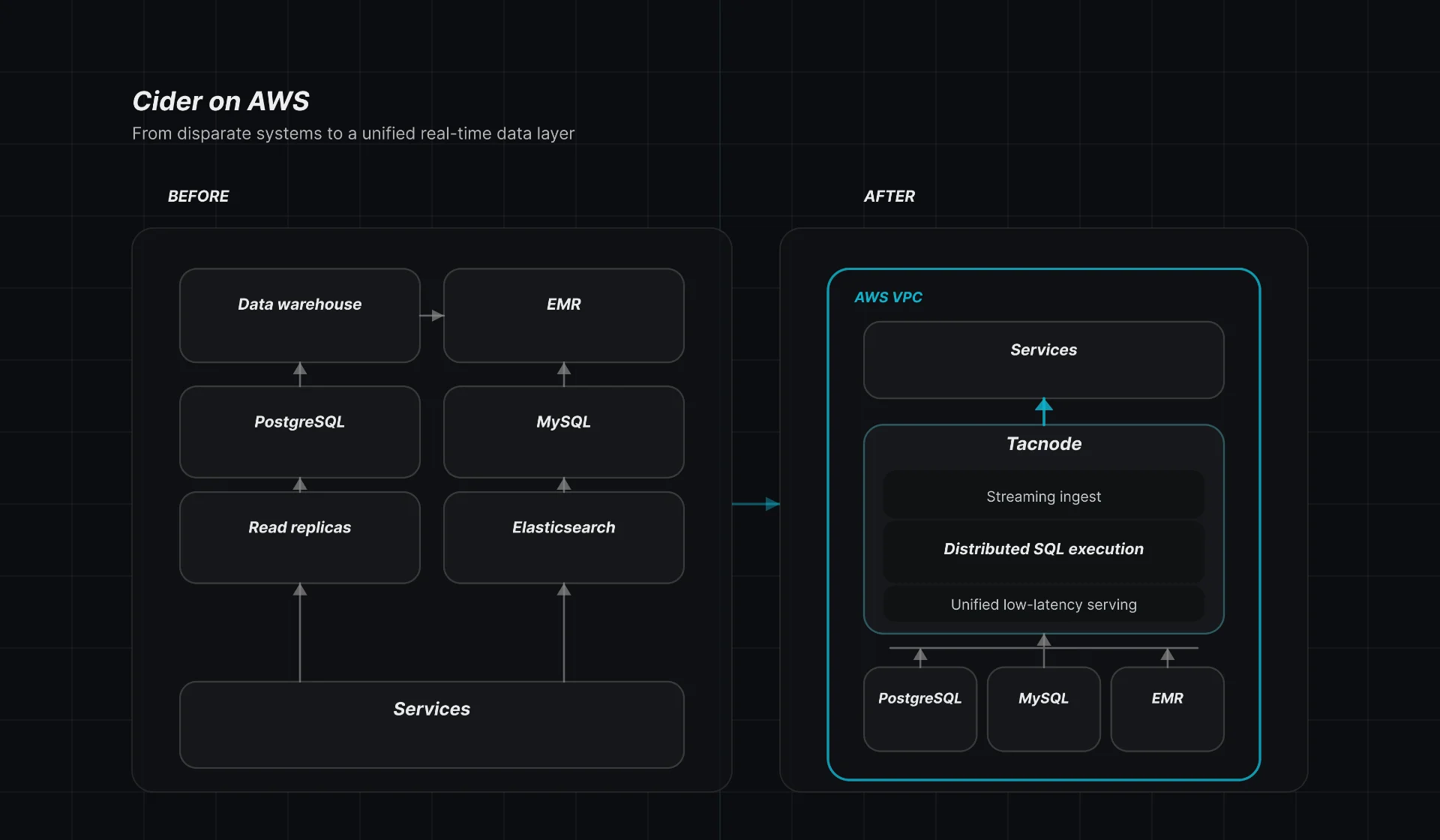
  • Real-Time Streaming Ingestion: Seamless ingestion of streaming data from diverse sources with sub-second latency.
  • Low-Latency Querying: Fast, reliable access to fresh data powered by PostgreSQL-compatible querying, eliminating the need for multiple replicas and synchronization pipelines.
  • Elastic Scalability: Independent scaling of compute resources to handle demand spikes instantly without performance loss.
  • Simplified Data Operations: Centralized data access reduced maintenance overhead and improved data consistency across teams.
Cider architecture before and after Tacnode

Technical Deep Dive: How Tacnode Unified Cider's Data Layer

The architectural shift from fragmented systems to a unified Context Lake required addressing three interconnected challenges: ingestion latency, query performance, and operational simplicity.

  • Streaming Ingestion Without ETL Delays: Traditional data pipelines rely on batch ETL jobs that run on fixed schedules—hourly, daily, or triggered manually. For Cider, this meant that logistics teams were often making decisions based on data that was hours old. Tacnode's streaming ingestion captures changes as they occur, writing them directly to the queryable layer without intermediate staging. The result: operational dashboards that reflect reality, not a snapshot from the last batch run.
  • Compute-Storage Separation for Elastic Scale: Peak traffic events like Black Friday or flash sales can dramatically increase query load within minutes. Legacy architectures struggle because compute and storage are tightly coupled—scaling one requires scaling both. Tacnode's architecture separates these concerns, allowing Cider to spin up additional compute capacity instantly while the underlying storage layer remains stable. When traffic subsides, compute scales back down, optimizing cost without sacrificing performance.
  • PostgreSQL Compatibility for Zero-Friction Adoption: One of the hidden costs of data infrastructure migration is retraining teams and rewriting applications. Because Tacnode exposes a PostgreSQL-compatible interface, Cider's existing SQL queries, BI tools, and application integrations worked without modification. Engineers didn't need to learn a new query language; analysts didn't need new dashboards. The migration was about architecture, not workflow disruption.
  • Unified Query Layer Across Workloads: Before Tacnode, different teams queried different systems depending on their use case—Elasticsearch for search, PostgreSQL for transactions, separate warehouses for analytics. Each system had its own latency characteristics and data freshness guarantees. By consolidating into a single query layer, Cider eliminated the cognitive overhead of choosing the right system and the operational overhead of keeping them synchronized.

Results

The transition to Tacnode's platform yielded transformative outcomes:

  • Dramatically Faster Queries: Query latency improved by an order of magnitude, making both real-time and historical analysis practical where it wasn't before.
  • Fresh, Trustworthy Data: Newly ingested data was available with sub-second latency, enabling operational dashboards and analytics to reflect current conditions without delay.
  • Reduced Operational Complexity: Consolidation of multiple databases and pipelines simplified architecture, lowered maintenance efforts, and enhanced data reliability.
  • Stable Performance Under Load: Tacnode's compute-storage separation allowed rapid scaling during events like Black Friday, maintaining consistent throughput and responsiveness.
  • Improved Analytical Stability: Integration with AWS EMR for reporting and ad-hoc analytics resolved prior memory issues and improved query reliability.
"As Cider scaled globally, we reached a point where operational data was being copied into too many systems just to keep up with queries. Tacnode allowed us to collapse that complexity into a single real-time layer. We're now querying fresh data directly, at scale, without the operational overhead that used to slow us down." — Cider Engineering

Key Takeaways for Data Leaders

Cider's experience highlights patterns that apply across high-growth e-commerce and beyond:

  • Data freshness is a competitive advantage. In real-time commerce, stale data leads to stale decisions. Whether it's inventory allocation, fraud scoring, or personalized pricing, the value of insight degrades rapidly as latency increases.
  • Fragmentation creates hidden costs. Multiple specialized systems seem efficient in isolation, but the synchronization overhead—both technical and cognitive—compounds over time. A unified layer reduces total cost of ownership even if individual components appear more capable on paper.
  • Elastic infrastructure changes the economics of peak traffic. When scaling is instant and automatic, engineering teams can focus on features rather than firefighting. The operational confidence to handle traffic spikes without pager alerts is a force multiplier for product velocity.
  • Compatibility reduces migration risk. PostgreSQL compatibility meant Cider could adopt Tacnode incrementally, validating performance improvements before full commitment. The ability to rollback to familiar tooling reduced organizational resistance to change.

Conclusion

By adopting Tacnode's modern real-time data architecture on AWS, Cider transformed its data capabilities—achieving faster insights, fresher data, streamlined operations, and resilient performance at global scale. This unified platform empowers teams to make data-driven decisions confidently and efficiently, supporting Cider's continued growth in a competitive market.

Tacnode's Context Lake platform offers enterprises a powerful solution for real-time data streaming, low-latency querying, and analytics on AWS, enabling seamless data ingestion, processing, and analysis with PostgreSQL compatibility and elastic scalability.

For easy deployment and integration, Tacnode is also available on the AWS Marketplace, providing a streamlined way to access and manage the platform within your AWS environment.

Customer StoryE-CommerceReal-Time AnalyticsAWSPostgreSQL
T

Written by Tacnode Staff

Building the infrastructure layer for AI-native applications. We write about Decision Coherence, Tacnode Context Lake, and the future of data systems.

View all posts

Ready to see Tacnode Context Lake in action?

Book a demo and discover how Tacnode can power your AI-native applications.

Book a Demo