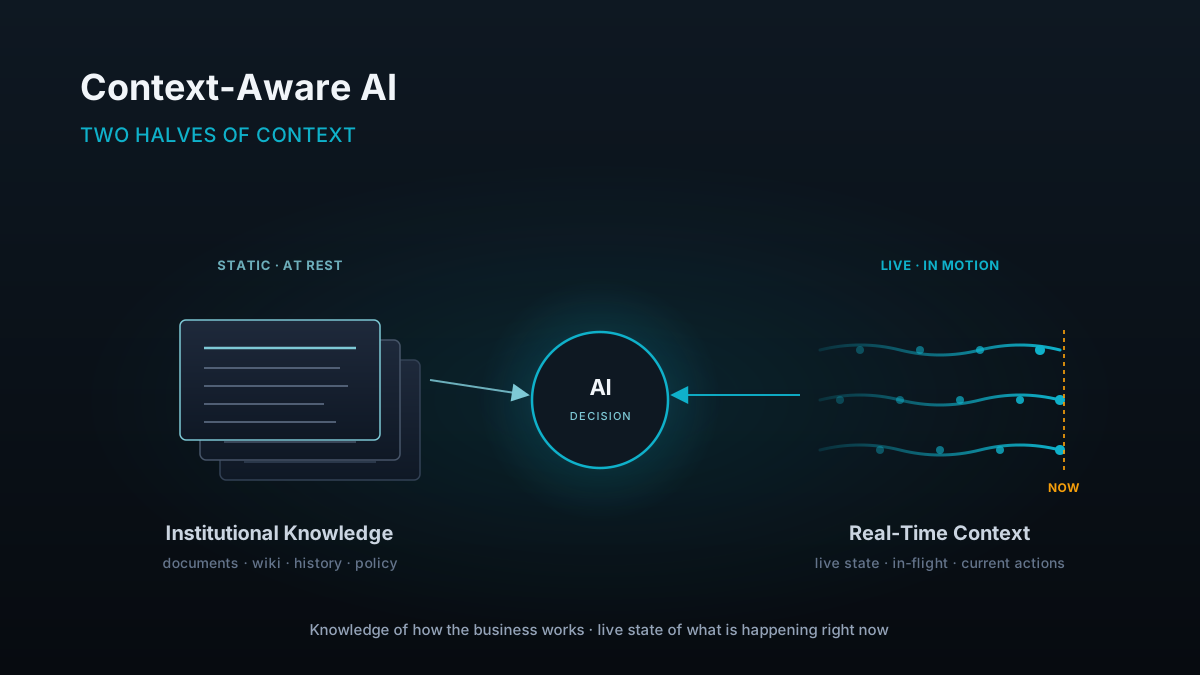
Context-aware AI needs two halves to work in production — institutional knowledge of how the business operates, and real-time context of current state. Most enterprise AI tools only solve the first.
TL;DR: Context-aware AI needs two halves of context to work in production. Institutional knowledge, the static-ish memory of how the business operates, is well-served by retrieval augmented generation, vector databases, and tools like Glean. Real-time context, the live and coherent state of the systems the AI reasons over, is mostly unsolved. AI that answers questions can get by with the first half. AI that takes action needs both. The architectural gap that breaks production AI initiatives is rarely model quality. It is the inability to read fresh, internally coherent state at the moment a decision is made. :::
Context-aware AI is artificial intelligence that interprets a query against the surrounding situation: who is asking, what just happened, what the system knows about the world right now. Instead of treating each prompt as if it arrived in isolation, a context-aware AI system grounds its answers in the relevant facts of the moment rather than generic responses drawn only from a model’s training data.
The challenge is that “context” comes from two structurally different places, and most enterprise AI tools only solve one of them. The first is institutional knowledge: documents, conversations, metric definitions, policies, and historical data that describe how the organization works. The second is real-time context: the current state of the systems the AI is reasoning over, including live balances, in-flight orders, fresh velocity counts, and what other agents and services have just done. Teams building context-aware AI today have made real progress on the first. The second is where production AI initiatives stall.
What Is Context-Aware AI?
Context-aware AI is an AI system that interprets each query against the broader situation, including the user’s intent, recent history, and the current state of the relevant systems. It produces answers, recommendations, or actions grounded in that situation rather than in the model’s training data alone.
Most context-aware AI is built on top of large language models. The model itself does not know your organization’s policies, your customer’s account history, or what just happened in the last few seconds. The “context aware” part is everything wrapped around the model: a retrieval layer that pulls relevant information, a memory layer that maintains continuity across a conversation, an orchestration layer that decides what to fetch and when, and the data systems that hold the underlying truth. Context-aware AI builds on top of generative AI by giving it the ability to recognize what is relevant in the moment and act accordingly.
Without context, AI starts every interaction from scratch. It treats each query as if it has never seen the user before, never seen the data before, never seen the same question before. With context, the same model can interpret intent, understand relationships across the business, and synthesize insights against the actual reality of the organization rather than a generic version of it.
How Most Context-Aware AI Is Built Today
The dominant pattern for context-aware AI in enterprise settings today is institutional memory. Give the AI access to the organization’s accumulated knowledge so it can answer questions, draft documents, and surface insights without forcing users to re-explain things from scratch. New employees onboarding ask the same questions that the last cohort asked. Product managers across different teams want the same metric definitions. Engineers want answers about systems that were built years ago by people who have since left. Context-aware AI built around institutional knowledge means the answer is in the system, the AI can find it, and nobody has to re-explain the same thing for the hundredth time.
This pattern is built on retrieval augmented generation, vector databases, knowledge graphs, and increasingly sophisticated indexing of enterprise data: code, documents, Slack threads, support tickets, design docs, runbooks, dashboards. The user asks a question in natural language, the system retrieves the relevant context from the corpus, and the model uses the retrieved context to produce an answer grounded in the organization’s own documents rather than the model’s pre-training.
For a large class of use cases, this works. AI tools that synthesize insights from internal documentation, answer questions about company policies, summarize past discussions, and maintain continuity of institutional knowledge across teams genuinely save time. The pattern is mature enough that several vendors (Glean, Notion, Microsoft Copilot, and others) compete to do it well.
Real-world examples of context-aware AI in this category:
An AI tool that answers questions about a deployment process by retrieving the relevant runbook
A research assistant that synthesizes insights from a hundred internal interviews into one answer
A code-aware AI that explains a function by retrieving the design doc and the related pull request
A support copilot that answers a customer question by surfacing similar patterns from past tickets
A sales AI that drafts a recap by pulling relevant information from CRM notes, email threads, and call transcripts
In each example, the surrounding context is essentially historical. The documents, discussions, and decisions already happened. The AI’s job is to find the relevant context, interpret the user’s intent, and produce an answer. The relevant data is at rest. The context window is the bottleneck. The retrieval pipeline is the engineering problem.
Where Institutional Knowledge Falls Short
This pattern works as long as the AI’s job is to answer questions. The moment AI starts to take action, whether approving a transaction, placing an order, routing a request, adjusting a price, or sending a message that commits the organization to something, institutional knowledge stops being enough.
Consider a product manager who asks an internal AI tool, “What is our current churn rate?” The AI retrieves the BI definitions document, finds the metric, queries the data warehouse, and returns 4.2%. The PM presents that number in a Monday review. The CFO interrupts: the team re-defined churn three hours ago to exclude annual-plan downgrades, and the actual number is 3.1%.
The AI did not lack institutional knowledge. It had the BI document. It had the historical data. What it lacked was awareness of a definition that changed in the last few hours and had not propagated through the indexing pipeline. The same shape of failure plays out across decision making AI:
A customer-service agent recommends a refund that conflicts with a payment that just settled
A fraud-screening model misses suspicious patterns because the velocity counter behind it lags by seconds during concurrent attack bursts, producing both false alarms and missed fraud
A sales AI promises inventory that just got allocated to another order
Two coordinating AI agents make conflicting decisions because each read its own cached snapshot of state
Each of these failures looks like a model bug. None of them are. The model is doing exactly what it was asked to do, with the context it was given. The failure is upstream. The context the AI was given was not a faithful picture of the world at the moment the decision had to be made. The AI had institutional knowledge. It did not have real-time context.
The Other Half: Real-Time Context
Real-time context is the live state of the systems the AI is acting on, available with sub-second freshness and internal coherence across signals. It includes:
Current balances, positions, and exposures
In-flight orders, requests, and transactions that have not yet settled
Velocity counts, rolling aggregates, and behavioral signals over recent windows
The actions other agents and services have just taken, even moments ago
Live policy and definition state, including changes that happened in the last few minutes
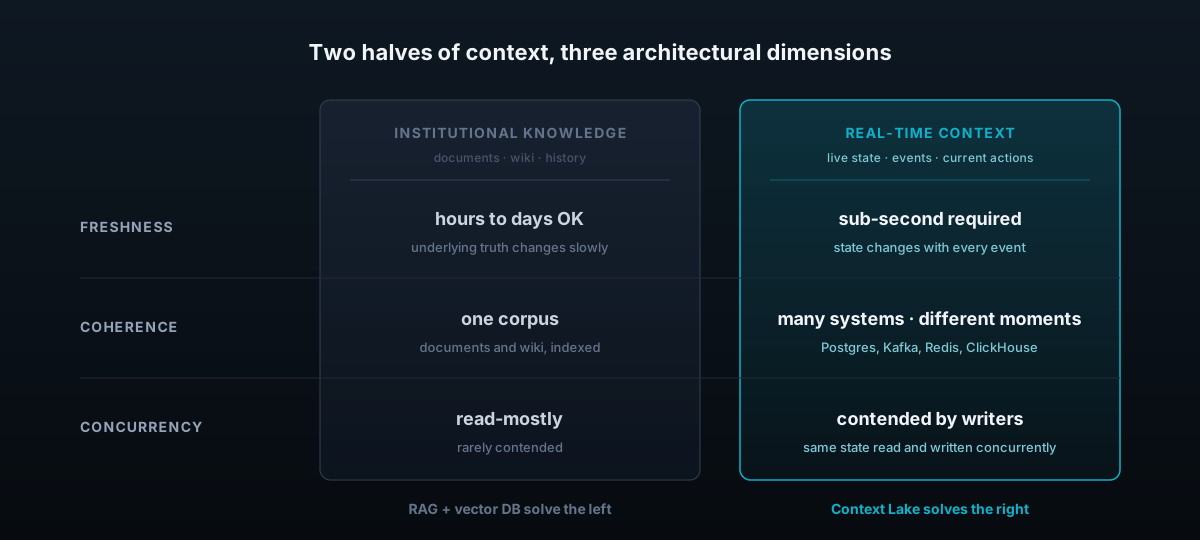
Real-time context differs from institutional knowledge along three axes that turn out to be architecturally important: freshness, coherence, and concurrency.
Freshness. Institutional knowledge can be a day stale and still useful. A definition document indexed last week is fine if the definition has not changed. Real-time context becomes wrong the instant the underlying state changes. A balance from five seconds ago can produce a refund the AI would never recommend if it saw the current balance.
Coherence. Institutional knowledge lives in one logical corpus: the documents, the wiki, the codebase. Real-time context lives in many systems: the transaction database, the message queue, the cache, the event stream, the analytical store. Each of these systems advances at its own rate. An AI that reads from each in turn sees a different version of reality from each, and there is no single moment in time at which all the signals it pulls together actually held simultaneously.
Concurrency. Institutional knowledge is read by many users but rarely contended. Real-time context is contended by definition, because the state being read is the state being written by other transactions, by other agents, by other services. Multiple decisions are evaluated against shared state at the same moment, and naive caching collapses under that load.
These three properties are why bolting on a vector database does not solve the real-time context problem. Vector databases were designed to store and retrieve embeddings of mostly-static content. They were not designed to maintain a moving picture of a transactional system. The pattern that solves institutional knowledge is the wrong shape for the pattern that solves real-time context.
Why Real-Time Context Is Architecturally Harder
The standard enterprise data architecture splits live state across many systems. Postgres holds the transactional record. Kafka carries the event stream. Redis caches frequently-read derived values. ClickHouse or Druid holds the analytical aggregates. A vector database holds embeddings for retrieval. Each of these systems exists for good reason, and each is good at what it does in isolation.
The problem appears when an AI has to make a decision that depends on signals from more than one. The Kafka stream is at offset 1,234,567. The Redis cache last refreshed at 12:42:01. The ClickHouse rollup was computed at 12:42:00. The Postgres row was updated at 12:42:03. The vector database was last refreshed an hour ago. There is no single moment in time at which all of these systems agreed on the state of the world. The AI that pulls from each of them is seeing five different versions of reality and trying to reason as if they were one.
This is the cross-system context gap: relevant data exists across enterprise systems that cannot be queried under a single coherent snapshot.
There is also pipeline lag: derived state (aggregates, velocity counters, scoring features) has to be computed before the AI can use it. The standard pattern is a stream-processing job that consumes events and updates a derived table or cache. That job runs on its own clock, and during periods of high write velocity, derived state lags the events that produced it. The AI reads a velocity counter that was current as of three seconds ago, and three seconds is forever when concurrent transactions are reshaping the state being measured.
Both gaps compound. The AI is reading derived state that is incomplete, from systems that disagree with each other about the current moment. No amount of better prompting or larger context windows fixes this. The fix is architectural.
What a Real-Time Context Layer Must Provide
A data layer designed for real-time context-aware AI has to do three things that the typical enterprise data architecture does not.
First, it must maintain derived context incrementally, not on a refresh schedule. As source events arrive, through change data capture from the system of record or through event streams from upstream services, the derived views must update sub-second so that an AI reading them moments later sees a faithful picture. Periodic batch refreshes leave windows in which derived state lags the underlying events, and for AI that acts within tight validity windows, those windows are where the failures happen.
Second, it must give a single coherent snapshot across signals. When an AI reads a balance, a velocity count, and a policy state in the same query, those values should reflect the same set of ingested events: not a balance from one cache, a velocity from another, a policy from a third, each at a different propagation stage. This is what eliminates the divergence between service-level state caches that produces conflicting decisions across an organization.
Third, it must support derivation on demand against live state. Some signals can be pre-computed as incrementally maintained views. Others, particularly aggregations that depend on the specific question being asked, vector similarity searches against current data, or LLM-derived signals over recent context, have to be computed at query time against the committed state, with the same coherence guarantees as the pre-computed views.
These properties together define what we call a Context Lake: a unified data layer that holds the live operational state behind a context-aware AI system, ingests from the systems of record asynchronously, maintains derived views incrementally, and serves AI queries over a coherent snapshot of the moment.
Feature Stores Are Not the Answer Either
A common reaction at this point: isn’t this just a feature store? The answer is no, for reasons that matter.
Feature stores were designed for ML training and batch inference. Their primary job is to serve features computed from historical data into a model that runs at training time or in batch. The “online” side of a feature store is designed to serve precomputed feature values to a model at inference time, but it inherits the assumptions of the offline architecture: features are mostly precomputed in pipelines that run on their own cadence, the online cache is a key-value store that does not enforce coherence across features, and the consistency model is “eventually fresh.”
Real-time context-aware AI imposes different requirements. The AI is reading state that is contended by other writers, in patterns that change query by query, with coherence required across multiple signals at the same moment. Feature stores were not built for that workload, and stretching them to fit it produces the same fragility as bolting a vector database onto a transaction system.
A real-time context layer is a different category of system. It lives closer to operational systems of record than feature stores do. It ingests via change data capture rather than batch pipelines. It maintains derived state incrementally rather than on refresh. And it serves AI reads under a coherent snapshot rather than as independent key lookups.
Both Halves Together: The Real Competitive Advantage
The organizations that get context-aware AI right in production are the ones that solve both halves. Institutional knowledge so the AI knows how the business works, and real-time context so the AI knows what is happening right now. Either half alone produces an AI that fails in a different way. Knowledge without real-time context produces confidently-wrong answers. Real-time context without knowledge produces correct readings of a state the AI does not know how to interpret.
The competitive advantage shows up in the use cases where AI has to make decisions that commit the organization to something. A real-time decisioning system at DoorDash uses Tacnode’s Context Lake to maintain decision-relevant features incrementally over a high-velocity event stream, including aggregations and behavioral signals that have to reflect activity from the last few seconds rather than the last few minutes. The institutional knowledge of patterns is necessary but not sufficient. Acting correctly under concurrency requires reading shared state under a coherent snapshot at the moment a transaction is being evaluated.
The same shape applies wherever AI moves from answering questions to taking action: real-time credit decisioning, card authorization with fresh exposure limits, agent coordination over shared business state, dynamic pricing against live demand and inventory, live offer eligibility against current balances. In every case, the AI needs both the institutional knowledge to interpret the situation and the real-time context to reflect it accurately.
When You Need Each
Not every AI initiative needs both halves. The honest split:
Institutional knowledge is enough when:
The AI’s job is to answer questions or surface insights from existing material
The underlying truth changes slowly relative to how often the AI is asked about it
A wrong answer is correctable: the user reads it, sanity-checks it, and acts on it themselves
Examples: enterprise search, document summarization, support copilots over knowledge bases, code-aware assistants, internal research tools
Real-time context is also required when:
The AI takes action that commits the organization to an outcome (money moves, an order is placed, access is granted, a message is sent)
The relevant state changes within the validity window of the decision (sub-second to seconds)
Multiple decisions are made concurrently against shared state
Examples: fraud screening, credit and risk decisions, agent-based automation that acts on operational systems, real-time personalization that depends on live state, AI features embedded inside transactional flows
The first column is well-served by current tools. The second column is where the architecture matters and where most enterprise AI initiatives have not yet built what they need.
How Tacnode Approaches Real-Time Context
Tacnode’s Context Lake is a unified data layer designed for the second column. It ingests from external systems of record (Postgres, Kafka, transactional databases) through change data capture, maintains derived views incrementally as new events arrive, and serves AI reads under a coherent snapshot of the moment. It supports both row-oriented point lookups and columnar analytical scans in the same store, so an AI agent can read a single account record and a sub-second-fresh aggregate over the last hundred transactions in the same query.
That architecture is what unifies reads (one store, one snapshot, no divergence between caches) and eliminates pipeline lag (incremental maintenance, sub-second freshness, no batch lag). For AI systems that have to act on the world rather than only describe it, that is the missing piece.