Kafka Alternatives (2026): Brokers, Managed Kafka, and When You Need Something Else
Kafka alternatives only make sense once you know what Kafka is doing for you: a durable event log, a simple work queue, a cloud-native stream, or a managed service you’d rather buy from someone other than Confluent. Here are the options in each group, the Confluent alternatives for managed Kafka, and the workload most lists miss: Kafka used to feed a decision that needs current context.
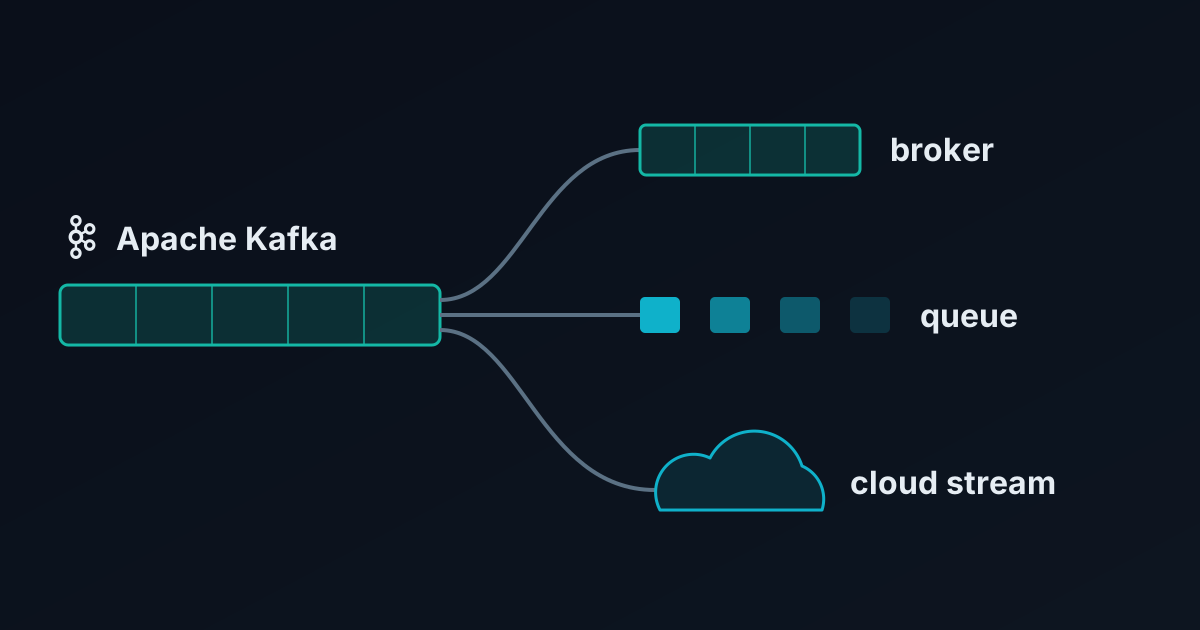
Kafka alternatives fall into four groups: Kafka-compatible brokers that keep the API and change the storage engine, message queues for simple task distribution, cloud-native managed streams that remove the cluster, and managed Kafka services that compete with Confluent. The right choice depends on whether you need Kafka’s durable, replayable log or only need to move messages from one service to another.
Apache Kafka is a distributed, partitioned, replicated commit log. Producers append events to topics, consumers read them at their own pace, and events stay on disk for a configurable retention period so any consumer can replay from any offset. That design made Kafka the default backbone for event-driven architectures, and it is also the source of most complaints. We cover what Kafka does and doesn’t do in more depth in Apache Kafka vs Apache Flink.
The reasons teams start looking elsewhere tend to be one of these.
Cost of the storage model. Classic Kafka brokers store data on local or block-storage disks and replicate each partition to other brokers, usually across availability zones. On public clouds, cross-zone replication traffic and provisioned disk are a large share of the bill. That pressure produced a wave of “diskless” designs that write to object storage instead, and in March 2026 the Apache Kafka community accepted KIP-1150 (Diskless Topics) as the project’s direction. The KIP sets direction; the implementation is still being worked out in follow-up KIPs.
Operational load. Partition rebalancing, broker replacement, capacity planning, and upgrades take real engineering time. Kafka 4.0, released March 18, 2025, removed ZooKeeper entirely and runs only in KRaft mode, which removes one moving part. It doesn’t remove the rest.
Vendor and licensing concerns. Apache Kafka itself is Apache 2.0. Several components people assume are part of “Kafka” are not: Confluent Schema Registry, ksqlDB, REST Proxy, and some connectors are under the Confluent Community License, which allows source access and modification but prohibits offering the software as a competing SaaS. And Confluent itself changed hands: IBM completed its acquisition of Confluent on March 17, 2026, at $31 per share, roughly $11 billion. Some buyers are re-evaluating their contracts as a result.
Wrong tool for the job. Kafka is a log, not a queue. Until recently, a consumer group could not have more active consumers than a topic has partitions, which made Kafka awkward for work-queue patterns. Kafka added share groups (KIP-932, “Queues for Kafka”) to address this; the feature shipped as early access in 4.0, as preview in 4.1, and is production-ready in Apache Kafka 4.2.
How to Choose: What Is Kafka Doing for You?
Before comparing products, name the job.
1.Durable event log and transport. Multiple independent consumers, replay from offsets, retention measured in days or longer, the Kafka client ecosystem. Look at Redpanda, diskless Kafka (AutoMQ, WarpStream, Aiven Inkless), or Apache Pulsar.
2.Simple queuing. Each message is work for one consumer, acknowledged and then gone. Look at RabbitMQ, NATS, or Amazon SQS.
3.Cloud-native managed streams. You want a stream with no cluster to size, and you’re committed to one cloud. Look at Amazon Kinesis Data Streams, Google Cloud Pub/Sub, or Azure Event Hubs.
4.Managed Apache Kafka, just not from Confluent. You want real Kafka APIs and semantics and someone else running it. Look at Amazon MSK, Aiven, Redpanda Cloud, Instaclustr, or Google Cloud Managed Service for Apache Kafka.
5.Feeding a real-time decision. Kafka carries events into Flink, which writes derived state into Redis or a database so a service can read it when it decides. The pain is stale or inconsistent context, not the broker. See the Tacnode section below.
Most organizations run several of these. Pick for the one that is load-bearing in the system you’re changing.
Kafka-Compatible Brokers: Durable Event Log and Transport
These keep the partitioned, replayable log and change how it is stored and operated. Most speak the Kafka wire protocol, so existing clients and connectors keep working with configuration changes. Test the client features you depend on, such as transactions, compaction, and admin APIs, before assuming full parity.
Redpanda
Kafka vs Redpanda:Redpanda is a Kafka API-compatible streaming platform written in C++, with no JVM and no ZooKeeper. It runs as a single binary, which removes the JVM tuning that a Kafka broker needs.
Licensing. The core broker is under the Business Source License 1.1, which permits most uses but prohibits offering Redpanda as a commercial streaming or queuing service. Enterprise features are under the Redpanda Community License. This is not an OSI open-source license, which matters if your legal team requires one.
Fits: teams that want the Kafka API with a simpler operational footprint on self-managed infrastructure, or a managed option through Redpanda Cloud (covered in the Confluent section below).
Watch for: it is a separate implementation of the protocol, not a fork of Kafka, so new Kafka features arrive on Redpanda’s schedule rather than Apache’s.
Diskless Kafka: AutoMQ and WarpStream
Diskless designs replace broker-local disks with object storage such as Amazon S3 as the durable store. That removes most inter-zone replication traffic and lets brokers scale without moving data. The trade-off is latency: object-store writes are slower than a local SSD, so these systems spend a lot of engineering on batching, caching, and metadata coordination to compensate.
AutoMQ.AutoMQ is a fork of Apache Kafka that stores stream data in S3-compatible object storage instead of on broker disks. It is licensed under Apache 2.0.
WarpStream.WarpStream is a Kafka protocol-compatible platform built directly on object storage, with stateless “agents” instead of brokers. Agents run in your cloud account and write to your own buckets, a bring-your-own-cloud model. Confluent acquired WarpStream on September 9, 2024, and positioned it for large-scale workloads with relaxed latency requirements, such as logging, observability, and feeding data lakes. WarpStream is therefore part of Confluent, and so now part of IBM, which matters if vendor independence was your reason for leaving.
Upstream direction. With KIP-1150 accepted, diskless topics are on Apache Kafka’s roadmap. Aiven’s open-source Inkless fork implements KIP-1150 today and runs classic and diskless topics in the same cluster, with the stated intent of being retired once the feature lands upstream.
Fits: high-volume, latency-tolerant streams (logs, telemetry, CDC into a lakehouse) where cross-zone traffic dominates the bill.
Watch for: produce-to-consume latency. If a downstream service acts on each event within tight time bounds, test end-to-end latency on your own workload before committing.
Apache Pulsar
Kafka vs Pulsar:Apache Pulsar separates serving from storage: stateless brokers handle producers and consumers, and a separate Apache BookKeeper cluster of “bookies” stores the data. Brokers and storage scale independently, which avoids Kafka’s partition-reassignment work when you add capacity. Pulsar also has built-in multi-tenancy (tenants and namespaces with their own policies) and built-in geo-replication, and it supports both streaming and queue-style subscriptions on the same topic.
Licensing and compatibility: Apache 2.0, as an Apache Software Foundation project. Kafka protocol support is not native. StreamNative’s Kafka-on-Pulsar (KoP) protocol handler allowed Kafka clients to talk to Pulsar brokers, but the KoP repository is now archived, and StreamNative points users to its commercial Kafka-on-StreamNative offering instead. Plan on Pulsar clients if you choose open-source Pulsar.
Fits: multi-tenant platforms, geo-distributed messaging, and teams that want log and queue semantics in one system.
Watch for: more components to operate (brokers, bookies, and a metadata store), and a smaller connector and tooling ecosystem than Kafka’s.
Rust-native brokers: Apache Iggy and Fluvio
A newer group of streaming platforms is written in Rust and does not speak the Kafka protocol. Apache Iggy is a persistent message streaming platform built on a thread-per-core, io_uring design; it graduated to an Apache Top-Level Project in August 2026 under Apache 2.0, and a Kafka protocol gateway is on its roadmap rather than shipped. Fluvio is an Apache 2.0 streaming engine with WebAssembly-based stream processing, now maintained under the fluvio-community organization. Both are worth watching for new, latency-sensitive systems, but plan on their own clients and a much smaller ecosystem than Kafka’s.
Message Queues: When You Only Need Simple Queuing
If each message is a unit of work for one consumer, and nobody needs to replay last Tuesday’s events, a log is more than you need. Queues deliver, get acknowledged, and delete.
RabbitMQ
Kafka vs RabbitMQ:RabbitMQ is a message broker built around exchanges, queues, and routing keys, with support for AMQP and other protocols. It pushes messages to consumers, tracks acknowledgements per message, and supports routing patterns (topic, fanout, header-based) that Kafka leaves to the application. It also offers streams, an append-only, replayable queue type, for cases that need some log behavior.
Licensing: MPL 2.0 for the server and core plugins; the project is now copyrighted by Broadcom, following Broadcom’s acquisition of VMware.
Fits: task distribution, request/reply, complex routing, and workloads where per-message acknowledgement and retries matter more than throughput.
Watch for: it is not designed for long retention or many independent consumers replaying history at high volume, which is Kafka’s design center.
NATS
Kafka vs NATS:NATS is a lightweight messaging system for publish/subscribe, request/reply, and queue groups. Core NATS is fire-and-forget; JetStream, its built-in persistence layer, adds stored streams, replay, at-least-once delivery, deduplication-based exactly-once publishing, and a key/value store.
Fits: service-to-service messaging, edge and IoT deployments, and teams that want one small binary for messaging with optional persistence.
Watch for: a smaller connector ecosystem than Kafka’s.
Amazon SQS
Kafka vs SQS:Amazon SQS is a fully managed queue with nothing to provision. Standard queues give at-least-once delivery with best-effort ordering. FIFO queues give ordered delivery and exactly-once processing, with producer deduplication over a five-minute window. Message retention is configurable up to 14 days, with a four-day default.
Fits: decoupling AWS services, background jobs, and buffering spikes, when you’d rather not run anything.
Watch for: it is a queue, not a log. Once a message is consumed and deleted, no other consumer can read it, and there is no offset-based replay.
Cloud-Native Managed Streams
Each cloud provider built its own streaming service. There are no brokers to size, and the trade is lock-in to one cloud and, mostly, APIs that are not Kafka’s.
Amazon Kinesis Data Streams
Kafka vs Kinesis:Kinesis Data Streams organizes data into shards, roughly analogous to Kafka partitions, and offers provisioned or on-demand capacity modes. Retention is 24 hours by default and extendable up to 365 days, billed in tiers.
Fits: AWS-committed teams that want a replayable stream with no cluster and native AWS integrations.
Watch for: the Kinesis API is not the Kafka protocol, so Kafka clients and connectors don’t work directly.
Google Cloud Pub/Sub
Kafka vs Pub/Sub:Pub/Sub is Google’s global, serverless messaging service. Subscriptions retain unacknowledged messages for seven days by default, and topics can retain messages for up to 31 days to support replay. Ordering is available per ordering key when enabled on the subscription and published in one region.
Fits: GCP-native event distribution and fan-out, with no capacity planning.
Watch for: no partitions or offsets in the Kafka sense and no Kafka protocol. Teams on GCP that need real Kafka should look at Google’s managed Kafka service in the next section.
Azure Event Hubs
Kafka vs Event Hubs:Azure Event Hubs is a managed event ingestion service with a Kafka-compatible endpoint, so many Kafka producers and consumers can connect with configuration changes. The Kafka endpoint is available on the Standard, Premium, and Dedicated tiers, not Basic.
Fits: Azure-committed teams that want Kafka client compatibility without running Kafka.
Watch for: Event Hubs exposes the Kafka protocol but is not a Kafka broker cluster. Check the compatibility FAQ for the specific APIs and features your clients use before migrating.
Confluent Alternatives: Managed Kafka Options
Confluent alternatives for managed Kafka include Amazon MSK, Aiven for Apache Kafka, Redpanda Cloud, Instaclustr, and Google Cloud Managed Service for Apache Kafka. They differ in how close they stay to open-source Apache Kafka, which clouds they run on, whether they can run in your own cloud account, and how much of Confluent’s surrounding platform (schema registry, connectors, stream processing) they include.
Confluent’s competitors fall into three groups: cloud providers’ own managed Kafka, independent vendors running open-source Kafka, and vendors with a different engine behind the Kafka API. Before switching, list the Confluent components you actually use. Moving brokers is usually the easy part; replacing Schema Registry, ksqlDB, and Confluent-licensed connectors is where migrations take time.
WarpStream often appears on these lists, but it is a Confluent product: an alternative to Confluent Cloud’s architecture, not to Confluent as a vendor.
Amazon MSK
Amazon MSK runs Apache Kafka in your AWS account’s VPC. MSK Provisioned offers Standard brokers and Express brokers, generally available since November 2024, which AWS preconfigures and pairs with pay-as-you-go storage. MSK Serverless removes broker sizing and bills per cluster-hour, partition-hour, and data volume.
Fits: AWS-first teams that want Apache Kafka with IAM, VPC, and billing through AWS.
Watch for: AWS only. There is no Confluent Schema Registry; teams typically use AWS Glue Schema Registry or run their own.
Aiven for Apache Kafka
Aiven runs open-source Apache Kafka on AWS, Google Cloud, and Azure from one control plane, with a bring-your-own-cloud option that places compute and storage in your cloud account. Aiven also maintains the open-source Inkless fork, which adds diskless topics alongside classic topics, and contributed KIP-1150 upstream. It also develops Karapace, an Apache-licensed schema registry compatible with the Confluent Schema Registry API.
Fits: multi-cloud teams that want open-source Kafka and an open-source schema registry without Confluent Community License components.
Redpanda Cloud
Redpanda Cloud comes in three forms: Serverless (in Redpanda’s cloud, pay per use), Dedicated (single-tenant clusters on AWS, GCP, or Azure), and BYOC (in your cloud account, managed by Redpanda). Each includes the broker, an HTTP proxy, and a schema registry.
Fits: teams that want the Kafka API with Redpanda’s engine and a managed or in-account deployment.
Watch for: you are moving to a different engine, not a different host for Apache Kafka, so test the client features you depend on.
Instaclustr
Instaclustr, part of NetApp since May 2022, offers managed open-source Apache Kafka on AWS, Azure, and GCP, either in Instaclustr’s cloud account or in yours. It also manages Kafka Connect and other open-source data systems such as Cassandra and PostgreSQL.
Fits: teams that want managed open-source Kafka with support, and may already use Instaclustr for other open-source systems.
Google Cloud Managed Service for Apache Kafka
Google Cloud Managed Service for Apache Kafka became generally available on November 12, 2024. It runs open-source Apache Kafka as a Google-managed service, with managed Kafka Connect for moving data to BigQuery, Cloud Storage, and Pub/Sub.
Fits: GCP-committed teams that need real Kafka rather than Pub/Sub.
Kafka Alternatives Compared
Option
Category
Kafka protocol
License / model
Where it runs
Best for
Apache Kafka (baseline)
Distributed log
Native
Apache 2.0
Anywhere
Durable, replayable event log with the largest ecosystem
Redpanda
Kafka-compatible broker
Compatible (separate implementation)
BSL 1.1 core, Redpanda Community License for enterprise features
Self-managed or Redpanda Cloud
Kafka API with a single-binary, JVM-free engine
AutoMQ
Diskless Kafka
Fork of Kafka
Apache 2.0
Self-managed or AutoMQ cloud
Cost-sensitive, high-volume streams on object storage
Decisions that must read current source data, derived signals and prior decisions in one snapshot
The Workload Most Kafka Alternatives Lists Miss: Feeding a Real-Time Decision
Many Kafka clusters exist not for log shipping or analytics ingestion, but for this path:
1.A payment, order, bet, or agent action commits in the system of record.
2.A CDC connector or the application publishes the event to Kafka.
3.Flink consumes the topic and computes derived state: a velocity count, a rolling exposure, a session aggregate, a risk tier.
4.Flink writes that derived state into Redis, or into a database, so it can be read fast.
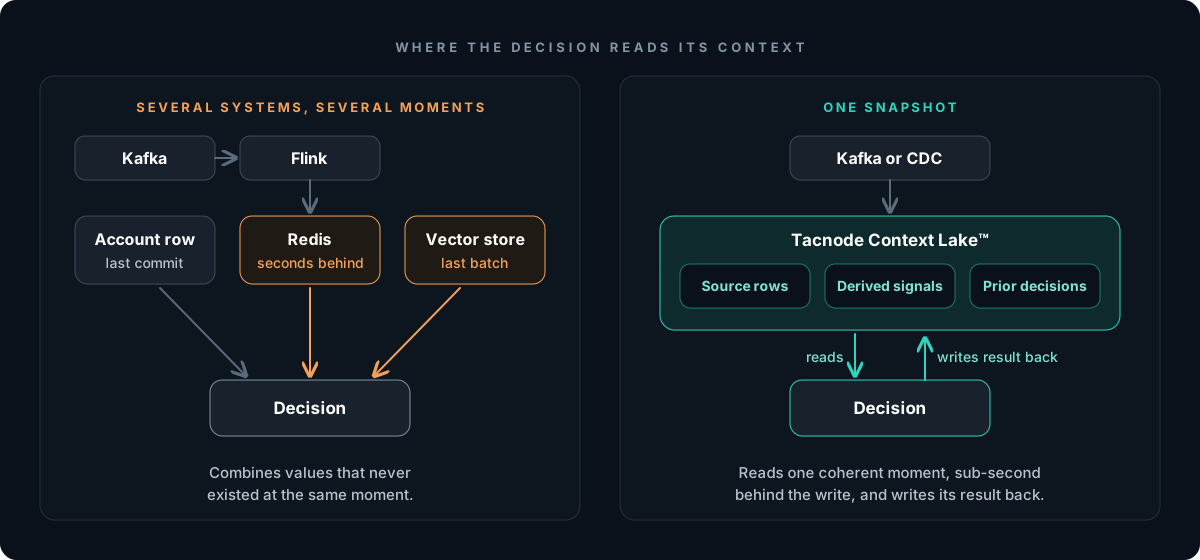
5.A service makes a decision (approve, hold, rank, price, let the agent act) by reading the raw record from one system, the derived signal from Redis, and sometimes a similarity result from a vector store.
Each hop works. The problem is that the decision in step 5 reads several systems that are each at a different point in time. The account row reflects the last committed write. The Redis feature reflects whatever Flink has processed so far, which could be seconds behind. The vector store reflects its last batch. The decision combines values that never existed together. We walk through this pattern, and where Kafka’s job ends, in Apache Kafka vs Apache Flink and What Is a Streaming Database.
Swapping the broker doesn’t change this. Redpanda, MSK, AutoMQ, and Kinesis all carry the event from step 2 to step 3. None of them computes the derived state, serves the read in step 5, or makes the systems in step 5 agree. If your Kafka alternatives search started because a fraud rule missed a burst, a limit was exceeded under concurrent requests, or an agent acted on context that was already out of date, a cheaper broker will leave that failure exactly where it is.
The same gap appears in reverse. Decisions produce state too: a verdict, a hold, a per-agent spending limit, a record that the agent already took an action. Teams often publish those outputs back to Kafka, so the next decision reads its own history through the same pipeline delay. It is the split between write side and read side that the CQRS pattern describes, with the same lag between them.
Where Tacnode Fits (and Where It Doesn’t)
Tacnode is not a Kafka alternative in the broker sense. It is not a message broker, it doesn’t implement the Kafka protocol for producers, and it doesn’t replace Kafka as the transport between your services. If your problem is broker cost, cluster operations, or a Confluent renewal, the options above are the ones to evaluate.
The Tacnode Context Lake™ holds the decision context: the source data a decision reads, the derived signals computed from it, and the decisions themselves. It ingests from the systems you already run, through CDC from your databases or by consuming Kafka topics directly, so Kafka stays where it is. Derived signals such as velocity counts, exposures, and session aggregates are computed inside Tacnode against the same set of ingested events as the raw rows, and are either maintained continuously as events arrive or computed on demand when the query runs. Similarity search runs against the same data. The decision reads all of it from one coherent snapshot, sub-second behind the write.
Decisions write back to it as well. A verdict, a hold, a per-agent limit, or an agent’s action is written to Tacnode directly rather than published to a topic and replayed through a pipeline, so the next decision reads it with everything else. For that state, which Tacnode holds, writes are ACID: two concurrent requests can’t both take the same remaining limit. For data that stays in your own system of record, Tacnode doesn’t enforce anything inside that system. It gives the decision accurate, current context so it doesn’t approve what it would have blocked had it seen current state.
In practice that looks like:
Kafka and CDC keep doing transport. Your topics, producers, and consumers don’t change. Tacnode becomes one more consumer, or reads CDC from the source database directly.
The Flink-to-Redis hop for that decision path is no longer needed. Derived signals that can be expressed in SQL are defined where the data already lives. Custom Java or Scala Flink operators still belong in Flink.
Services and agents read one PostgreSQL-compatible endpoint. Existing Postgres drivers and tooling work, and the read returns raw state, derived signals, similarity results and prior decisions from the same point in time.
Freshness is set per signal. The signals the decision depends on stay current; others can be allowed to lag. See Live for how that works.
When it’s the wrong fit: if your Kafka consumers are analytics pipelines, log aggregation, or lakehouse ingestion, nothing is making a decision under time pressure, and there’s no context gap to close. If the decision reads a single row or a single counter, a cache or plain Postgres is usually enough; our Redis alternatives guide covers that case. Tacnode starts to make sense when a decision path needs derived context, in several shapes, at high concurrency, and loses money when that context is out of date.
When Kafka Is Still the Right Choice
Kafka isn’t the wrong answer just because alternatives exist. Stay on Kafka, self-managed or managed, when:
You need a durable, replayable log with many independent consumers reading at their own pace.
Your integrations depend on the Kafka Connect ecosystem, Kafka Streams, or tools that assume the Kafka protocol.
You’ve already migrated to KRaft and your operational load is under control; Kafka 4.x removed the ZooKeeper dependency that drove much of the historical pain.
Your queue-style needs can be met by share groups in Kafka 4.2 rather than a second messaging system.
Your cost problem is cross-zone storage traffic and you can wait for diskless topics upstream, or adopt a managed provider that already offers them.
You’re comfortable with your managed-service contract, including after the IBM acquisition of Confluent.
For most teams the answer is to keep Kafka as transport and fix the specific problem: the host, the storage model, the queue semantics, or the decision path downstream.
Frequently Asked Questions
Apache KafkaConfluentRedpandaMessage BrokersEvent StreamingReal-Time Data